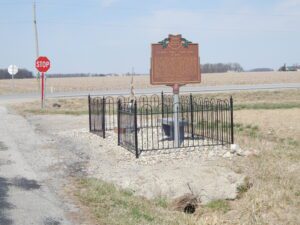
One of Ohio’s greatest manhunts ended here on the morning of July 23, 1948. Robert M. Daniels and John C. West, parolees from the state prison in Mansfield, had gone on a killing spree that left six people dead. Driving west on U.S. Route 224 in a stolen auto transport truck, the pair approached this intersection and encountered a roadblock. It was manned by Van Wert County Sheriff Roy Shaffer, Frank Friemoth, the county game warden, and Sergeant Leonard Conn of the Van Wert city police. West was driving the truck; Daniels was asleep in a car overhead. As Sheriff Shaffer climbed onto the truck and apprehended Daniels, West leaped from the cab and shot Conn in the chest and Friemoth in the arm. Conn returned fire and killed West. The officers survived their wounds. Daniels was convicted, sentenced to die, and electrocuted at the Ohio Penitentiary in Columbus on January 3, 1949. This marker pays tribute to all law enforcement officers who risk their lives to protect the citizens of their communities.
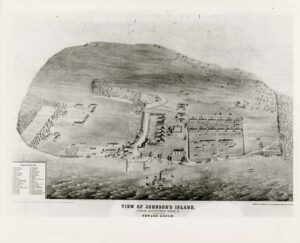
Military Prison Camp In 1861 the United States Army established a prisoner of war camp on Johnson’s Island, approximately 1 mile south of this point. The camp, which housed captured Confederate officers, was maintained until 1865 when it was dismantled. The camp cemetery contains the graves of 206 men who died as a result of disease, wounds, or by execution while incarcerated.
On this site in October of 1870 met a group of enlightened individuals dedicated to the reformation and improvement of penal systems. This first Congress of the National Prison Association, now known as the American Correctional Association, adopted a far-sighted philosophy of corrections. This philosophy, embodied in its Declaration of Principles, remains today as the basic guide for modern correctional systems.
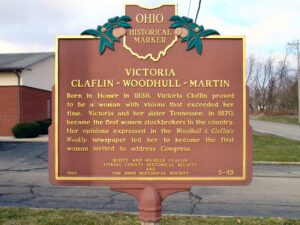
Born in Homer in 1838, Victoria Claflin proved to be a woman with visions that exceeded her time. Victoria and her sister Tennessee, in 1870, became the first women stockbrokers in the country. Her opinions expressed in the Woodhull & Claflin’s Weekly newspaper led her to become the first woman invited to address Congress.
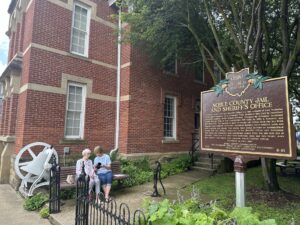
The Noble County Jail and Sheriff’s Office is a fine example of Late Victorian architecture designed by a prominent Ohio architect and built by important nineteenth century Noble County builders. Designed by Columbus architect Joseph Warren Yost, it was constructed 1881-1882 by Mills & Summers and cost $9,477.55. The building is made of orange-red bricks from the Ava Brick Company and features horizontal sandstone banding and a detailed gable end with brackets and finials. The Queen Anne design includes an asymmetrical façade with two distinct entrances to the Sheriff’s Office and Residence. The office and residence face courthouse square while the jail cells are at the rear. There are four first-floor individual cells and two larger men’s and women’s cells above with concrete barrel-vaulted ceilings. (Continued on other side)
Archibald Worthington (1818-1895) was a freed slave from Virginia, a Civil War veteran, and prominent landowner in Highland Township. Census records indicate he was manumitted prior to 1850, and by 1860 owned land in northwest Ohio. Worthington also farmed, boarded freed slaves, and owned apple orchards and livestock. April 1866 township records show that he supported the local school for Black families. He and his wife Elizabeth raised three children: Henry, Mathilda, and James. Henry enlisted in the Massachusetts 54th Volunteer infantry, one of the first Black regiments formed in the Civil War. He died January 8, 1865, in a prison camp and is buried in North Carolina’s Salisbury National Cemetery. Mathilda and James both met partners and married, had children, and left the area. Archibald Worthington died in 1895 and is buried in Wilmington’s Sugar Grove Cemetery.
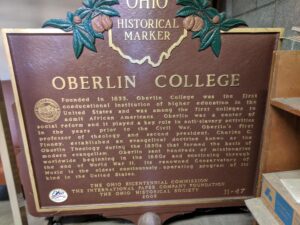
Founded in 1833, Oberlin College was the first coeducational institution of higher education in the United States and was among the first colleges to admit African Americans. Oberlin was a center of social reform and it played a key role in anti-slavery activities in the years prior to the Civil War. Oberlin’s first professor of theology and second president, Charles G. Finney, established an evangelical doctrine known as the Oberlin Theology during the 1850s that formed the basis of modern evangelism. Oberlin sent hundreds of missionaries worldwide beginning in the 1880s and continuing through the end of World War II. Its renowned Conservatory of Music is the oldest continuously operating program of its kind in the United States.
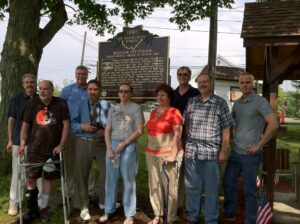
The General at Union Station in Chattanooga, Tennessee (circa 1907). Born in Knoxville in 1840 and reared at a farm in New Somerset, William Pittenger mustered into the 2nd Ohio Volunteer Infantry, under a 90-day enlistment, in 1861. He fought at the First Battle of Bull Run and was the war correspondent for the Steubenville Herald. After reenlisting, he participated in the ill-fated Andrews Raid of 1862. While attempting to disrupt enemy supply lines, the raiders stole the Confederate locomotive “The General.” After being chased north, they were captured. (Continued on other side)