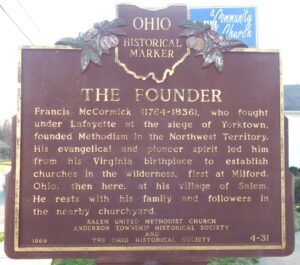
Francis McCormick (1764-1836), who fought under Lafayette at the siege of Yorktown, founded Methodism in the Northwest Territory. His evangelical and pioneer spirit led him from his Virginia birthplace to establish churches in the wilderness, first at Milford, Ohio, then here, at his village of Salem. He rests with his family and followers in the nearby churchyard.
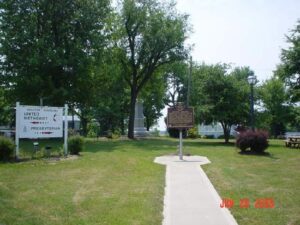
Originally called St. Clairsville and platted in 1801, Decatur was named for early 19th century naval hero Stephen Decatur. It is among the oldest villages in Brown County, which before 1817 was a part of Adams County. Among its notable early residents were Nathaniel Beasley (1774-1835), the first surveyor of Adams County, and Sarah Boone Montgomery (1763-1848), a heroine of the border wars in Kentucky. Decatur and Byrd Township supported at least four known stations on the Underground Railroad. Many area residents helped conduct escaping slaves northward to freedom.
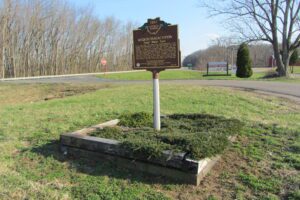
In the early 1770s, Chief White Eyes (Koquechagachton) of the Delaware tribe founded White Eyes Town approximately two miles southeast of this marker on a plain near present day West Lafayette. A friend of the Moravian leader David Zeisberger, White Eyes was an ardent supporter of Moravian missionary efforts and kept the Delawares neutral during the American Revolutionary War. White Eyes’s dream was to bring his people under the influence of Christianity. He also hoped to establish a fourteenth state for the Indian nations, which would join the other thirteen. White Eyes died at the height of his career in November 1778 near Pittsburgh. The cause of his death remains open to question.
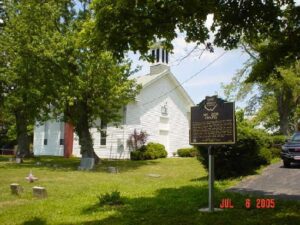
The Mount Zion Chapel of the Christian Church was built in 1872 on this hill adjacent to the members’ cemetery outside of Clermontville. The site was part of a two-acre parcel that had been secured from the farm of William R. Clark, Sr. for church and cemetery purposes. The Mount Zion Chapel replaced the Boat Run Christian Church that was organized in 1842 by a sect called the Christians, or the New Lights. Their first meeting house in Clermontville was dedicated on June 4, 1843 and damaged by floods in 1871. Worship was first held in the new frame church with the new name on October 6, 1872 and the church remains active today.
801 E. Pete Rose Way, Bicentennial Commons at Sawyer Point
Cincinnati
, OH
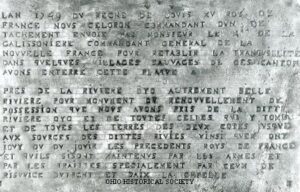
In 1749, the French in North America perceived a threat by British expansion west of the Allegheny Mountains to the Ohio River Valley and beyond. The French commander, Pierre Joseph Celeron, sieur de Blainville, with 250 men, left Montreal, New France, to establish French claims. They buried inscribed lead plates at the mouths of six important tributaries to the Ohio River. Three lead plates have been recovered, one was sent to England, and two are in American historical societies. The final plate was buried just west of here at the mouth of the Great Miami River, before the detachment turned north. However, after the British captured Montreal in 1760, French claims east of the Mississippi River were ceded to Britain by the 1793 Treaty of Paris. British Parliament annexed to Quebec (now Canada) and controlled all lands north of the Ohio River until 1776.(Continued on other side)
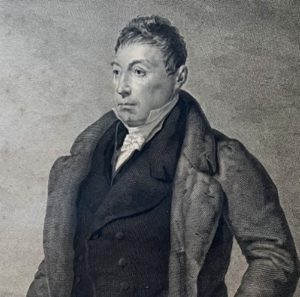
President James Monroe invited the Marquis de Lafayette to visit the United States in 1824. Upon his arrival that August, Lafayette embarked upon a 13-month tour of the nation, visiting all twenty-four states and traveling 6,000 miles. The nobleman was accompanied by his son, George Washington Lafayette, and his private secretary, Auguste Levassuer. Hailed as the “Nation’s Guest,” Lafayette was feted with parades, speeches, dinners, and balls concluding with a banquet at the White House.
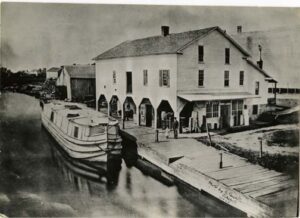
The Wabash & Erie Canal opened between Toledo and Lafayette, Indiana, May 8, 1843. The Miami Extension Canal was completed to Junction, Ohio, on July 4, 1845, linking the Wabash & Erie Canal with Cincinnati and resulting in changing the canal’s name to the Miami and Erie Canal. Prosperity reigned until the 1850s when railroad competition caused a slow decline in commerce. The canal branch to Indiana was in disuse by 1858 and totally abandoned in 1888. The canal system was revived from 1906-1909 with much reconstruction and improvement only to be badly damaged by severe statewide flooding in 1913. The canal was maintained from here to Maumee for generating hydro-electric power until it was drained in 1929. Twelve miles of canal and the Maumee Side Cut Canal have been leased to the Toledo Area Metroparks since 1932.