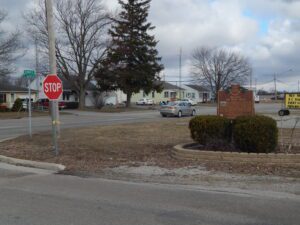
Here, on September 6, 1918, Bryan’s Air Mail Field began operations as one of Ohio’s first official airfields with the arrival of a survey flight to establish air mail service between New York and Chicago. Scheduled service began on July 1, 1919, and stretched west to San Francisco on September 8, 1920, completing the 2,666 mile U.S transcontinental air mail route. Flying the Curtiss JN-4H “Jenny,” R-4, Standard JR-1B, and later, the De Havilland DH-4, aviators pioneered cross continental flight in open cockpit biplanes without radios or electronic navigational aids and reduced coast to coast mail delivery from 87 hours by rail to 33 hours by air.
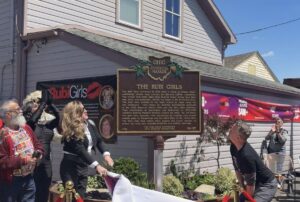
The Rubi Girls originated in 1984 when a group of friends began performing comedy drag routines for Dayton’s LGBTQ+ community. The troupe took their name from Rubicon Street where they first met, lived, and performed. During the height of the HIV/AIDS crisis, The Rubi Girls decided to use their talents to raise funds for the community. They began by donating performance proceeds to the Ohio AIDS Coalition and volunteering as performers and facilitators at the Ohio AIDS Coalition Healing Weekend Retreats. By the 1990s, The Rubi Girls expanded their fundraising efforts to include such annual benefit galas as Kweenz with Kause, Masquerage, and The Show Must Go On. For almost four decades, the Rubi Girls have shared their comedy while raising millions of dollars for local and regional HIV/AIDS and LGBTQ+ charities.
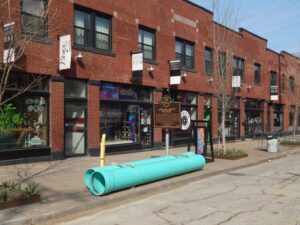
This block of W. 29th Street was home to Cleveland’s vibrant LGBT community and central to the development of the modern LGBT civil rights movement. In 1988, the Striebinger Building, at 1418 W. 29th, housed Cleveland’s Lesbian-Gay Community Services Center, which addressed the needs of the LGBT community. Cleveland’s first Pride Festival since the mid-1970s was held on the block in 1989, and in 1990 Cleveland’s first Pride Parade culminated here. During the HIV/AIDS crisis, The Living Room and ACT UP were located in the Striebinger Building and gave support to those with HIV/AIDs and provided a platform for political activism. It was on this block where many people could find their voices to “come-out” and advocate for their rights and their humanity. (Continued on other side)
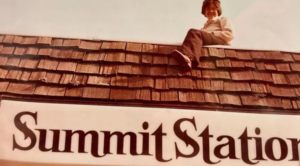
2210 Summit Street once housed one of Ohio’s longest-running lesbian bars. In 1970, a lesbian bartender at Jack’s A Go Go recognized that while Columbus had bars for gay men, it needed one geared toward lesbian clientele. Patrons knew the bar as “Jack’s,” Logan’s Off Broadway, and Summit Station. Staff welcomed women from small towns, women working in trades, women of color, butch/femme lesbians, and transgender people. Regulars recall that stepping through the door felt like finally entering a place of true belonging. Women could dance, “get together,” break up, sing karaoke, party with friends, and celebrate birthdays and holidays. Summit Station remained a safe public space, despite ongoing police harassment of its gender non-conforming regulars. A sign posted outside declared: “Ladies Night, Every Night. Men $5.” (Continued on other side)
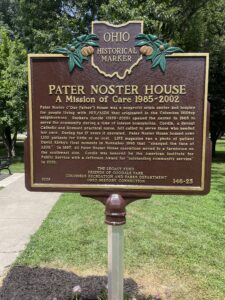
Pater Noster (“Our Father”) House was a nonprofit crisis center and hospice for people living with HIV/AIDS that originated in the Columbus Hilltop neighborhood. Barbara Cordle (1939-2020) opened the center in 1985 to serve the community during a time of intense homophobia. Cordle, a devout Catholic and licensed practical nurse, felt called to serve those who needed her care. During the 17 years it operated, Pater Noster housed over 1,100 patients for little or no cost. LIFE magazine ran a photo of patient David Kirby’s final moments in November 1990 that “changed the face of AIDS.” In 1997, all Pater Noster House operations moved to a farmhouse on the southwest side. Cordle was honored by the American Institute for Public Service with a Jefferson Award for “outstanding community service” in 2002.