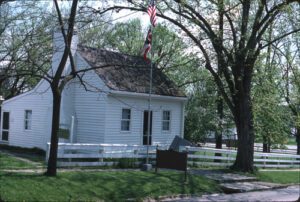
Hiram Ulysses Grant was born in this one-story, timber-frame home on April 27, 1822 to Jesse and Hannah Simpson Grant. The Grants settled in Point Pleasant the previous year, and Jesse took charge of the tannery located near the cottage. Now restored, the building remained in relatively good condition through the 1880s. In 1823, the family moved to Georgetown, Ohio, where Hiram lived until his appointment to West Point at age 17. Although reluctant to attend the Academy, Grant, now known as Ulysses Simpson Grant due to an error on the application, graduated in 1843 and was stationed at Jefferson Barracks near St. Louis, where he courted his future wife Julia Dent, with whom he had four children, Frederick, Ellen, Ulysses Jr., and Jesse. (continued on other side)
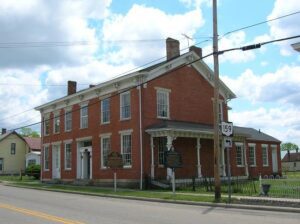
Major General William Sooy Smith was born in Tarlton on July 22, 1830. He attended Ohio University and supported himself throughout his college undergraduate career, graduating in 1849. He then entered the United States Military Academy at West Point to pursue engineering and graduated 6th in the class of 1853. In 1857, Smith established the private engineering firm Parkinson & Smith and made the first surveys for the international bridge across the Niagara River near Niagara Falls. At the outbreak of the Civil War, Smith joined the 13th Ohio Infantry, winning the commission of colonel in June 1861. After early victories in western Virginia, he was promoted to brigadier general in April 1862 for his gallant and meritorious service at the Battle of Shilo. (continued on other side)
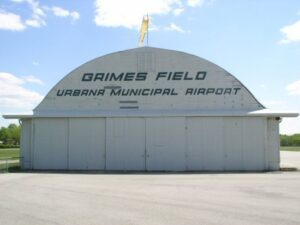
Raised in an Ohio orphanage, Warren G. Grimes (1898-1975) ran away after finishing the ninth grade and at age 16 went to work for the Ford Motor Company in Detroit. He later became a partner in an electrical business where he was instrumental in designing and developing the first lights for the Ford Tri-Motor airplane. In 1930 Grimes moved to Urbana and founded a small lighting fixture plant, Grimes Manufacturing. The inventor of the familiar red, green, and white navigation lights found on the wing tips and tails of aircraft, Grimes, known as the “Father of the Aircraft Lighting Industry,” also developed other aircraft fixtures, including landing, instrumental, and interior lights. Every American-made airplane flown during World War II was equipped with Grimes lights. Grimes served as mayor of Urbana and chairman of the State of Ohio Aviation Board.
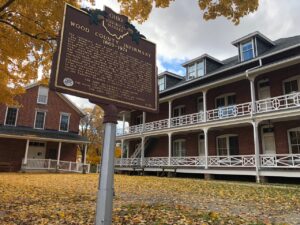
The Infirmary, also known as the poorhouse or simply “The Home,” is one of the last county poorhouse sites in Ohio where nearly all of the original structures still stand. The main building, constructed in 1868 with outbuildings added over the years, served as home for the county’s poor, sick, orphaned, elderly, and mentally ill. The Lunatic House was added in 1885 as a facility for the violently insane. The Infirmary operated as a self-sufficient farm where residents contributed according to their ability. Throughout its 102 years of service, the Infirmary had an average population of eighty residents, swelling to over 140 during the Great Depression of the 1930s. The site closed as a poorhouse in 1971 but reopened in 1975 as the Wood County Historical Center and Museum. The Wood County Infirmary was added to the National Register of Historic Places in 1979.
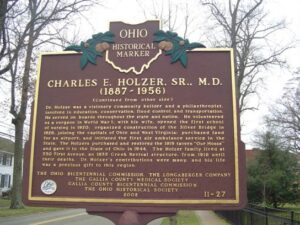
Dr. Charles Elmer Holzer came to Gallipolis in 1909, as a resident surgeon at the Ohio Hospital for Epileptics. Recognizing the need for a community hospital, he returned in May 1910, after completing his training. With a local loan, he opened a seven-bed hospital. In 1913, he furthered his training in surgery, closing the hospital temporarily to study in Europe. He returned to Gallipolis in 1914, married nurse Alma Vomholt and resumed his practice. In 1916, he began construction on the First Avenue Holzer Hospital, the first general hospital in southeast Ohio. In 1949, the Holzers gave the growing hospital to the citizens of the five county area, to be administered by the Holzer Hospital Foundation. After outgrowing its downtown location, Holzer Medical Center opened on Jackson Pike in 1972 with 269 beds. (continued on other side)
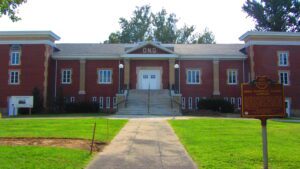
With a mission to protect citizens at home and aboard, the Ohio National Guard was originally established as the Northwest Territory Militia in Marietta on July 25, 1788, and has fought in every war since the War of 1812. Built in 1914, this Ohio National Guard Armory served both as Regimental and Company B, 7th Infantry, O.N.G. Headquarters. Later Company A, 166th Infantry, 37th Division, occupied the dual-purpose armory. The armory served Washington County as a departure point for soldiers leaving for service in World War I, World War II, and Korea. The armory also served the area in times of crisis and celebration, often used by the Red Cross, Marietta College, and other civic groups.
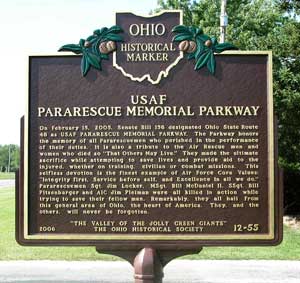
On February 15, 2005, Senate Bill 156 designated Ohio State Route 48 as USAF PARARESCUE MEMORIAL PARKWAY. The Parkway honors the memory of all Pararescuemen who perished in the performance of their duties. It is also a tribute to the Air Rescue men and women who died so “That Others May Live.” They made the ultimate sacrifice while attempting to save lives and provide aid to the injured, whether on training, civilian or combat missions. This selfless devotion is the finest example of Air Force Core Values: ” Integrity first, Service before self, and Excellence in all we do.” Pararescuemen Sgt. Jim Locker, MSgt. Bill McDaniel, SSgt Bill Pitsenbarger and AIC Jim Pleiman were all killed in action while trying to save their fellow man. Remarkably, they all hail from this general area of Ohio, the heart of America. They, and the others, will never be forgotten.
In February 1819, seven individuals met in Isaac Barnes’ home to form a Congregational Church and entered into covenant. Reverend William Hanford of the Connecticut Missionary Society provided guidance and charged the new congregation to “walk worthy of their high vocation.” Prominent members led the way. In 1832, charter member Nira B. Northrup led the Wadsworth Presbytery in releasing Reverend John Shipherd from pastoral duties to help found what would become Oberlin College. Harrison Gray (H.G.) Blake was a committed abolitionist who, as a state senator, helped repeal the Ohio Black Laws and who was a principal “station master” on the Underground Railroad. (Continued on other side)