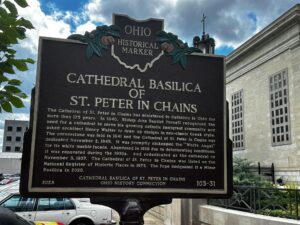
The Cathedral of St. Peter In Chains has ministered to Catholics in Ohio for more than 175 years. In 1840, Bishop John Baptist Purcell recognized the need for a cathedral to serve his growing catholic immigrant community and asked architect Henry Walter to draw up designs in neo-classic Greek style. The cornerstone was laid in 1841 and the Cathedral of St. Peter in Chains was dedicated November 2, 1845. It was promptly nicknamed the “White Angel” for its white marble façade. Abandoned in 1938 due to deteriorating conditions, it was renovated during the 1950s, and rededicated as the cathedral on November 3, 1957. The Cathedral of St. Peter in Chains was listed on the National Register of Historic Places in 1973. The Pope designated it a Minor Basilica in 2020.
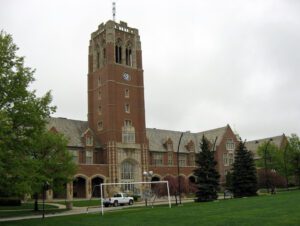
John Carroll University opened its doors as Saint Ignatius College on September 6, 1886. Originally located on Cleveland’s West Side, the College was founded at the request of Bishop Richard Gilmour by German members of the Society of Jesus (the Jesuits, founded in 1540). In 1923, the College was renamed John Carroll University after America’s first bishop. In 1925, the University acquired land in Idlewood Village (now University Heights) and initiated construction of a new campus in 1931. Classes began there in 1935 with 456 students. The institution admitted laywomen to evening and graduate classes in the 1930s and officially became coeducational in 1968. The University’s Jesuit Catholic mission inspires individuals to excel in learning, leadership, and service, both regionally and worldwide. John Carroll University is one of 28 Jesuit institutions of higher learning in the United States.
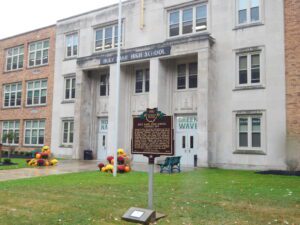
Founded in 1914, Holy Name High School was one of the first co-educational Roman Catholic high schools in Cleveland. Originally located at Harvard and Broadway Avenues, the school opened under the direction of Holy Name Parish with educational leadership of the Sisters of Charity from Cincinnati. In 1978, Holy Name High School moved to its present location in Parma Heights, the former home of Nazareth Academy. Throughout its history, Holy Name High School has served the community by providing a Catholic, college-preparatory education. The Holy Name spirit lives on through its alumni, who have made a difference around the world.
In 1886, Bishop Richard Gilmour (1824-1891) of the Roman Catholic diocese of Cleveland requested that the Jesuit superior of Buffalo establish a high school on Cleveland’s west side. The Jesuits, an order of the Roman Catholic Church founded by St. Ignatius Loyola in 1540, sought to establish schools that instilled a zeal for the Gospel and a love of learning. Under the leadership of Father Henry Behren, S.J. (1815-1895), the twentieth Jesuit secondary school in the United States opened in September 1886. Named Saint Ignatius College, the school grew from 76 students in 1886 to 490 in 1924. In 1924, the College split into two separate institutions: John Carroll University, which moved to University Heights in 1935, and Saint Ignatius High School, which remains on its original site. (Continued on other side)
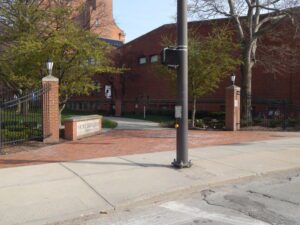
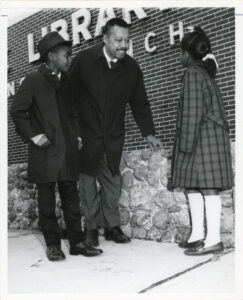
On November 19, 1968, the Columbus Metropolitan Library dedicated the first public library in the nation named after Dr. Martin Luther King Jr. After King’s assassination on April 4, 1968, the East Side Community Council requested that the new library being planned for the King-Lincoln Bronzeville community bear his name. The King family had both family and civic ties to Columbus and were honored by the tribute. More than 1,000 people gathered outside 1600 E. Long Street to hear Martin Luther King Sr. deliver the November dedication speech. Continuing the King family tradition, Martin Luther King III cut the ribbon to open a new branch building at 1487 E. Long Street on October 18, 2018. The Martin Luther King Branch was the first Columbus public library to bear an individual’s name.
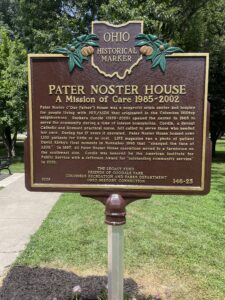
Pater Noster (“Our Father”) House was a nonprofit crisis center and hospice for people living with HIV/AIDS that originated in the Columbus Hilltop neighborhood. Barbara Cordle (1939-2020) opened the center in 1985 to serve the community during a time of intense homophobia. Cordle, a devout Catholic and licensed practical nurse, felt called to serve those who needed her care. During the 17 years it operated, Pater Noster housed over 1,100 patients for little or no cost. LIFE magazine ran a photo of patient David Kirby’s final moments in November 1990 that “changed the face of AIDS.” In 1997, all Pater Noster House operations moved to a farmhouse on the southwest side. Cordle was honored by the American Institute for Public Service with a Jefferson Award for “outstanding community service” in 2002.