The land on which Coventry Township is situated was ceded in 1785 to the United States by the Delaware, Chippewa, Ottawa, and Wyandot tribes under the Treaty of Fort McIntosh. The area was a choice location for Native Americans, settlers, and fur traders due to the abundant bodies of water and proximity to the Portage Path, a land connection between the Tuscarawas and Cuyahoga rivers and Lake Erie. In 1788, Coventry Township was initially part of Washington County, the first county formed in the Ohio Territory. After Moses Warren finished a survey in 1797, a succession of county splits located Coventry Township in Jefferson County, Trumbull County, Portage County, and, finally, Summit County in 1840. The township originally encompassed Summit Lake and the lands south to the southern line of the Western Reserve (Green-New Franklin lines). Daniel Haines was the first resident to settle in Coventry Township in 1806.
Oran Follett constructed his Sandusky house between 1835 and 1837. The golden sandstone mansion was home to Follett and his family until his death in 1894. Sold to James Flynn and then the Krupp family, the house remained a private residence until rented to the Works Progress Administration in 1935. The Sandusky Board of Education purchased the house in 1939 and used it as the adjacent high school’s Home Economics annex, meeting space, offices, and occasionally as art gallery or dance venue. From 1958 to 1968, it housed the Sandusky School of Practical Nursing. The Sandusky Library took over management of the house in 1973, opening it as museum in 1976. Considered one of the finest Greek Revival mansions in Ohio, the Follett House was listed on the National Register of Historic Places in 1974.
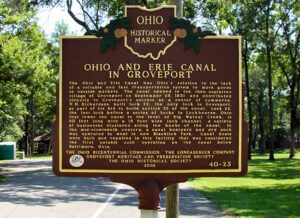
The Ohio and Erie Canal was Ohio’s solution to the lack of a reliable and fast transportation system to move goods to outside markets. The canal opened in the then unplatted village of Groveport on September 25, 1831 and contributed directly to Groveport’s success as a center of commerce. W.H. Richardson built lock 22, the only lock in Groveport, as part of his bid to build section 52 of the canal. Lock 22, the last lock before a series of locks in Lockbourne, Ohio that lower the canal to the level of Big Walnut Creek, is 90 feet long with a 15 foot wide lock channel. A variety of businesses clustered along the banks of the canal. In the mid-nineteenth century, a canal boatyard and dry dock was operated in what is now Blacklick Park. Canal boats were built and repaired in this facility that was considered the first notable such operation on the canal below Baltimore, Ohio.
On the night of January 3, 1894, Toledo’s largest fire broke out in the massive King-Quale grain elevators. A westward wind from Maumee River drove flames toward the center of Toledo’s business district. The blaze destroyed several buildings including the Chamber of Commerce and the West and Truaz building. Despite the best efforts of city firefighters using horse-drawn steam pumpers, the fire continued until a serendipitous shift in the winds allowed the firefighters to contain the conflagration.
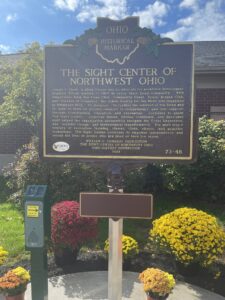
Joseph F. Clunk, a blind Ohioan and an advocate for workforce development, inspired Toledo leaders in 1923 to serve their blind community. With cooperation from the Lions Club, Community Chest, Toledo Rotary Club, and Chamber of Commerce, the Toledo Society for the Blind was organized in November 1923. Its purpose, “to further the interest of the blind and to open to them all possible avenues to independence and self-support, through investigation, education, and recreation,” continues to guide The Sight Center. Generous donors, tireless volunteers, and dedicated staff helped the organization successfully navigate the Great Depression, war, societal change, and technological transformation. For more than a century of innovative training, classes, clubs, clinics, and assistive technology, The Sight Center continues to empower independence and enrich the lives of people who are blind or have low vision.
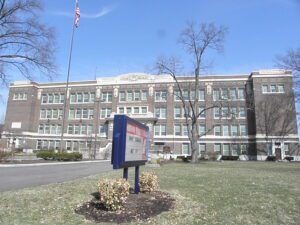
In 1910, voters approved a $275,000 bond issue to construct this school on seven and one-half acres of an old orchard on Sherman Avenue. Opened in 1914, Norwood High School offered standard educational classes as well as home economics, manual training, and commercial courses. Increased enrollment required additions of an east wing in 1924, a west wing in 1931, and a field house in 1927. Adding a technical building in 1950 provided Norwood with one of the first vocational education programs in the area. A source of community pride, this building has been a high school, junior high school, and middle school.