

, OH
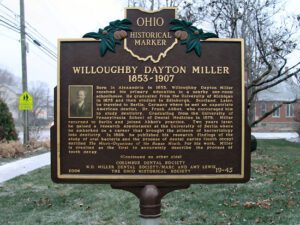
Born in Alexandria in 1853, Willoughby Dayton Miller received his primary education in a nearby one-room schoolhouse. He graduated from the University of Michigan in 1875 and then studied in Edinburgh, Scotland. Later, he traveled to Berlin, Germany where he met an expatriate American dentist, Dr. Frank Abbot, who encouraged him to study dentistry. Graduating from the University of Pennsylvania School of Dental Medicine in 1879, Miller returned to Berlin and joined Abbot’s practice. Two years later, he gained a research appointment at the University of Berlin where he embarked on a career that brought the science of bacteriology into dentistry. In 1889, he published his research findings of the study of oral bacteria and the process of dental caries (tooth decay) entitled The Micro-Organisms of the Human Mouth. For his work, Miller is credited as the first to accurately describe the process of tooth decay. (Continued on other side)
, OH
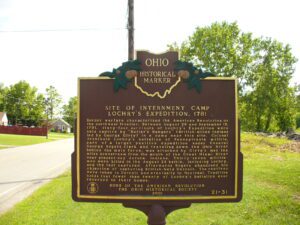
Border warfare characterized the American Revolution on the northwest frontier. Between August 26 and September 15, 1781, sixty-four survivors of Lochry’s Expedition were held captive by “Butler’s Rangers” (British-allied Indians led by George Girty) in a camp near this site. Colonel Archibald Lochry’s battalion of Pennsylvania militia, part of a larger punitive expedition under General George Rogers Clark and traveling down the Ohio River behind the main force, was attacked by Girty’s men ten miles downstream from the mouth of the Great Miami River near present-day Aurora, Indiana. Thirty-seven militiamen were killed in the August 24 battle, including Lochry, and the rest captured. Afterwards Rogers abandoned his objective of capturing British-held Detroit. The captives were taken to Detroit and eventually to Montreal. Tradition holds that fewer than twenty of Lochry’s battalion ever returned to their homes.
, OH
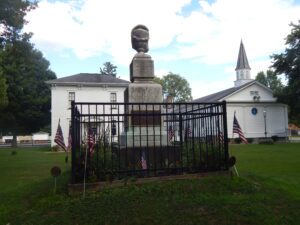
With the outbreak of the Civil War in 1861, many young men of Bristol Township enlisted in the army when President Abraham Lincoln issued his call to defend the Union cause. The death toll of some of these men at the Battle of Shiloh in Tennessee in April 1862 touched the local community as did the loss of Bristol Township lives at the Battle of Perryville in Kentucky, the Battle of Cedar Mountain in Virginia, and other theaters of war later in the year. The local citizenry responded to a plan for a lasting public memorial at the Town Park through a fund raising campaign. In 1863 the town square was transformed with a marble monument placed on an elevated mound at its center. The monument was designed by local artist Frank J. Hammond and manufactured by Myers, Uhl & Company of Cleveland at a cost of $500. [continued on other side]
, OH
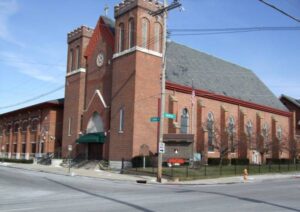
Built in 1852 and dedicated a year later, St. Patrick Church is the second oldest Roman Catholic Church in Columbus. Founded as the English speaking parish, this church of Norman Gothic design served as the home for three future bishops. Located on Naghten Street, the “Irish Broadway” of the nineteenth century, St. Patrick’s parish provided a vital place for the acculturation of the neighborhood Irish immigrants into mainstream American society. The Irish heritage is remembered through the shamrocks that emblazon the heads of each pew. Severely damaged by “the Great Fire” in 1935, the church was quickly restored and serves today as a vibrant religious center for central Ohio. The Dominican Fathers have staffed St. Patrick Church since 1885.
, OH
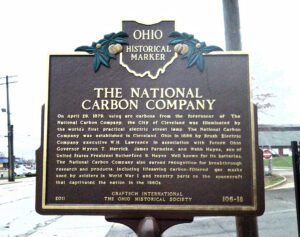
On April 29, 1879, using arc carbons from the forerunner of The National Carbon Company, the City of Cleveland was illuminated by the world’s first practical electric street lamp. The National Carbon Company was established in Cleveland, Ohio in 1886 by Brush Electric Company executive W.H. Lawrence in association with future Ohio Governor Myron T. Herrick, James Parmelee, and Webb Hayes, son of United States President Rutherford B. Hayes. Well known for its batteries, The National Carbon Company also earned recognition for breakthrough research and products, including lifesaving carbon-filtered gas masks used by soldiers in World War I and reentry parts on the spacecraft that captivated the nation in the 1960s.
, OH
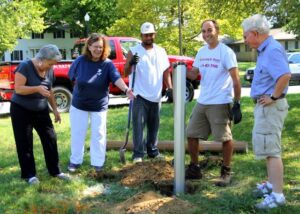
In 1798, Articles of Confederation Congress provided land to British Canadians who lost property because of loyalty to American revolutionaries during the American War of Independence (1775-1783). This land was part of the Refugee Tract and the present-day Truro Township. In 1850, Henry Stanbery, first Attorney General of Ohio, purchased a portion of this land. In 1923, Charles Johnson bought a section of this land and had it platted as the Eastmoor Addition by the Jennings-Lawrence Company with the polo field at the center. Eastmoor has houses ranging in age from the 1920s to the early 21st century, including Lustron homes built after WWII.
, OH
William Henry Fouse was born in Westerville to former slaves Squire Fouse and “Sallie” Syler. The first Black student to graduate from Westerville High School (1884), he worked as a bootblack and waiter to earn college tuition. Fouse graduated cum laude from Otterbein (1893), and as the college’s first Black graduate, delivered “A Plea for the Afro-American” at commencement. For forty-five years Fouse worked as a teacher and administrator in Corydon (Indiana), Gallipolis (Ohio), Covington (Kentucky), and Lexington (Kentucky). He served as principal at Lexington’s Paul Lawrence Dunbar High School from its opening in 1923 until his retirement in 1938. During that time, Fouse developed the Bluegrass Oratorical Association, served as president of the Kentucky Negro Education Association, and earned his MA in Education. In 1937, Otterbein conferred a Doctor of Pedagogy upon the distinguished educator.
, OH
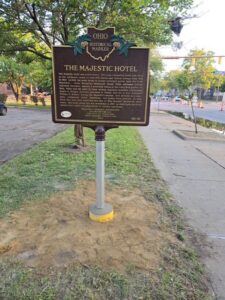
The Majestic Hotel was a five-story, 250-room residential hotel that stood on the northeast corner of East 55th Street and Central Avenue from 1902 to 1967. In 1924 the hotel began to accept overnight guests. Amid the Great Migration, owner Hungarian immigrant Joseph Weiss welcomed African American travelers, earning a perennial listing in the Green Book guides. In 1944, Weiss sold the hotel to three African American investors: businessman Alonzo G. Wright, attorney Lawrence O. Payne, and Call & Post publisher William O. Walker. During the Majestic’s heydey, such services as a pharmacy, restaurant, tailor, beautician, and barber were offered. Its Rose Room jazz club drew musicians and fans to “Blue Monday” parties for many years. The hotel closed and was demolished in 1967, as civil rights advances opened more public accommodations to African Americans.