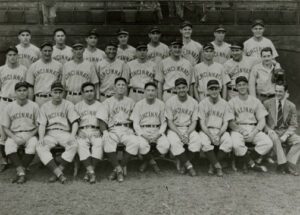
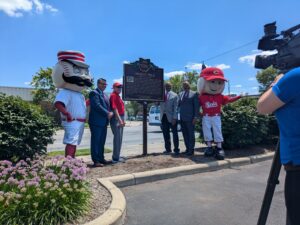
The 1869 Cincinnati Red Stockings made history not only as the most dominant baseball club of its time, but also as the first band of professional ballplayers. Cincinnati’s decision to pay players proved to be a success, and other cities soon began establishing their own professional clubs throughout America. In 1876, the Reds joined the newly formed National League. Baseball soon became one of Cincinnati’s most popular entertainment venues, aided in part by the team’s World Series titles in 1919 and 1940. Cincinnati’s “Big Red Machine,” featuring players such as Johnny Bench, Joe Morgan, and Pete Rose, dominated baseball in the 1970s, picking up additional titles in 1975 and 1976. A surprise wire-to-wire title again in 1990 strengthened the Reds’ legacy and helped ensure future generations of Reds fans.
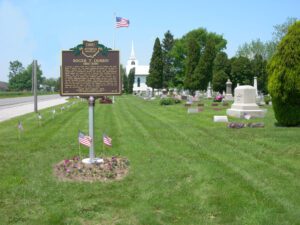
According to fellow World War II veteran and U.S. Senator Bob Dole, Roger T. Durbin was “the public persona—the beacon—of the drive to build a National World War II Memorial in our nation’s capital.” It started with a conversation between Mr. Durbin and Congresswoman Marcy Kaptur at a local fish fry in February 1987. Enlisting Kaptur’s support, the work to create the memorial began. Described as a “gentleman with a square jaw, twinkling eyes, and churlish grin,” Mr. Durbin committed himself to serving others. He was a rural letter carrier, Richfield Township trustee, and coached Little League baseball. He was a veteran of the Tenth Armored (Tiger) Division and saw action at the Battle of the Bulge. The National WWII Memorial was dedicated May 29, 2004. Although Mr. Durbin did not live to see that day, his determination is the reason it stands.
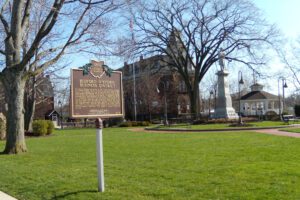
The town of Bedford was settled in 1837. Early residents, Hezekiah and Clarissa Dunham donated the land that serves as Bedford Public Square. The Dunhams built one of the area’s first homes in 1832, which stands at 729 Broadway with the letters H & D above the doorway. Early settlers were attracted to the area by the abundance of natural resources and a large waterfall for mill sites. Bedford also served as a stagecoach stop on the route from Cleveland to Pittsburgh. The road or Turnpike Road as it was called was originally part of the Mahoning Indian Trail. By 1895 the road was renamed Main Street (and later Broadway) when the Akron, Bedford, and Cleveland Railway Company (ABC) traversed the middle of the street carrying passengers. The interurban is called “America’s first high speed long distance electric interurban” with speeds in excess of 60 miles per hour. [continued on other side]
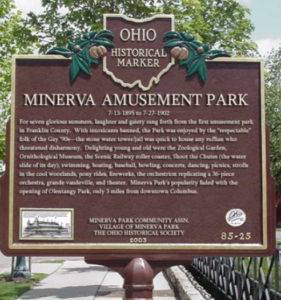
For seven glorious summers, from July 13, 1895 to July 27, 1902, laughter and gaiety rang forth from the first amusement park in Franklin County. With intoxicants banned, the Park was enjoyed by the “respectable” folk of the Gay ’90s – the stone water tower/jail was quick to house any ruffian who threatened disharmony. Delighting young and old were the Zoological Garden, Ornithological Museum, the Scenic Railway roller coaster, Shoot the Chutes (the water slide of its day), swimming, boating, baseball, bowling, concerts, dancing, picnics, strolls in the cool woodlands, pony rides, fireworks, the orchestrion replicating a 36-piece orchestra, grande vaudeville, and theater. Minerva Park’s popularity faded with the opening of Olentangy Park, only 3 miles from downtown Columbus.
Crosley Field was the home of the Cincinnati Reds for almost 58 years. Opened in 1912 as Redland Field, the ballpark was renamed in 1934 when famed Cincinnati industrialist Powel Crosley Jr. purchased the team. Over its years of service, Crosley Field was home to Reds teams that won National League Championships in 1919, 1939, 1940, and 1961, and World Series titles in 1919 and 1940. The park also played host to the Major League Baseball All-Star Game in 1938 and 1953. Crosley Field famously held what was then acknowledged as the first night game under lights on May 24, 1935. Such visiting legends as “Shoeless” Joe Jackson, Babe Ruth, Joe DiMaggio, Willie Mays, and Jackie Robinson played at Crosley Field. (Continued on other side)
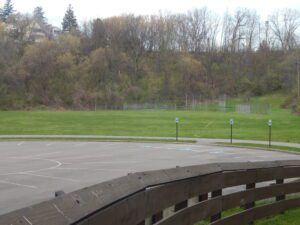
For more than 120 years, the natural amphitheater of Brookside Stadium has been a place of recreation for visitors to enjoy community events, festivals, and even a concert by John Philip Sousa. Engineered by William Stinchcomb, chief architect of the Cleveland Metroparks, Brookside Stadium officially opened as a premier space for sandlot baseball in May 1909. As amateur baseball found increased esteem, both locally and nationally, Brookside Stadium regularly became popular with thousands of spectators. On Sunday, October 10, 1915, it was host to the National Inter-City Amateur Championship, during which a crowd of an estimated 115,000 people witnessed the White Autos beat the Omaha Luxus 11 to 6. Although there was no formal ticketing system to verify the exact attendance, photographs taken that day strongly suggest that Brookside Stadium hosted the largest crowd in amateur baseball history.
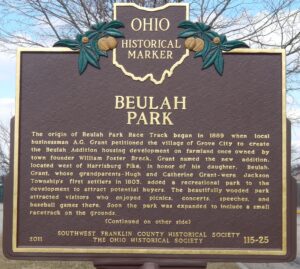
The origin of Beulah Park Race Track began in 1889 when local businessman A. G. Grant petitioned the village of Grove City to create the Beulah Addition housing development on farmland once owned by town founder William Foster Breck. Grant named the new addition, located west of Harrisburg Pike, in honor of his daughter, Beulah. Grant, whose grandparents, Hugh and Catherine Grant, were Jackson Township’s first settlers in 1803, added a recreational park to the development to attract potential buyers. The beautifully wooded park attracted visitors who enjoyed picnics, concerts, speeches, and baseball games there. Soon the park was expanded to include a small racetrack on the grounds.