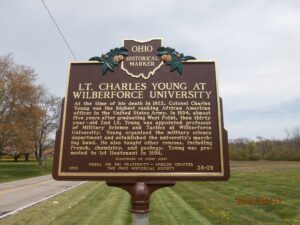
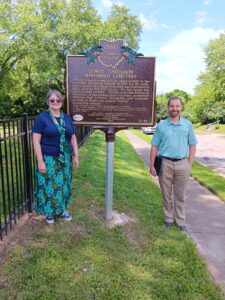
At the time of his death in 1922, Colonel Charles Young was the highest ranking African American officer in the United States Army. In 1894, almost five years after graduating West Point, then thirty year-old 2nd Lt. Young was appointed professor of Military Science and Tactics at Wilberforce University. Young organized the military science department and established the university’s marching band. He also taught other courses, including French, chemistry, and geology. Young was promoted to 1st lieutenant in 1896. (Continued other side)
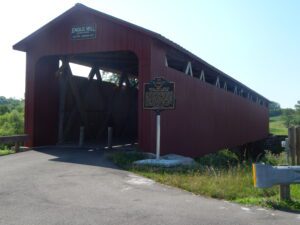
Built in 1877 and spanning 136 feet, the Engle Mill Road Covered Bridge carried vehicular traffic until 2003. The bridge is named after the nearby Levi Engle Mill. It is one of a few dozen Smith Truss bridges in the United States. The Smith Bridge Company manufactured the bridge using the Smith Truss patent, invented by founder, Robert W. Smith. The company originated in Tippecanoe City, Ohio and relocated to Toledo, where it was purchased by the Toledo Bridge Company in 1890. Smith died in 1898 at the age of 63, leaving a legacy of unique bridges.
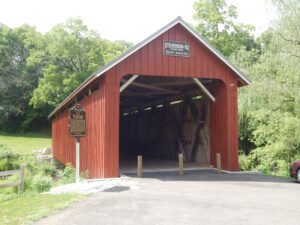
Built in 1877 and spanning approximately ninety-five feet, the Stevenson Road Covered Bridge carried vehicular traffic until 2003. It is one of the few Smith truss bridges left in the United States. The Smith Bridge Company manufactured the bridge using various patents of the company, which were secured by its founder, Robert W. Smith. The company originated in Tippecanoe City, Ohio (Tipp City) and later relocated to Toledo. In 1890 the Toledo Bridge Company Purchased the company from Smith. Robert Smith died in 1898 at the age of sixty-five leaving behind a legacy of unique covered bridges.
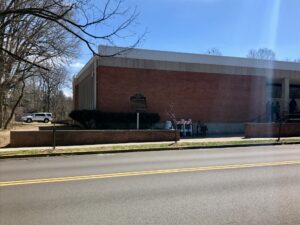
Virginia Hamilton was an author who was born in Yellow Springs in 1934, living and writing here for much of her life. She referred to her works as “Liberation Literature.” focusing on the struggles and journeys of African Americans. Hamilton published more than forty books in a variety of genres, including realistic novels, science fiction, picture books, folktales and mysteries. Some of her most beloved titles include The House of Dies Drear, M.C. Higgins the Great, Her Stories and The People Could Fly. Her books have had a profound influence on the study of race throughout American history, the achievements of African Americans, and the ramifications of racism. Hamilton received numerous awards for her writing before passing away in 2002. Her work is enshrined at the Library of Congress in Washington, D.C.
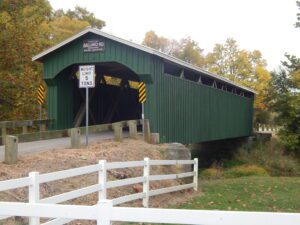
In 1883, James E. Brown built this seven-panel Howe truss bridge over the North Branch of Caesar Creek, near the site of Lyman Ballard’s grist mill and on the property of William C. Dean. At the time it was built, iron, concrete, and steel structures began to surpass the construction of wooden covered bridges. The construction of U.S. Route 35 severed the bridge from its original connection to the Dean property. In 1975, the bridge was added to the National Register of Historic Places. As of 2016, the Ballard Road bridge is one of six covered bridges in Greene County.
In 1918, Charles Young made a desperate attempt to convince the U.S. Army that he was fit for duty. The Army’s highest-ranking Black officer, he had been medically retired and not given a command during World War I. To demonstrate his fitness, he rode 497 miles from his home in Wilberforce, Ohio, to Washington, D.C. Leaving on June 6 he made the journey in 17 days, 16 on horseback and 1 resting. Averaging 31 miles each day, he rode 45 minutes and walked 15 minutes every hour. Upon his arrival, Young met with Secretary of War Newton Baker. Pressured by the Black press and the White House, Baker hedged. He recalled Young to active duty a year later and assigned him to Camp Grant, Illinois, just five days before the end of the war.
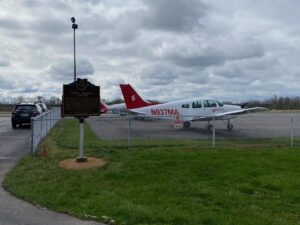
Lewis Albert Jackson (December 29, 1912-January 8, 1994) was an African American aviator remembered for training Tuskegee Airmen during World War II. As a teenager in Indiana, he began flight lessons and soloed in 1932, flying his own Waco 10. Jackson spent 1932-1937 barnstorming to save money for college while earning his Transport Pilot’s License. He re-rated to a Commercial License with Instructor Rating in 1939, and then completed advanced acrobatic training at Coffey School of Aeronautics. In late 1940, he was appointed Director of Training in the Army Air Force 66th Flight Training Detachment at Tuskegee Institute. After the war he moved to Ohio and served as an FAA Flight Examiner from 1947 to 1960. The Lewis A. Jackson Greene County Regional Airport was posthumously renamed to honor this true aviation pioneer.
Gowdy Cemetery was sold by James Gowdy to the Associate Reformed Church in 1820 for 50 cents. After Xenia’s Woodland Cemetery was chartered in 1845, Gowdy fell into disuse. Its last burial was James Gowdy in 1853. Gowdy Associate Reformed Cemetery is the resting place for many prominent citizens that brought mercantile and economic growth to Xenia and Greene County. Gravesites include:
Revolutionary War veteran Robert Kendall (1751-1842);
War of 1812 veterans James (1777-1853) and Robert Gowdy (1732-1831);
James and Samuel Gowdy (1780-1851), who opened Xenia’s first permanent store in 1806.