


, OH
The Mustill house and store are survivors of Akron’s canal era and date to the 1840s. Joseph and Sarah Mustill moved their family from England to Akron in 1833 and owned the store and Greek Revival house at Lock 15 on the Ohio & Erie Canal. Three generations of Mustills lived and worked the grocery business at Lock 15, first Joseph and Sarah, then their son Fred with his wife Emma, and their children Maria, Frederick, Edwin and Franklin. A popular place to buy or barter goods, the store served canallers, farmers, craftsmen, and neighbors for many years.
, OH
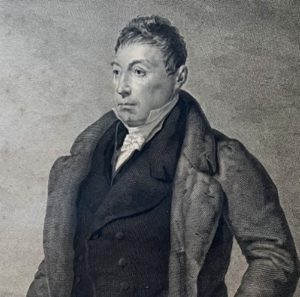
President James Monroe invited the Marquis de Lafayette to visit the United States in 1824. Upon his arrival that August, Lafayette embarked upon a 13-month tour of the nation, visiting all twenty-four states and traveling 6,000 miles. The nobleman was accompanied by his son, George Washington Lafayette, and his private secretary, Auguste Levassuer. Hailed as the “Nation’s Guest,” Lafayette was feted with parades, speeches, dinners, and balls concluding with a banquet at the White House.
, OH
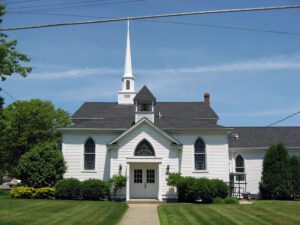
The Canfield Christian Church began as a Baptist congregation in 1822 and church met for worship in William Dean’s home. The Mahoning Baptist Association Meeting of 1826 was held in David Hayes barn. In 1827, Walter Scott was asked by the Association to be the first paid traveling evangelist in the Mahoning Valley area of Ohio. Scott accepted the offer and moved his family to a house next to the Canfield Church. By June of 1829, the Canfield Church voted to lay aside the Baptist name for the name Disciples of Christ. They believed all creeds were unnecessary and took the Bible alone as their sole rule of faith and practice. In 1847, a new church was built. Charter members of the church include James and Sarah Caldwell, Ann Winfield, Mr. and Mrs. Benjamin Caldwell and daughter, Mr. and Mrs. Andrew Flick, Mr. and Mrs. Walter Clark, Mr. and Mrs. John Flick, and Mr. and Mrs. Simmon Sackett and daughter. (Continued on other side)
, OH
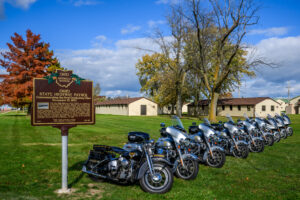
The Ohio State Highway Patrol (OSHP) was created by Ohio House Bill 270 in 1933. Over 5,000 applications to join the newly formed Division were trimmed and approximately 125 individuals — between the ages of 24 and 40 years — were admitted into the inaugural cadet class. The Ohio National Guard graciously volunteered the use of their facilities on Lake Erie’s shores. Colonel Lynn Black, the first OSHP superintendent, opened “Camp Perry School” on October 3, 1933. Although 54 new motorcycles were purchased for patrol duties, many of the cadets lacked motorcycle experience and had to be trained quickly. Severe weather shortened the training as cadets endured frigid temperatures and unheated facilities. The first class of 60 uniformed patrolmen were sworn in on November 15, 1933.
, OH
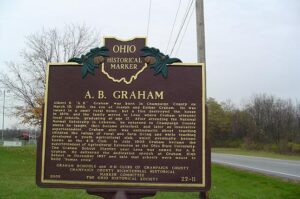
Albert B. “A.B.” Graham was born in Champaign County on March 13, 1868, the son of Joseph and Esther Graham. He was raised in a small rural home, but a fire destroyed the house in 1879, and the family moved to Lena where Graham attended local schools, graduating at age 17. After attending the National Normal University in Lebanon, he returned to Champaign County where he taught, then became principal, and later an innovative superintendent. Graham also was enthusiastic about teaching children the values of rural and farm living and while teaching developed a youth agricultural club, which eventually became known as the 4-H Club. In July 1905 Graham became the superintendent of Agricultural Extension at the Ohio State University. The Graham School District near Lena was named for A.B. Graham. He delivered the dedication speech at Graham High School in December 1957 and said that schools were meant to build “human souls.”
, OH
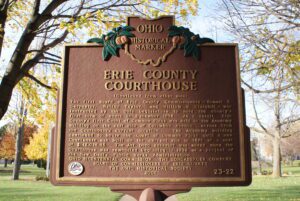
Jury of Erie County Women, First to be Impaneled Under Federal Suffrage proclaimed the headline of the Sandusky Register on August 28, 1920. One of the first female Court of Common Pleas juries in the nation was impaneled in Erie County on August 26, 1920, moments after the 19th amendment to the Constitution of the United States was declared ratified. On that date, Judge Roy Williams was to conduct a trial and jurors were needed. Out of the ten men he contacted, only one could serve. Frustrated, Judge Williams later told the women, “When I learned shortly after 10:30 this morning that suffrage had been proclaimed, I decided to impanel a woman jury. Twelve women were summoned. Twelve women served.” (continued on other side)
, OH
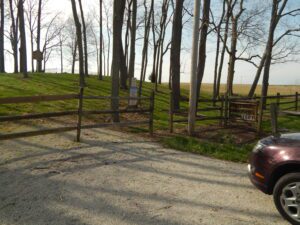
In the early years of the nineteenth century, a religious unrest known as the Second Great Awakening spread across much of the American frontier. Among the most influential of the evolving religious organizations were the Campbellites, or Disciples of Christ, founded in the 1820s by Thomas and Alexander Campbell. The Campbellite movement sought to “restore” New Testament Christianity by calling for a return to the primitive church revealed in the gospels. Campbellites denied creeds and oath-taking and rejected sectarianism. They believed in baptism by immersion and communion on Sundays. Followers also dealt with problems and transgressions of members within the church and did not use civil courts. They held a millennial view that professed human happiness and the belief that Christ would reign on earth for a thousand years. Believers spread this word to the pioneers of the Doty Settlement and elsewhere. By 1850, there were ninety Campbellite Churches in Ohio.
, OH
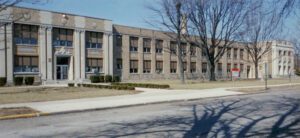
The North Baltimore Elementary and High School stood at 124 S. Second St. and was dedicated November 11, 1927. The tan and brown brick building replaced a school (built 1884) that a fire destroyed on January 26, 1926. The new school building, for children in grades 1-12, also included classrooms for home economics and business courses, as well as a 900-seat auditorium (including balcony), second floor cafeteria, gymnasium, administrative offices, and a public library. E.E. Leidy was the school’s superintendent and R. Vern Northup was the high school principal. The members of the board of education were Dr. E.A. Powell, President, D.B. Bushey, Vice President, C.G. Nigh, Clerk, and Nellie Roberts and R.E. Simon. Previously known as the “Independents,” the school’s sports teams became the “Tigers” in 1931. (Continued on other side)