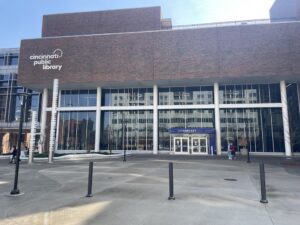
Among the first in America, Cincinnati’s public library dates from March 14, 1853. A public reading room opened in 1856, but funding remained a problem until 1867, when local school board president Rufus King II secured legislation for a renamed Cincinnati Public Library. In 1869, King lured leading librarian William Frederick Poole to organize Cincinnati as a national model for the growing public library movement. Poole designed 19th century America’s most advanced library at 629 Vine Street, which fully opened in 1874. Becoming a countywide system in 1898, the Public Library of Cincinnati and Hamilton County was a pioneer in the 20th century with special services for the blind and for children, bookmobile services, and circulation of audiovisual materials. (continued on other side)
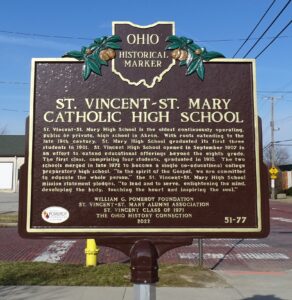
St. Vincent-St. Mary High School is the oldest continuously operating, public or private, high school in Akron. With roots extending to the late 19th century, St. Mary High School graduated its first three students in 1901. St. Vincent High School opened in September 1907 in an effort to extend educational offerings beyond the eighth grade. The first class, comprising four students, graduated in 1910. The two schools merged in late 1972 to become a single co-educational college preparatory high school. “In the spirit of the Gospel, we are committed to educate the whole person,” the St. Vincent-St. Mary High School mission statement pledges, “to lead and to serve, enlightening the mind, developing the body, touching the heart and inspiring the soul.”
The Village of Collinwood was originally a part of Euclid Township of the Western Reserve and named after the death of railroad chief engineer Charles Collins in 1876. Originally known as “Frogsville,” the population of Collinwood dramatically increased in the 1870s, due partly to repair roundhouses of the Lake Shore & Michigan Southern Railroad. By 1901, the Village has grown to 7,500, and as a result, the schoolhouse, which once housed 200 students and four classrooms, had been enlarged twice to house 350 students in eight classrooms. Constructed in 1901, the Lakeview School was the site of a tragedy that reverberated across the nation and around the world. (Continued on other side)
On December 30, 1847, six educators met at the Summit County Courthouse to organize the first convention of the Ohio State Teachers’ Association, now known as the Ohio Education Association (OEA). The organizers Josiah Hurty (Richland County), Thomas W. Harvey (Geauga County), M.D. Leggett (Summit County), Lorin Andrews (Ashland County), William Bowen (Stark County), and Marcellus F. Cowdery (Lake County) hoped “to elevate the profession of teaching” and “to promote the interests of schools in Ohio.” In 1853, the General Assembly enacted the new association’s entire slate of proposals into law, thus ensuring free, universal, public education in Ohio. For 176 years, the Ohio Education Association has advocated for fair terms and conditions of employment for Ohio educators and for the betterment and improvement of public education for all students.
Charles Campbell Gard was born in Hamilton on January 13, 1895. He was the only child of Homer and Lutie Gard. His father, owner and publisher of the Hamilton Journal-News, taught him a love of the newspaper business and a devotion to public service. “Campbell” Gard graduated from Hamilton High School in 1913, attended Amherst College, and completed a one-year journalism course at the University of Wisconsin. After the U.S. entered World War I in 1917, the 22-year-old registered for military service. He saw active duty in Europe and was honorably discharged May 19, 1919. On October 25, 1921, while working at the Journal Publishing Company, 26-year-old Campbell Gard collapsed and died of myocarditis, an often-undetected heart disease, just days before marrying fiancée Helen Raymond. Gard was buried privately at Greenwood Cemetery two days later.
William E. Telling (1869-1938) was one of ten children born in a farmhouse on this property. As a boy he sold strawberries and milk door-to-door and worked in a local sandstone quarry until at age 23 he purchased a milk route. He and four brothers formed the Telling Brothers Ice Cream Company in 1895 with William as president. A merger in 1915 formed the Telling Belle Vernon Dairy Company that was the first local distributor of pasteurized, glass-bottled milk. Their unique bacteriological laboratory (later Sealtest Laboratories) developed the baby food S.M.A. His recipe for success was “just work and work and work some more; do the work of two and draw the pay of one.”
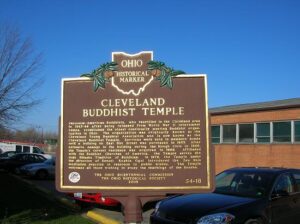
Japanese-American Buddhists, who resettled in the Cleveland area in 1943-44 after being released from World War II internment camps, established the oldest continually meeting Buddhist organization in Ohio. The organization was originally known as the Cleveland Young Buddhist Association and is now known as the Cleveland Buddhist Temple. Services were held in members’ homes until a building on East 81st Street was purchased in 1955. After extensive damage to the building during the Hough riots in 1966, the Temple’s current residence was acquired in 1968. Affiliated with the Buddhist Churches of America, the Temple serves the Jodo Shinshu Tradition of Buddhism. In 1979, the Temple under the direction of Sensei Koshin Ogui introduced the Zen Shin meditation practice in response to public wishes. The Temple welcomes all those wishing to study the teachings of the Buddha.
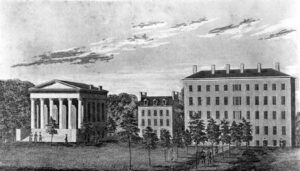
The Lanes, Baptist merchants from New Orleans, and the Kempers, a Presbyterian family from Cincinnati, gave money and land respectively for Cincinnati’s first manual labor theological seminary and high school, which opened in suburban Walnut Hills in 1829. The Reverend Lyman Beecher came from Boston as its first president. The president’s house, now known as the Stowe House after Beecher’s daughter Harriet Beecher Stowe, author of Uncle Tom’s Cabin, still remains at Gilbert and Foraker. Lane Theological Seminary, bound by present day Gilbert, Chapel, Park, and Yale streets, continued to educate Presbyterian ministers until 1932, when it was merged with McCormick Theological Seminary in Chicago.