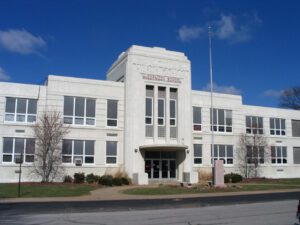
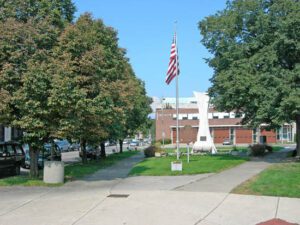
Ohio’s oldest continuing summer theatre, the Huron Playhouse has been housed at McCormick Middle School for its entire history. Dr. Frederick G. Walsh (1915-1999) of the Bowling Green State University (BGSU) Speech Department founded the theatre in 1949. Huron met Walsh’s expectations for an attractive site for the playhouse, and Huron Schools Superintendent R.L. McCormick (1904-1978) offered the use of this school. The curtain opened on the first Huron Playhouse production, Norman Krasna’s hit Broadway comedy John Loves Mary, on June 29, 1949. With persisting support from BGSU, actors and alumni, and the local community, the acclaimed Playhouse has provided theatrical experience for thousands of students and entertainment for generations of Huron residents.
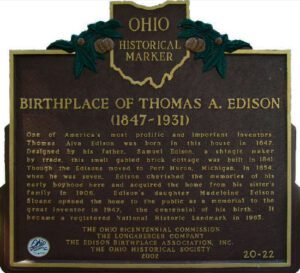
One of America’s most prolific and important inventors, Thomas Alva Edison was born in this house in 1847. Designed by his father, Samuel Edison, a shingle maker by trade, this small gabled brick cottage was built in 1841. Though the Edisons moved to Port Huron, Michigan, in 1854, when he was seven, Edison cherished the memories of his early boyhood here and acquired the home from his sister’s family in 1906. Edison’s daughter Madeleine Edison Sloane opened the home to the public as a memorial to the great inventor in 1947, the centennial of his birth. It became a registered National Historic Landmark in 1965.
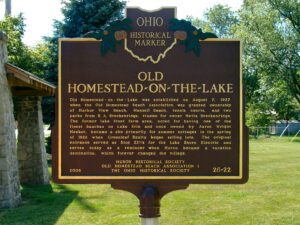
Old Homestead-on-the-Lake was established on August 7, 1927, when the Old Homestead Beach Association was granted ownership of Harbor View Beach, Mansell Beach, tennis courts, and two parks from R. A. Breckenridge, trustee for owner Metta Breckenridge. The former lake front farm area, noted for having one of the finest beaches on Lake Erie and once owned by Aaron Wright Meeker, became a site primarily for summer cottages in the spring of 1922 when Greenleaf Realty began selling lots. The original entrance served as Stop 22 1/2 for the Lake Shore Electric and serves today as a reminder when Huron became a vacation destination, which forever changed the village.
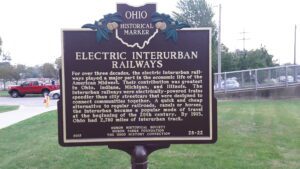
For over three decades, the electric interurban railways played a major part in the economic life of the American Midwest. Their contribution was greatest in Ohio, Indiana, Michigan and Illinois. The interurban railways were electrically-powered trains speedier than city streetcars that were designed to connect communities together. A quick and cheap alternative to regular railroads, canals or horses, the interurban became a popular mode of travel at the beginning of the 20th century. By 1915, Ohio had 2,780 miles of interurban track.
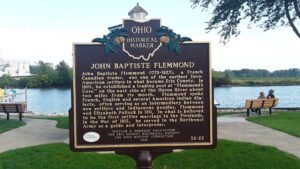
John Baptiste Flemmond (1770-1827), a French Canadian trader, was one of the earliest Euro-American settlers in what became Erie County. In 1805, he established a trading post at “Flemmond’s Cove” on the east side of the Huron River about two miles from its mouth. Flemmond spoke French, English and several American Indian dialects, often serving as an intermediary between new settlers and indigenous peoples. Flemmond wed Elizabeth Pollock in 1811, in what is believed to be the first settler marriage in the Firelands. In the War of 1812, he served in the Northwest Army as a guide and interpreter.
Almon Ruggles (1771-1840) came to Ohio from Connecticut in 1805 and led survey teams that divided the Firelands section of the Connecticut Western Reserve into townships. The Firelands was territory granted to Connecticut residents whose property was destroyed by the British during the Revolutionary War. Ruggles purchased a lakeshore section of this surveyed land for one dollar per acre, which is now known as Ruggles Beach. After settling permanently in Ohio in 1810, he established a farm, built gristmills, and worked for different Connecticut land proprietors. Ruggles also served in the Ohio Senate, the Ohio House, and was briefly appointed as associate judge of Huron County. Upon his death, his ashes were buried on part of his property, now known as Oak Bluff Cemetery.
Toledo’s first fire station was built in November 1837 one city block due north of this site at the southwest corner of Cherry Street and Eagle Lane at 519 Cherry on what is now the driveway for the Goodwill Industries Building. It was a small non-descript, wooden building, built by contractors Hoisington and Manning for $78. It was replaced by a two-story brick building with tin-clad window sills and trim in December 1854. With fire trucks becoming larger and heavier, it was necessary to construct a new building in 1872 at a cost of $7000. Designated Station No. 2, it remained in service until 1953 when the new headquarters station at Huron and Orange streets was dedicated. It disappeared for good during the Urban Renewal projects of the late 1950s and 1960s.