

, OH
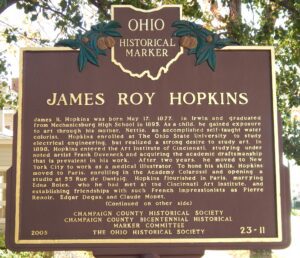
James R. Hopkins was born May 17, 1877, in Irwin and graduated from Mechanicsburg High School in 1895. As a child, he gained exposure to art through his mother, Nettie, an accomplished self-taught water colorist. Hopkins enrolled at The Ohio State University to study electrical engineering, but realized a strong desire to study art. In 1898, Hopkins entered the Art Institute of Cincinnati, studying under noted artist Frank Duveneck and acquiring the academic draftsmanship that is prevalent in his work. After two years, he moved to New York City to work as a medical illustrator. To hone his skills, Hopkins moved to Paris, enrolling in the Academy Colarossi and opening a studio at 55 Rue de Dantzig. Hopkins flourished in Paris, marrying Edna Boies, who he had met at the Cincinnati Art Institute, and establishing friendships with such French Impressionists as Pierre Renoir, Edgar Degas, and Claude Monet. [continued on other side]
, OH
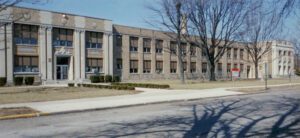
The North Baltimore Elementary and High School stood at 124 S. Second St. and was dedicated November 11, 1927. The tan and brown brick building replaced a school (built 1884) that a fire destroyed on January 26, 1926. The new school building, for children in grades 1-12, also included classrooms for home economics and business courses, as well as a 900-seat auditorium (including balcony), second floor cafeteria, gymnasium, administrative offices, and a public library. E.E. Leidy was the school’s superintendent and R. Vern Northup was the high school principal. The members of the board of education were Dr. E.A. Powell, President, D.B. Bushey, Vice President, C.G. Nigh, Clerk, and Nellie Roberts and R.E. Simon. Previously known as the “Independents,” the school’s sports teams became the “Tigers” in 1931. (Continued on other side)
, OH
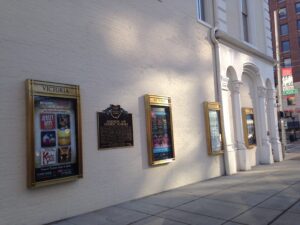
Dayton natives Hermene (1902-1986) and Josephine Schwarz (1908-2004) were pioneers of dance who founded one of the first regional ballet companies in the country. In 1927, they opened the Schwarz School of Dance, which eventually became the Dayton Ballet in 1978. Josephine’s choreography blended classical ballet traditions and contemporary dance, creating a fusion of styles that through her students and other companies shaped the development of dance in the United States. The sisters are credited with introducing organized dance to African-American and underserved children in the Dayton area. As part of the sisters’ legacy, Josephine created a fund at the Dayton Foundation in memory of Hermene to support Dayton arts and artists.
, OH
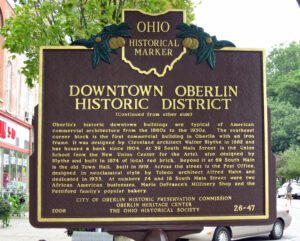
The intersection of Main and College streets has been the center of Oberlin since the town and college were founded in 1833. The first downtown buildings were made of wood and were destroyed by a series of spectacular fires. The first college building, Oberlin Hall, stood on the southwest corner of College and Main and included recitation rooms, a dining hall, chapel, offices, and lodging. In 1887, Akron architect Frank Weary designed the large brick building at numbers 5 to 13 West College. Number 23 West College (Gibson Block) once housed a silent movie theater on the second floor. East College Street’s historic buildings include the Apollo Theater, which showed Oberlin’s first talking movie on May 11, 1928. From 1897 to 1929, an interurban streetcar line connected Oberlin’s downtown to Cleveland. Oberlin’s downtown historic district was placed on the National Register of Historic Places in 2003.
, OH
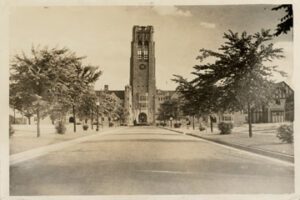
The Toledo University of Arts and Trades was established in 1872 with an endowment of 160 acres of land from Jesup W. Scott, local pioneer, publisher, and real estate broker. Scott envisioned Toledo as the “Future Great City of the World” and wanted an institution to train young people to fulfill their roles in the city’s bright future.
, OH
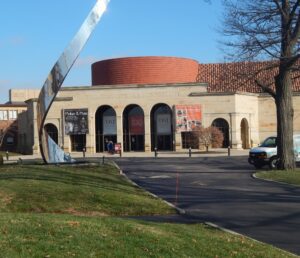
The Dayton Art Institute, one of the region’s premier fine arts museums, was founded in 1919 as the Dayton Museum of Arts. Founding patrons included Orville Wright, members of the Patterson family, and philanthropist Julia Shaw Patterson Carnell, who donated a mansion for the museum’s first home. In 1923, the museum changed its name to The Dayton Art Institute to reflect the growing importance of its art school, which operated until 1974. After outgrowing its first home, Carnell contributed $2 million for a new building designed by architect Edward B. Green. Completed in 1930 and modeled after two sixteenth century Italian Renaissance villas, the building was added to the National Register of Historic Places in 1974 as a preeminent example of Second Renaissance Revival architecture. As it commemorates its centennial, The Dayton Art Institute continues to serve the community with exhibitions, educational programs, and events.
, OH
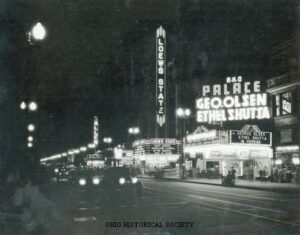
The Theater District, bound by Chester Avenue, Prospect Avenue, East 18th, East 9th and East 12th Streets, came into being at the turn of the 20th century, when Cleveland emerged as a thriving metropolis. Built between 1890-1928, the area hosted a variety of fine retail stores, theaters, prestigious clubs, restaurants, and distinct office buildings. The rise of television and flight to the suburbs sent downtown entertainment into a death spiral, until a 1970 grass roots effort saved from demolition the surviving post-World War I theaters (the State, Ohio, Hanna, Allen, and Palace), making it the “world’s largest theater restoration project.” It became a catalyst for reinvestment in downtown properties, restoring civic pride and giving testimonial to the creative vision of the city’s civic leaders and citizenry. By the year 2000, Cleveland’s Theater District boasted the nation’s 2nd largest performing arts center.
, OH
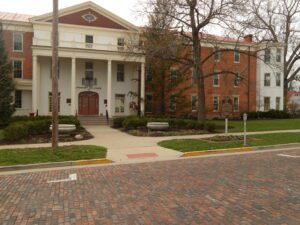
Chartered in 1849, the Institute was the first of three women’s colleges established in Oxford. The original brick building was completed in 1850, and forms the core structure. The Reverend John Witherspoon Scott, a member of Miami University’s early faculty, headed the Institute. In 1867, the Institute merged with Oxford Female College and later became the Oxford College for Women. Miami University acquired the building in 1928; in 1930 the Daughters of the American Revolution rededicated it as the “Caroline Scott Harrison Memorial.” From 1929-1998 it served as a Miami dormitory, nicknamed “Ox College.” Since 2003, the three-story building has housed the Oxford Community Arts Center. The structure is the oldest extant women’s college building in Ohio. It was placed on the National Register of Historic Places in 1976.