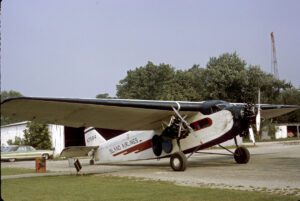
In 1936, Milton Hersberger, an early barnstormer and accomplished aviator, purchased the first Ford Tri-Motor to be used for air service to the nearby Lake Erie Islands. Affectionately known as the “Tin Goose,” the legendary all-metal Ford Tri-Motor was a true workhorse that played a vital role in hauling passengers, mail, and cargo to and from the islands. Pushing a top speed of 85 mph, the complete 17 mile roundtrip from Port Clinton consisted of 12 take-offs and landings and took less than 45 minutes. The airline earned its reputation as “The Shortest Airline in the World” averaging a trip of less than 10 minutes between each stop.
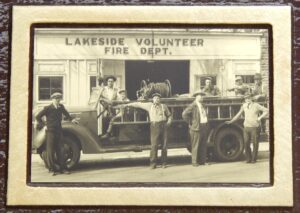
The Lakeside Volunteer Fire Protective Association responded to both fire and medical emergencies on the Marblehead Peninsula for more than 100 years. It was founded in 1905, after a devastating fire destroyed Lakeside’s business district. In 1946, the Association began providing emergency medical aid. During their service, the Lakeside Volunteer Fire Protective Association progressed from hand-drawn chemical carts to the area’s first heavy-duty fire and rescue truck. In 2013, the Association donated its assets to the newly-formed Danbury Township Volunteer Fire Department and passed into history.
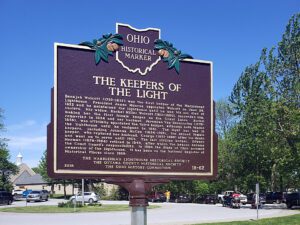
The Marblehead Lighthouse is the oldest lighthouse in continuous operation on the Great Lakes. Originally known as the Sandusky Bay Light Station, the lighthouse was built here in 1821 to aid navigation and prevent shipwrecks. William Kelly (1779-1867) received the contract and, using local limestone, completed construction in eight weeks. The lighthouse was 50 feet high and had a diameter of 25 feet at the base and 12 feet at the top. When the lighthouse had a keeper, the beacon was updated with ever brighter lamps and more powerful lenses. At the turn of the 19th century, a watch room and new lantern room were added, increasing the lighthouse’s height 15 feet. Beacons were lit with whale oil, lard oil, kerosene, and then, in 1923, with electricity. As of 2018, the light is an LED that is visible up to eleven nautical miles.
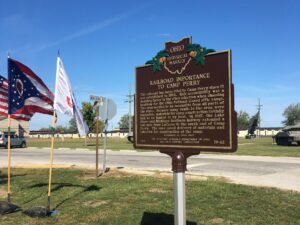
Railroad Importance to Camp Perry. The railroad has been vital to Camp Perry since it was established in 1906. Rail accessibility was a deciding factor in the site’s selection when choosing locations for the Ohio National Guard rifle range. The area needed to be accessible from all parts of the state. Because many roads in the area were impassible, materials for camp construction initially had to be hauled in by boat. In 1907, the Lake Shore and Michigan Southern Railway extended a rail spur from LaCarne to the south end of Camp Perry. The spur eased delivery of materials and laborers for construction of the camp. (Continued on other side)
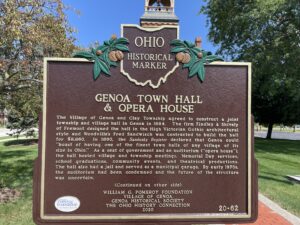
The Village of Genoa and Clay Township agreed to construct a joint township and village hall in Genoa in 1884. The firm Findley & Shively of Fremont designed the hall in the High Victorian Gothic architectural style and Woodville’s Fred Sandwisch was contracted to build the hall for $8,860. In 1890, the Sandusky Register declared that Genoa could “boast of having one of the finest town halls of any village of its size in Ohio.” As a seat of government and an auditorium (“opera house”), the hall hosted village and township meetings, Memorial Day services, school graduations, community events, and theatrical productions. The hall also had a jail and served as a municipal garage. By early 1970s, the auditorium had been condemned and the future of the structure was uncertain. (Continued on other side)
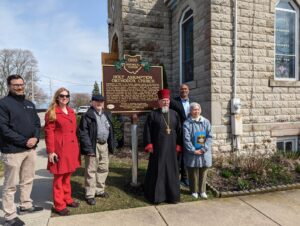
Established in 1898 as the Russian Orthodox Church of the Dormition, Holy Assumption was founded by Carpatho-Russian immigrants from the Austro-Hungarian Empire. Constructed in 1905-1906, it is considered to be the oldest Orthodox church building in Ohio. Archbishop Tikhon, head of the Russian Orthodox Church in North America, consecrated the church and celebrated the first Liturgy. Tsar Nicholas II of Russian personally donated the four icons on the iconostas, or icon screen, as well as liturgical items. Both the Tsar and, by then Patriarch, Tikhon were murdered by the Bolsheviks during the 1917 Russian Revolution and were glorified as Saints of the Orthodox Church. Holy Assumption Orthodox Church continues to be a beacon of the Orthodox Faith on the Marblehead peninsula.
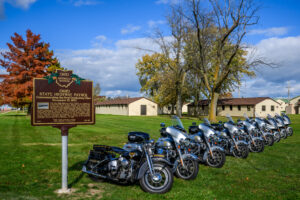
The Ohio State Highway Patrol (OSHP) was created by Ohio House Bill 270 in 1933. Over 5,000 applications to join the newly formed Division were trimmed and approximately 125 individuals — between the ages of 24 and 40 years — were admitted into the inaugural cadet class. The Ohio National Guard graciously volunteered the use of their facilities on Lake Erie’s shores. Colonel Lynn Black, the first OSHP superintendent, opened “Camp Perry School” on October 3, 1933. Although 54 new motorcycles were purchased for patrol duties, many of the cadets lacked motorcycle experience and had to be trained quickly. Severe weather shortened the training as cadets endured frigid temperatures and unheated facilities. The first class of 60 uniformed patrolmen were sworn in on November 15, 1933.