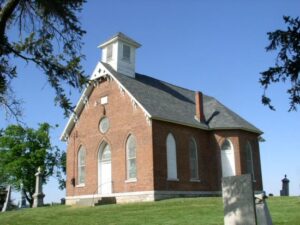
The first Mt. Tabor Church, a log meetinghouse, was erected on this site in 1816. It stood on land originally selected by Griffith and Martha Evans for a graveyard at the death of their daughter circa 1812. Deeds show the Evans family gave two and one half acres of land “for the purpose of erecting a meetinghouse and establishing a burying site.” Camp meetings, religious gatherings popular in frontier Ohio, were held on the hillside west of the meetinghouse. Simon Kenton was converted at a Mt. Tabor camp meeting in 1819. The log meetinghouse burned in 1824 and was replaced with a brick church on the same spot. In 1881, the present brick church was completed and dedicated.
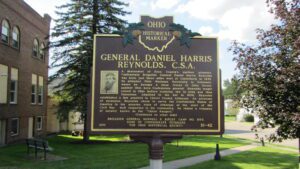
A descendent of Knox County’s earliest pioneers, Confederate Brigadier General Daniel Harris Reynolds was born just three miles west of Centerburg in 1832. He attended Ohio Wesleyan University in Delaware, where he became a close friend of Otho Strahl, another Ohio born Confederate general. Reynolds taught school in Ohio before studying law in Iowa and then Tennessee. Admitted to the bar in 1858, Reynolds established a law practice in Chicot County Arkansas. An advocate of secession, Reynolds chose to serve the Confederate States of America in his adopted state of Arkansas at the start of the Civil War. Well respected in his community, he raised a company of cavalry known as the “Chicot Rangers.” (Continued on other side)
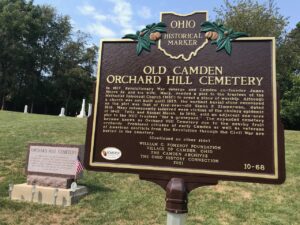
In 1817, Revolutionary War veteran and Camden co-founder James Moore Sr. and his wife, Mary, deeded a plot to the trustees of the Methodist Episcopal Church (MEC) to erect a place of worship. Although a church was not built until 1825, the earliest burial stone recovered on the plot was that of five-year-old Simon P. Zimmerman, dated 1818. Many subsequently interred were victims of the cholera epidemic of 1849. Felix and Rachel Marsh, in 1852, sold an adjacent one-acre plot to the MEC trustees “for a graveyard.” The expanded cemetery became known as Orchard Hill Cemetery due to the nearby fruit orchards. Prominent citizens of early Camden as well as veterans of American conflicts from the Revolution through the Civil War are buried in the cemetery. (Continued on the other side)
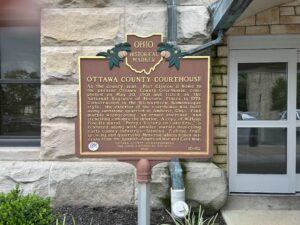
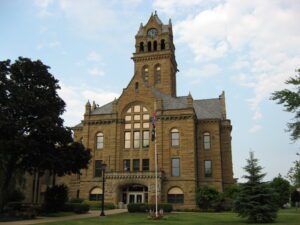
As the county seat. Port Clinton is home to the present Ottawa County Courthouse, completed on May 20, 1901 and listed on the National Register of Historic Places in 1974. Constructed in the Richardson Romanesque style, the exterior of the courthouse was built using sandstone quarried at Amherst, Ohio. Pink marble wainscoting, an ornate staircase, and stenciling enhance the interior. A copy of William Powell’s mural, “Perry’s Victory on Lake Erie,” is featured along with smaller murals depicting early county industries–farming, fishing, fruit growing, and quarrying. Memorial tablets honor veterans from the Spanish-American War and Civil War.
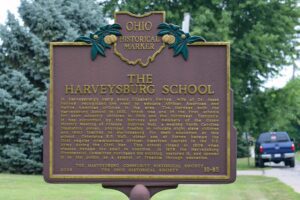
The Quaker village of Harveysburg was founded in 1829 on land originally a part of Colonel Abraham Buford’s Revolutionary War Land Grant. Levi Lukens, a Virginia Quaker, purchased the 1000 – acre survey in 1812 and sold a portion to Rhoden Ham in 1815. Ham then sold a portion of his holdings to William Harvey, a Quaker originally from North Carolina, who developed 47 lots for a village which thrived from its beginnings. Early businesses included grist mills, a tin shop, hardware store, blacksmith shop, a large pork packing plant, a bank, and a dry goods store owned by William Harvey. Its first post office opened in 1839. Harveysburg was incorporated in 1844. The village received its name from a merchant in Cincinnati who told William Harvey that he should add burg to his name and call the place Harveysburg.
As the county seat, Port Clinton is home to the present Ottawa County Courthouse, completed on May 20, 1901 and listed on the National Register of Historic Places in 1974. Constructed in the Richardson Romanesque style, the exterior of the courthouse was built using sandstone quarried at Amherst, Ohio. Pink marble wainscoting, an ornate staircase, and stenciling enhance the interior. A copy of William Powell’s mural, “Perry’s Victory on Lake Erie,” is featured along with smaller murals depicting early county industries – farming, fishing, fruit growing, and quarrying. Memorial tablets honor veterans from the Spanish-American War and Civil War.
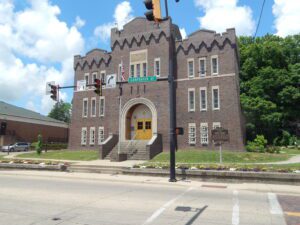
In the first years of the twentieth century, Athens’ citizens formed a new National Guard company. The guardsmen initially held drill at the Campbell Block on Court Street, but soon the Athens Commercial Club began advocating for an armory from the Ohio National Guard. In 1912, the Armory Board approved the request. Plans were drawn up for the armory and the Guard purchased land from the Athens Brick Company at the foot of Shale Hill. Construction began in the spring of 1915 and the Armory opened in December. In March of 1917, the city held a dedication ceremony and parade. Before World War I, the Athens Armory housed Company L and the Machine Gun Company, both part of the 7th Infantry Regiment, Ohio National Guard. (Continued on other side)
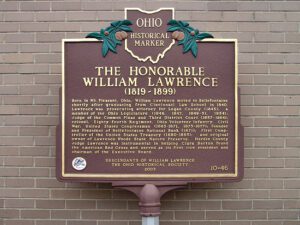
Born in Mt. Pleasant, Ohio, William Lawrence moved to Bellefontaine shortly after graduating from Cincinnati Law School in 1840. Lawrence was prosecuting attorney for Logan County (1845); a member of the Ohio Legislature (1846, 1847, 1849-51, 1854); Judge of the Common Pleas and Third District Court (1857-1864); colonel, Eighty-fourth Regiment, Ohio Volunteer Infantry, Civil War; United States Congressman (1865-1871, 1873-1877); Founder and President of Bellefontaine National Bank (1871); First Comptroller of the United States Treasury (1880-1885); and original owner of Lawrence Woods State Nature Preserve, Hardin County. Judge Lawrence was instrumental in helping Clara Barton found the American Red Cross and served as its first vice president and chairman of the Executive Board.