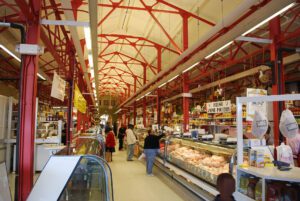
Ohio’s oldest surviving municipal market house, Findlay Market was designed under the direction of City Civil Engineer Alfred West Gilbert (1816-1900). It was listed on the National Register of Historic Places in 1972. The structure was among the first market houses in the United States to use iron frame construction technology. Originally an open pavilion, much of the market was erected in 1852, but disputes with contractors delayed its opening until 1855. The center masonry tower was built in 1902. Soon after, public health concerns prompted enclosure of the market stalls and the addition of plumbing and refrigeration. Until then, vendors found cool storage in deep cellars beneath nearby breweries. The tower bell was brought from Cincinnati’s Pearl Street Market in 1934. Findlay Market was renovated in 1973-74 and again in 2002-03.
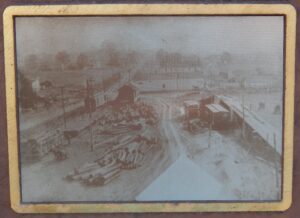
The earliest improved public road west from Lake Erie to the Indiana border, the Territorial-Indiana Road was built by the U.S. Government in 1834-1835 through the Cottonwood Swamp, then a major obstacle to travel. It ran parallel to the Harris Line, the northern boundary of a narrow strip of land contested by Ohio and Michigan from 1803 until 1836, when Ohio annexed it following the “Toledo War.” Completion of the 110-mile road gave farmers and settlers much improved access to markets and new western lands. It became the Indiana Plank Road in 1848 and later Sylvania-Metamora Road. The Toledo and Western Electric Railway’s parallel right-of-way was completed in 1902.
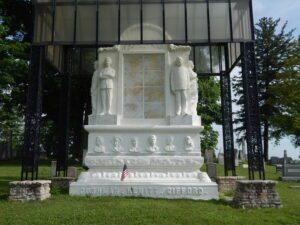
Warren Cushman was a respected painter, sculptor, photographer, musician, and inventor. He created the towering Cushman monument in Woodstock’s Rush Township cemetery and is believed to have shown his painting “Spanish Dancing Girls” at the 1893 World’s Columbian Exposition in Chicago. Warren was born to Franklin and Susan (Gifford) Cushman on January 17, 1845 in Woodstock and had three siblings, Julius, Charles and Lucy. (Continued on other side)
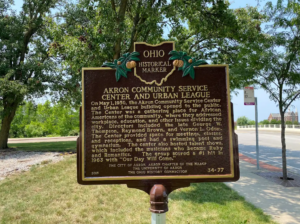
On May 1, 1950, the Akron Community Service Center and Urban League building opened to the public. The Center was a gathering place for African Americans of the community, where they addressed workplace, education, and other issues dividing the city. Directors included the late George W. Thompson, Raymond Brown, and Vernon L. Odom. The Center provided space for meetings, classes and receptions and had a swimming pool and gymnasium. The Center also hosted talent shows, which included the musicians who became Ruby and the Romantics. The group scored a #1 hit in 1963 with “Our Day Will Come.”
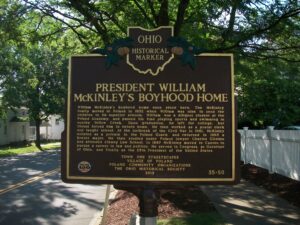
William McKinley’s boyhood home once stood here. The McKinley family moved to Poland in 1852 when William was nine to send the children to its superior schools. William was a diligent student at the Poland Academy, and passed his time playing sports and swimming in nearby Yellow Creek. Upon graduation, he left for college, but illness forced him to return home. He then worked as a postal clerk and taught school. At the outbreak of the Civil War in 1861, McKinley enlisted as a private in the Poland Guard, and returned in 1865 a brevet major. He then studied under Poland lawyer Charles Glidden and attended Albany Law School. In 1867 McKinley moved to Canton to pursue a career in law and politics. He served in Congress, as Governor of Ohio, and finally as the 25th President of the United States.
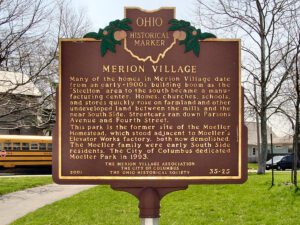
Merion Village was named for the Nathaniel Merion family, who in 1809 settled what is now the South Side of Columbus on 1800 acres of the Refugee Lands. Entrepreneur William Merion operated “Merion’s Landing” in the 1830s to capitalize on the canal trade from the Columbus Feeder Canal. This area saw a large influx of German immigrants as the South Side industrialized in the mid-nineteenth century. Later, many Irish, Italian, and eastern European immigrants who worked in the local steel mills and foundries made their homes here.
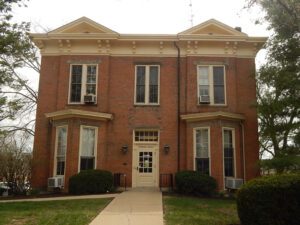
Built by “Old Miami” University President Robert L. Stanton, D.D. (1810-1885) as his private home and president’s office, Stanton’s 1868 Italianate house faced University Square, and welcomed students and guests. The house retains its original symmetrical façade, enclosed portal, grand staircase, double parlors, parlor doors, marbleized slate mantels, and triangular bay windows. Stanton served as president from 1866-1871. Stanton’s son, Robert Brewster Stanton, MU ’71, famed civil engineer, lived here as an undergraduate. His Miami mentor, mathematics professor Robert W. McFarland (1825-1910), purchased the house in 1873. McFarland rented it while distinguishing himself at Ohio State University during Miami’s twelve-year closure, and then resided here while first president of “New Miami” (1885-1888) and until his death. McFarland’s daughter Frances and her husband Llewellyn Bonham sold the home to Miami in 1940.
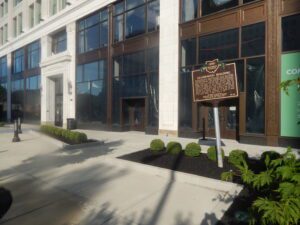
Steel-frame skyscrapers and retail buildings replaced wood-frame residences as the downtown evolved into a commercial district. A small public library branch occupied the north side of the square from 1923 to 1954. The Keith-Albee Theater (later the Palace) in the northeast corner of the square from 1926 to 1964, featured vaudeville performances and movies. Streetcar tracks around the square were removed for scrap during World War II. With expansion of suburban shopping malls, downtown theaters and department stores gradually closed. In 1973-74 Central Square was converted to a pedestrian Federal Plaza by closing off traffic on Federal Street one block east and west of Market Street. Central Square reopened in 2004 with a new traffic pattern, planting beds, and street furniture. Marker for “Central Square (1798-1899)” across the street.