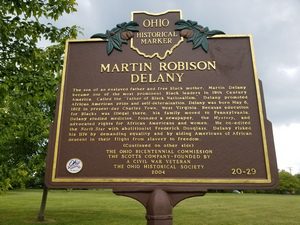
The son of an enslaved father and free Black mother, Martin Delany became one of the most prominent Black leaders in 19th Century America. Called the “Father of Black Nationalism,” Delany promoted African American pride and self-determination. Delany was born May 6, 1812 in present-day Charles Town, West Virginia. Because education for Blacks was illegal there, his family moved to Pennsylvania. Delany studied medicine, founded a newspaper, the “Mystery,” and advocated rights for African Americans and women. He co-edited the “North Star” with abolitionist Frederick Douglass. Delany risked his life by demanding equality and by aiding Americans of African descent in their fight from slavery to freedom. (Continued on other side)
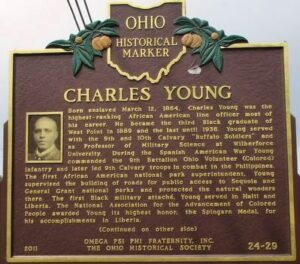
Born enslaved March 12, 1864, Charles Young was the highest-ranking African American line officer most of his career. He became the third Black graduate of West Point in 1889 and the last until 1936. Young served with the 9th and 10th Calvary “Buffalo Soldiers” and as Professor of Military Science at Wilberforce University. During the Spanish American War Young commanded the 9th Battalion Ohio Volunteer (Colored) Infantry and later led 9th Calvary troops in combat in the Philippines. The first African American national park superintendent, Young supervised the building of roads for public access to Sequoia and General Grant national parks and protected the natural wonders there. The first Black military attache, Young served in Haiti and Liberia. The National Association for the Advancement of Colored People awarded Young its highest honor, the Spingarn Medal, for his accomplishments in Liberia. (continued on other side)
In 1942, Charity Adams Earley (1918-2002) became the first African American woman to receive a commission in what became the Women’s Army Corps (WACs). She rose through the ranks to command the 6888th Central Postal Directory Battalion in Europe, the only unit of African American women to serve overseas in World War II. Upon leaving the service in 1946, she was the WAC’s highest-ranking African American officer, a lieutenant colonel. Raised in Columbia, South Carolina, Earley moved to Ohio to attend Wilberforce University and later The Ohio State University. She married Stanley Earley, Jr., M.D. in 1949 and they later moved to Dayton. She became active in civic affairs, including serving on the Sinclair Community College Board of Trustees.
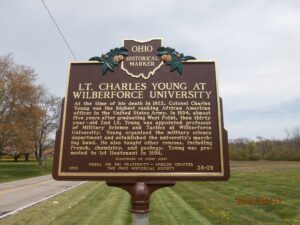
At the time of his death in 1922, Colonel Charles Young was the highest ranking African American officer in the United States Army. In 1894, almost five years after graduating West Point, then thirty year-old 2nd Lt. Young was appointed professor of Military Science and Tactics at Wilberforce University. Young organized the military science department and established the university’s marching band. He also taught other courses, including French, chemistry, and geology. Young was promoted to 1st lieutenant in 1896. (Continued other side)
In 1918, Charles Young made a desperate attempt to convince the U.S. Army that he was fit for duty. The Army’s highest-ranking Black officer, he had been medically retired and not given a command during World War I. To demonstrate his fitness, he rode 497 miles from his home in Wilberforce, Ohio, to Washington, D.C. Leaving on June 6 he made the journey in 17 days, 16 on horseback and 1 resting. Averaging 31 miles each day, he rode 45 minutes and walked 15 minutes every hour. Upon his arrival, Young met with Secretary of War Newton Baker. Pressured by the Black press and the White House, Baker hedged. He recalled Young to active duty a year later and assigned him to Camp Grant, Illinois, just five days before the end of the war.
In 1798, Articles of Confederation Congress provided land to British Canadians who lost property because of loyalty to American revolutionaries during the American War of Independence (1775-1783). This land was part of the Refugee Tract and the present-day Truro Township. In 1850, Henry Stanbery, first Attorney General of Ohio, purchased a portion of this land. In 1923, Charles Johnson bought a section of this land and had it platted as the Eastmoor Addition by the Jennings-Lawrence Company with the polo field at the center. Eastmoor has houses ranging in age from the 1920s to the early 21st century, including Lustron homes built after WWII.