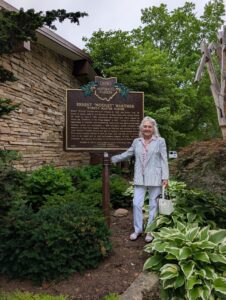
Ernest “Mooney” Warther was born October 30, 1885, near Dover, Ohio. He began to carve, aged 5, and did not set his knife down until shortly before his death on June 8, 1973. Fascinated with trains and steam engines he began his “Evolution of the Steam Engine” in 1913, hoping to convey the importance of invention and engineering. Each model was meticulously hand-sculpted, scaled, and mechanized. A 1923 newspaper article attracted the attention of New York Central Railroad and Warther was invited to tour on their Service Progress Special and later to exhibit at Grand Central Station. This success enabled Warther to quit his local steel mill job and to concentrate on his hobby and his own knife-making business. In 2023, his home, workshop, and museum were listed on the National Register of Historic Places.
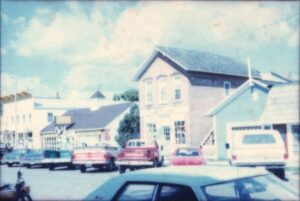
Born in Rhode Island, John Pray (1783-1872) moved to the Maumee River Valley from New York shortly after serving in the War of 1812 and completing a prospecting tour in Ohio. He built a dam across the river to Granger Island and in 1821 constructed a water-powered gristmill, the first on the lower Maumee. In 1831, he laid out the Village of Waterville with the first 50 lots. The Columbian House, a stagecoach inn constructed by Pray in 1828 and expanded in 1837, was for years the commercial and social center of Waterville and accommodated travelers from cities such as Detroit and Cincinnati. From this building, he operated the village’s post office. When Wood County was organized in 1820, Pray became a commissioner until Lucas County was formed from part of Wood in 1835. For nine years he served as Justice of the Peace in Waterville. He and his wife Lucy raised eleven children to adulthood. Circa 1854 he constructed his home, which today overlooks Pray Park.