

, OH
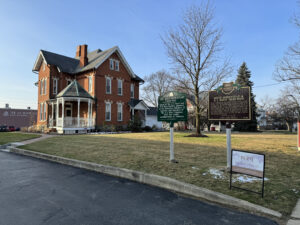
The Root Homestead was built in 1879 by Amos Ives Root, founder of the A. I. Root Company, shortly after he moved his business from the town square. The homestead housed several generations of the Root family until 1953 and was listed on the National Register of Historic Places in 1975. A pioneer of the beekeeping industry, Root helped to standardize such beekeeping equipment and tools as the Langstroth removable frame hive and the centrifugal honey extractor. As a result, beekeepers were able to harvest more honey every season without harming the bees. A prolific author and publisher, Root educated beekeepers across the globe and built a sense of community within the profession. (Continued on other side)
, OH
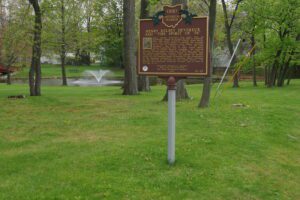
Henry Kelsey Devereux was born into an aristocratic family on October 10, 1859 in Cleveland, Ohio. Ohio artist, Archibald Willard, chose Harry, as he was fondly known, to portray the drummer boy in one of America’s most famous patriotic paintings, “The Spirit of ’76”. At the time Willard approached him to pose, young Harry was a cadet at Brooks Military Academy. He married socialite Mildred French in 1885 and in 1910 they settled in her father’s pretentious country estate in Wickliffe, Ohio (presently Telshe Yeshiva College). His passion for harness racing and for breeding horses culminated in the organization of the American Association of Trotting Horse Breeders and his position as president of the Grand Circuit. The affluent and charitable Wickliffe resident died in 1932 at the age of 72.
, OH
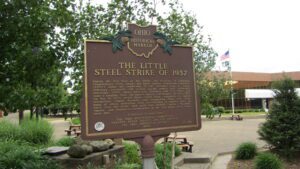
During the New Deal of the 1930s, the Congress of Industrial Organizations (CIO) formed the Steel Workers Organizing Committee (SWOC) under the leadership of CIO president John L. Lewis. Following successful CIO strikes in the rubber and automobile industries, SWOC signed hard-won contracts with U.S. Steel and Jones & Laughlin Steel, the nation’s largest steelmakers, in early 1937. On May 26 SWOC struck three “Little Steel” companies for similar recognition: Inland, Republic, and Youngstown Sheet and Tube, many of whose operations were concentrated in eastern Ohio. By early June the strike idled more than 28,000 Canton, Massillon, Warren, and Youngstown steelworkers in the first major steel strike since 1919. (continued on other side)
, OH
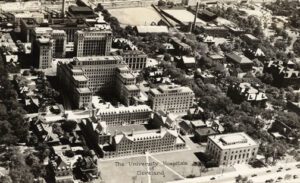
Named for the streetcar turnaround once located at Euclid Avenue and East 107th Street, University Circle is a 600-acre district that is home to many of Cleveland’s major cultural, educational, medical, and service institutions. The area was first settled in 1799 by tavernkeeper Nathaniel Doan and became known as Doan’s Corners. In 1882, Western Reserve College moved here from Hudson, followed in 1885 by the Case School of Applied Science from downtown Cleveland. These two colleges federated in 1967 to become Case Western Reserve University. (continued on other side)
, OH
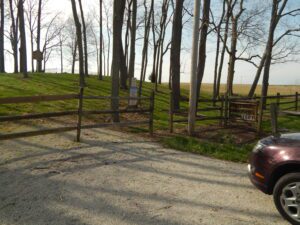
In the early years of the nineteenth century, a religious unrest known as the Second Great Awakening spread across much of the American frontier. Among the most influential of the evolving religious organizations were the Campbellites, or Disciples of Christ, founded in the 1820s by Thomas and Alexander Campbell. The Campbellite movement sought to “restore” New Testament Christianity by calling for a return to the primitive church revealed in the gospels. Campbellites denied creeds and oath-taking and rejected sectarianism. They believed in baptism by immersion and communion on Sundays. Followers also dealt with problems and transgressions of members within the church and did not use civil courts. They held a millennial view that professed human happiness and the belief that Christ would reign on earth for a thousand years. Believers spread this word to the pioneers of the Doty Settlement and elsewhere. By 1850, there were ninety Campbellite Churches in Ohio.
, OH
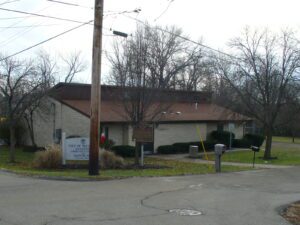
Civic organizations played pivotal roles in the development of the residential community of Hazelwood, founded as a subdivision of Blue Ash in 1888. The Hazelwood Civic Association, initially established as the Brothers Civic Society in 1941, addressed community needs by working for public improvements and promoting civic relations through social events and educational programs. Efforts by the HCA led to the construction of a new civic center and the introduction of the Boy and Girl Scouts and other programs that were previously unavailable to African-American children. Hazelwood’s deterioration and the threat of encroaching industrial development led to the formation of the Hazelwood Improvement Corporation in 1968. The HIC, acting as an agent of the city of Blue Ash, helped to upgrade housing, pave roads, build new homes to ensure a residential nature, install water and sewage systems, and erect streetlights. In 1997, the Hazelwood Community Association was organized to assist residents during Hazelwood’s transition to a racially integrated community.
, OH
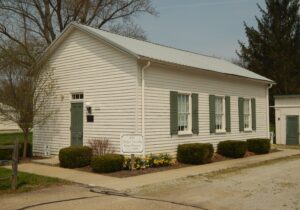
On April 20, 1857, the trustees of Morgan Township met in Okeana to obtain a lot for the township house. From a quarter mill tax levy, $850 was budgeted for a house and lot. Money expended on the project included $50 for the lot, $650 for the construction of the building, $41 for fencing, $12.60 for twelve chairs, and $10.25 for a table. Since its completion in 1858, this meeting house has been used for trustee meetings, a voting precinct, village singing schools and concerts, public school, bank, and township garage. The trustees moved to a new building across the street in 1972 and into their Chapel Road complex in 2000.
, OH
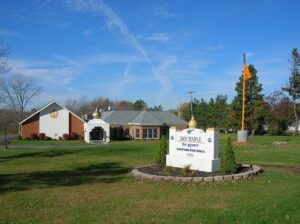
This marks the site of the first Sikh Gurdwara in the state of Ohio. Sikhs began to arrive in Ohio after India’s freedom from British rule in 1947. They came for advanced education at universities in the state. With liberalization of immigration laws in the 1960s, many Sikhs settled in metropolitan areas and set up organizations to hold congregational prayer. The Guru Nanak Foundation of Greater Cleveland Area was named after Guru Nanak, the founder of Sikh Faith. The Foundation, which at first used rental facilities for religious activities, was incorporated in 1976. However, by 1980 it was able to purchase a building at 3305 West 25th Street in Cleveland. Membership swelled during the 1980s, and in 1991 the congregation decided to move the Gurdwara to its present location in Richfield.