Born in Rhode Island, John Pray (1783-1872) moved to the Maumee River Valley from New York shortly after serving in the War of 1812 and completing a prospecting tour in Ohio. He built a dam across the river to Granger Island and in 1821 constructed a water-powered gristmill, the first on the lower Maumee. In 1831, he laid out the Village of Waterville with the first 50 lots. The Columbian House, a stagecoach inn constructed by Pray in 1828 and expanded in 1837, was for years the commercial and social center of Waterville and accommodated travelers from cities such as Detroit and Cincinnati. From this building, he operated the village’s post office. When Wood County was organized in 1820, Pray became a commissioner until Lucas County was formed from part of Wood in 1835. For nine years he served as Justice of the Peace in Waterville. He and his wife Lucy raised eleven children to adulthood. Circa 1854 he constructed his home, which today overlooks Pray Park.
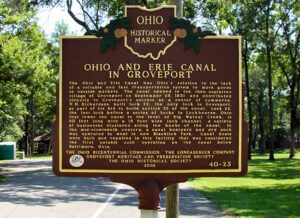
The Ohio and Erie Canal was Ohio’s solution to the lack of a reliable and fast transportation system to move goods to outside markets. The canal opened in the then unplatted village of Groveport on September 25, 1831 and contributed directly to Groveport’s success as a center of commerce. W.H. Richardson built lock 22, the only lock in Groveport, as part of his bid to build section 52 of the canal. Lock 22, the last lock before a series of locks in Lockbourne, Ohio that lower the canal to the level of Big Walnut Creek, is 90 feet long with a 15 foot wide lock channel. A variety of businesses clustered along the banks of the canal. In the mid-nineteenth century, a canal boatyard and dry dock was operated in what is now Blacklick Park. Canal boats were built and repaired in this facility that was considered the first notable such operation on the canal below Baltimore, Ohio.
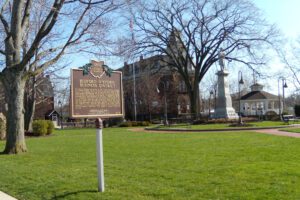
The town of Bedford was settled in 1837. Early residents, Hezekiah and Clarissa Dunham donated the land that serves as Bedford Public Square. The Dunhams built one of the area’s first homes in 1832, which stands at 729 Broadway with the letters H & D above the doorway. Early settlers were attracted to the area by the abundance of natural resources and a large waterfall for mill sites. Bedford also served as a stagecoach stop on the route from Cleveland to Pittsburgh. The road or Turnpike Road as it was called was originally part of the Mahoning Indian Trail. By 1895 the road was renamed Main Street (and later Broadway) when the Akron, Bedford, and Cleveland Railway Company (ABC) traversed the middle of the street carrying passengers. The interurban is called “America’s first high speed long distance electric interurban” with speeds in excess of 60 miles per hour. [continued on other side]
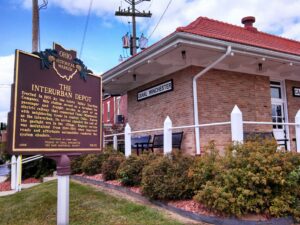
Erected in 1905 by the Scioto Valley Traction Company, this station served as a terminal for passenger and freight service as part of an electric railway that connected Canal Winchester with neighboring towns in central Ohio. Known as the interurban, its arrival signaled the end of the gaslight era in the village. Regular service was maintained from 1904-1930 when improved roads and affordable automobiles rendered the system obsolete. [continued on other side]