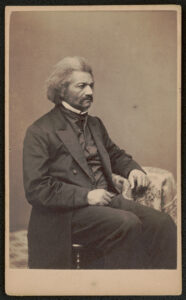
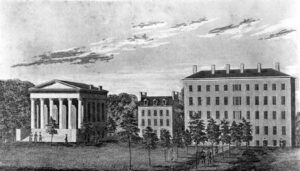
Frederick Douglass, the formerly enslaved man celebrated as one of America’s most powerful abolitionist voices, delivered a historic commencement address at Western Reserve College on July 12, 1854. Invited by the graduating students of the Philozetian and Phi Delta literary societies, Douglass passionately delivered his two-hour speech, “The Claims of the Negro: Ethnologically Considered,” to a gathering of 3,000. Douglass challenged the rising tide of scientific racism and promoted the shared humanity and equality of all people. At a time when few Black Americans were granted such a platform, the moment embodied the spirit of abolition that defined the Western Reserve region. In an era of deep national division, the students’ bold invitation and Douglass’s powerful message affirmed education’s enduring role in advancing truth and justice.
The Lanes, Baptist merchants from New Orleans, and the Kempers, a Presbyterian family from Cincinnati, gave money and land respectively for Cincinnati’s first manual labor theological seminary and high school, which opened in suburban Walnut Hills in 1829. The Reverend Lyman Beecher came from Boston as its first president. The president’s house, now known as the Stowe House after Beecher’s daughter Harriet Beecher Stowe, author of Uncle Tom’s Cabin, still remains at Gilbert and Foraker. Lane Theological Seminary, bound by present day Gilbert, Chapel, Park, and Yale streets, continued to educate Presbyterian ministers until 1932, when it was merged with McCormick Theological Seminary in Chicago.
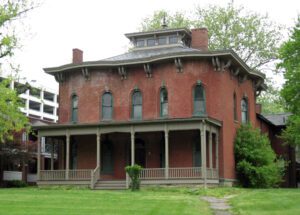
The Cozad-Bates House is one of the oldest remaining structures in Cleveland’s University Circle. The original section, built circa 1853, is the only pre-Civil War residential structure left in the neighborhood. Built by Samuel and Jane Cozad’s son, Andrew Cozad, the first section used locally made brick to form a simple two-story, one-room-deep, vernacular English-I house. The family owned a large portion of the land which is now occupied by University Circle. Justus Cozad, Andrew’s son, returning from the west where he worked as a railroad superintendent and civil engineer, built the later section on Mayfield Road for his larger family in 1872. It is a rare surviving example of Italianate-influenced residential architecture, including a hipped roof, curved bay windows, paired eave brackets, and prominent belvedere. The house was listed on the National Register of Historic Places in 1974 and designated as a Cleveland Landmark in 2006.