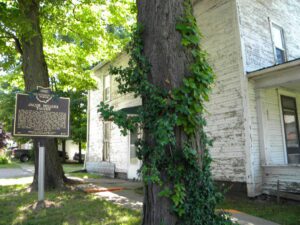
In 1805, for $1.50 an acre, Jacob Miller purchased this property in the Congressional Land Office in Chillicothe, capital of the new state of Ohio. He and Somerset co-founder John Finck then each built a tavern on either side of town along the Zane’s Trace, laid out along existing Indian trails in 1796-1797 and Ohio’s first major thoroughfare. Finck built his home and tavern in 1807 and Miller his shortly after. From 1800 to 1815, Zane’s Trace saw significant traffic between the established eastern states and the newly opened Northwest Territory. A perpetual stream of emigrants rolled westward, giving constant occupation to hundreds of tavern-keepers. Besides operating his tavern and farming, Jacob Miller was a public servant. In 1809, he was appointed Overseer of the Poor as there was a need to “bind out” poor children to families who could take care of them. [continued on other side]
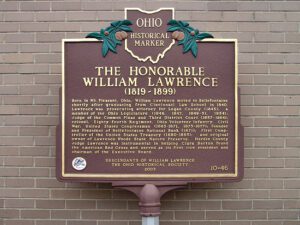
Born in Mt. Pleasant, Ohio, William Lawrence moved to Bellefontaine shortly after graduating from Cincinnati Law School in 1840. Lawrence was prosecuting attorney for Logan County (1845); a member of the Ohio Legislature (1846, 1847, 1849-51, 1854); Judge of the Common Pleas and Third District Court (1857-1864); colonel, Eighty-fourth Regiment, Ohio Volunteer Infantry, Civil War; United States Congressman (1865-1871, 1873-1877); Founder and President of Bellefontaine National Bank (1871); First Comptroller of the United States Treasury (1880-1885); and original owner of Lawrence Woods State Nature Preserve, Hardin County. Judge Lawrence was instrumental in helping Clara Barton found the American Red Cross and served as its first vice president and chairman of the Executive Board.
As the county seat. Port Clinton is home to the present Ottawa County Courthouse, completed on May 20, 1901 and listed on the National Register of Historic Places in 1974. Constructed in the Richardson Romanesque style, the exterior of the courthouse was built using sandstone quarried at Amherst, Ohio. Pink marble wainscoting, an ornate staircase, and stenciling enhance the interior. A copy of William Powell’s mural, “Perry’s Victory on Lake Erie,” is featured along with smaller murals depicting early county industries–farming, fishing, fruit growing, and quarrying. Memorial tablets honor veterans from the Spanish-American War and Civil War.
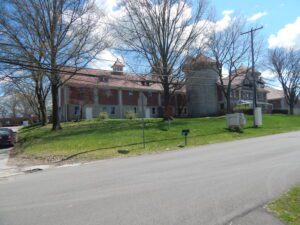
Ohio Columbus Barber began construction of his farm complex in 1909; Barn No. 1 was the first structure. The farm, named for his daughter and son-in-law, ultimately encompassed 3500 acres and 102 structures. It was famous for both the design of its buildings and its scientific agriculture. Listed on the National Register of Historic Places, Barn No. 1 was renovated in 1985 by Yoder Brothers, Inc., for their world headquarters.
In 1873, Tiffin’s Cronise sisters became the first women admitted to the Ohio Bar. At that time, Ohio laws did not provide for the admission of women attorneys. On April 4th 1873, Nettie Cronise applied to the district court. Despite vigorous opposition, leading local attorneys, including William Harvey Gibson and George Seney, supported Nettie’s applications. Ironically, at the same time as Nettie’s admission, the U.S. Supreme Court affirmed Illinois’ denial of admission to the bar to another woman based upon gender. Regardless, Nettie opened the door for the admission of women to the bar of Ohio. Six months later, Florence, Nettie’s younger sister, was admitted. Florence was also the first female notary public in the state. Together the sisters opened the first female-owned law practice in Ohio, N. & F. Cronise. (Continued on other side)
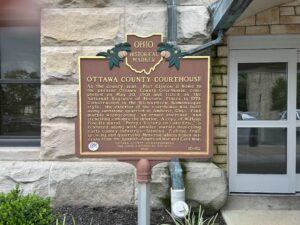
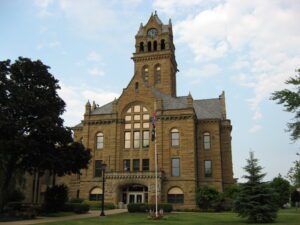
As the county seat, Port Clinton is home to the present Ottawa County Courthouse, completed on May 20, 1901 and listed on the National Register of Historic Places in 1974. Constructed in the Richardson Romanesque style, the exterior of the courthouse was built using sandstone quarried at Amherst, Ohio. Pink marble wainscoting, an ornate staircase, and stenciling enhance the interior. A copy of William Powell’s mural, “Perry’s Victory on Lake Erie,” is featured along with smaller murals depicting early county industries – farming, fishing, fruit growing, and quarrying. Memorial tablets honor veterans from the Spanish-American War and Civil War.
In 1918, Charles Young made a desperate attempt to convince the U.S. Army that he was fit for duty. The Army’s highest-ranking Black officer, he had been medically retired and not given a command during World War I. To demonstrate his fitness, he rode 497 miles from his home in Wilberforce, Ohio, to Washington, D.C. Leaving on June 6 he made the journey in 17 days, 16 on horseback and 1 resting. Averaging 31 miles each day, he rode 45 minutes and walked 15 minutes every hour. Upon his arrival, Young met with Secretary of War Newton Baker. Pressured by the Black press and the White House, Baker hedged. He recalled Young to active duty a year later and assigned him to Camp Grant, Illinois, just five days before the end of the war.
Intersection of National Road (U.S. 40) and Old National Road
Morristown
, OH
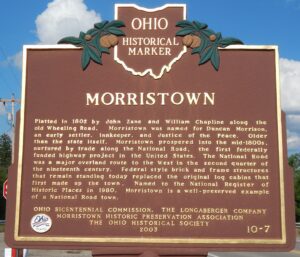
Platted in 1802 by John Zane and William Chapline along the old Wheeling Road, Morristown was named for Duncan Morrison, an early settler, innkeeper, and Justice of the Peace. Older than the state itself, Morristown prospered into the mid-1800s, nurtured by trade along the National Road, the first federally funded highway project in the United States. The National Road was a major overland route to the West in the second quarter of the nineteenth century. Federal style brick and frame structures that remain standing today replaced the original log cabins that first made up the town. Named to the National Register of Historic Places in 1980, Morristown is a well-preserved example of a National Road town.