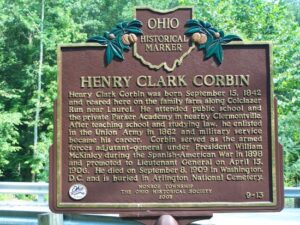
Henry Clark Corbin was born September 15, 1842 and reared here on the family farm along Colclazer Run near Laurel. He attended public school and the private Parker Academy in nearby Clermontville. After teaching school and studying law, he enlisted in the Union Army in 1862 and military service became his career. Corbin served as the armed forces adjutant-general under President William McKinley during the Spanish-American War in 1898 and promoted to Lieutenant General on April 15, 1906. He died on September 8, 1909 in Washington, D.C. and is buried in Arlington National Cemetery.
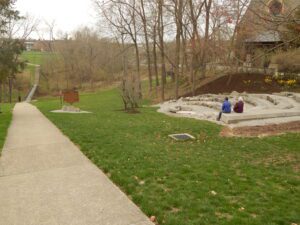
In what was called the “Freedom Summer” of 1964, more than 800 volunteers, most of them college students, gathered at the Western College for Women (now Western Campus of Miami University) to prepare for African-American voter registration in the South. Three of the volunteers – James Chaney of Mississippi, and Andrew Goodman and Michael Schwerner of New York – disappeared on June 21, 1964, in rural Mississippi mere days after leaving Oxford, Ohio. Their bodies were discovered forty-four days later, buried in an earthen dam. Ku Klux Klan members were later convicted on federal conspiracy charges. Erected in 1999, this outdoor amphitheater is a memorial to the slain activists, other volunteers, and ideals of the Freedom Summer movement.
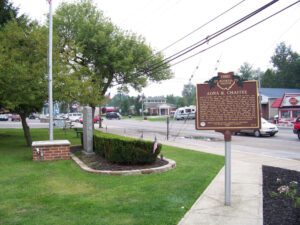
Adna R. Chaffee was born in Orwell on April 14, 1842, and grew up on the family farm. He left home in 1861 to pursue a career in the military, enlisting first in the 6th U.S. Cavalry for service in the Civil War. Distinguishing himself in many battles, including Gettysburg, Chaffee rose to the rank of 1st Lieutenant. He then fought in the Indian Wars of the West from 1867-1888, assisting in the capture of Geronimo and being promoted to the rank of Major. He also saw action in the Spanish American War, the Boxer Rebellion in China, and the Philippine Insurrection. On January 9, 1904, Chaffee was promoted to Lt. General and became Chief of Staff of the U.S. Army, the first to achieve this office without attending West Point. He retired in 1906. He died in 1914 and was buried in Arlington National Cemetery with the highest military honors.
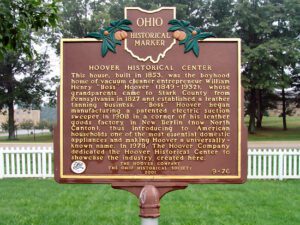
This house, built in 1853, was the boyhood home of vacuum cleaner entrepreneur William Henry “Boss” Hoover (1849-1932), whose grandparents came to Stark County from Pennsylvania in 1827 and established a leather tanning business. “Boss” Hoover began manufacturing a patented electric suction sweeper in 1908 in a corner of his leather goods factory in New Berlin (now North Canton), thus introducing to American households one of the most essential domestic appliances and making Hoover a universally-known name. In 1978, The Hoover Company dedicated the Hoover Historical Center to showcase the industry created here.
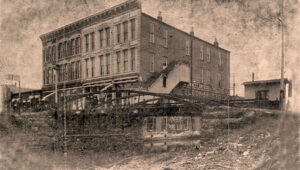
Emmitt-Greenbaum Building, 200 North Market Street, was built around 1878 by businessman and politician James Emmitt (1806-1893) to replace his 1837 wooden warehouse. The brick three-story Italianate building featured five vertical cast iron belts of simulated stone, a projecting cornice, reeded pilasters, and a “fortress-like fourteen bay front.” A covered wooden stairway on the building’s south side originally projected over the canal. Charles Louis Greenbaum (1871-1935) purchased the building in 1912 and opened his department store advertising it as “The Store with The Goods!” Over 140 years, the Emmitt-Greenbaum building was occupied by Jas. Emmitt Dry Goods, Hoffman’s, Greenbaum’s, Armbruster and Armbruster, Waverly Drugs, and the Bee Hive Tavern. A structural collapse after decades of deterioration condemned the building and the southwestern half was razed in 2021.
In 1769, Pierre-Louis de Lorimier (Peter Loramie) traveled from Canada to this vicinity to establish fur trading with the local indigenous tribes. This location is a portage between tributaries of the Ohio River and Lake Erie that eased the transport of the quantity of furs in this lucrative trade. His very profitable trading post was located just west of this marker along Loramie Creek. Lorimier’s friendship with the local Shawnee and Delaware tribes, and the British, led him to join them in efforts to curtail the movement of white settlers into the Northwest Territory. In 1782, in an attempt to halt raids along the Ohio River (many of which were formulated at Lorimier’s store), General George Rogers Clark ordered Col. Benjamin Logan to burn Lorimier’s store.
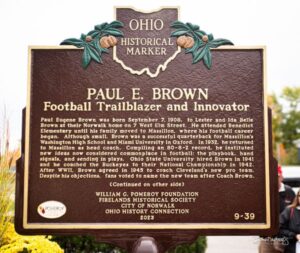
Paul Eugene Brown was born September 7, 1908, to Lester and Ida Belle Brown at their Norwalk home on 7 West Elm Street. He attended Benedict Elementary until his family moved to Massillon, where his football career began. Although small, Brown was a successful quarterback for Massillon’s Washington High School and Miami University in Oxford. In 1932, he returned to Massillon as head coach. Compiling an 80-8-2 record, he instituted new ideas now considered commonplace in football: the playbook, hand signals, and sending in plays. Ohio State University hired Brown in 1941 and he coached the Buckeyes to their National Championship in 1942. After WWII, Brown agreed in 1945 to coach Cleveland’s new pro team. Despite his objections, fans voted to name the new team after Coach Brown. (Continued on other side)
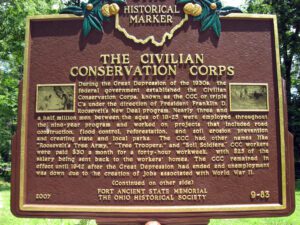
During the Great Depression of the 1930s, the federal government established the Civilian Conservation Corps, known as the CCC or triple C’s under the direction of President Franklin D. Roosevelt’s New Deal program. Nearly three and a half million men between the ages of 18-25 were employed throughout the nine-year program and worked on projects that included road construction, flood control, reforestation, and soil erosion prevention and creating state and local parks. The CCC had other names like “Roosevelt’s Tree Army,” “Tree Troopers,” and “Soil Soldiers.” CCC workers were paid $30 a month for a forty-hour workweek, with $25 of the salary being sent back to the workers’ homes. The CCC remained in effect until 1942 after the Great Depression had ended and unemployment was down due to the creation of jobs associated with World War II.