W side of intersection of Riverside Drive and Busenbark Road
Trenton
, OH
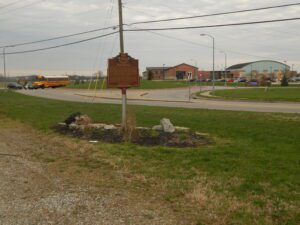
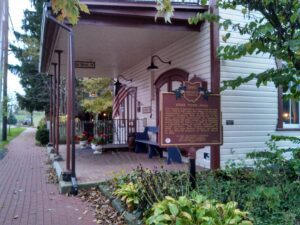
In 1833, Robert Busenbark deeded land to the directors of School District No. 6 for Busenbark School. Twenty years later, Robert and son David granted a right-of-way on their property for a station on the Cincinnati, Hamilton & Dayton Railroad (CH&D). One of eleven depots in Butler County, Busenbark station attracted the Kinsinger-Augspurger Warehouse and the Kennel Grain Elevator to the area in the 1860s. The railroad also enabled the cross-roads settlement to host an American championship prize fight in 1867. Fighting with bare knuckles in an outdoor ring, Mike McCoole bested Aaron Jones in a match seen by thousands. The Busenbark generating station supplied power to interurban lines until 1912 and later furnished electricity to local residents. Farmers and the Miami Poultry Yards depended on the trains and interurban to ship produce. The railroad depot disappeared between 1914 and 1916; the school closed after 1937; interurban service ended in 1939. All that remains of Busenbark is Busenbark Road, which was established in 1858.
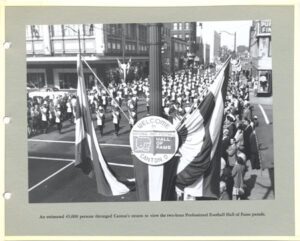
On September 17, 1920, representatives from ten professional football teams met in Canton and formed the American Professional Football Association, which in 1922 became the National Football League (NFL). Pro football evolved from club football in the 1890s, and by the early 1900s had begun to spread across the country, concentrating in the Midwest. Jim Thorpe, the first nationally prominent pro, started with the Canton Bulldogs-an early pro football power-in 1915. In 1959, Canton citizens launched a well-organized and ultimately successful effort to have their city, “the cradle of professional football,” designated as the site of a monument to the sport’s historic stars. The Professional Football Hall of Fame opened on September 7, 1963, inducting seventeen charter members. The Hall of Fame interprets and promotes the study of the role of professional football in American culture.
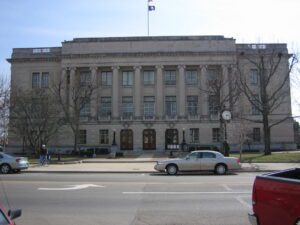
The current Preble County Courthouse, the third courthouse erected on this site, was designed by noted architect and Preble County native Harvey Heistand. Its cornerstone was laid on March 17, 1917, with a copper box containing a bible, historic papers, and other memorabilia placed under the stone. Upon completion, the building was dedicated on September 10, 1918, with three thousand people attending the ceremony. Designed in the Neo-Classical style, the exterior was constructed of Indiana Bedford limestone with ten immense columns that extend upward from the second floor. Above the colonnade, a dentiled entablature is inscribed, Salus Populi Suprema Lex, meaning “The health of the people is the supreme law.” The façade is enhanced with a bricked courtyard flanked by balustraded terraces. [continued on other side]
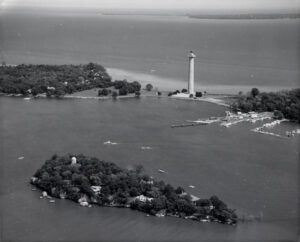
This 6.5 acre island, named for the resemblance of its dolomite ledges to the Rock of Gibraltar, was the likely observation site for Commodore Oliver Hazard Perry’s naval forces during the Battle of Lake Erie in September 1813. Stone Laboratory, located on both Gibraltar and South Bass islands, is the oldest freshwater biological field station and research laboratory in the United States. Founded in 1895 as the Lake Laboratory, it was named for Franz Stone, whose son Julius purchased the island from the Jay Cooke family and presented it to Ohio State University in 1925. It continues as the research and teaching laboratory for the Ohio Sea Grant College Program. The Jay Cooke Castle on the island is a National Historic Landmark.
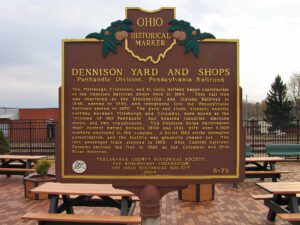
The Pittsburgh, Cincinnati, and St. Louis Railway began construction of the Dennison Railroad Shops here in 1864. This rail line was chartered as the Steubenville and Indiana Railroad in 1849, opened in 1855, and integrated into the Pennsylvania Railroad system in 1870. The yard and shops, situated exactly halfway between Pittsburgh and Columbus, were known as the “Altoona of the Pan Handle” and boasted foundries, machine shops, and two roundhouses. The Dennison Shops experienced their busiest period between 1900 and 1921, with over 3,000 workers employed in the complex. A bitter 1922 strike prompted consolidation, and the facility was gradually phased out. The last passenger train stopped in 1970. Ohio Central Railroad Systems revived the line in 1992 as the Columbus and Ohio River Railroad.
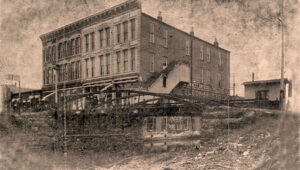
Emmitt-Greenbaum Building, 200 North Market Street, was built around 1878 by businessman and politician James Emmitt (1806-1893) to replace his 1837 wooden warehouse. The brick three-story Italianate building featured five vertical cast iron belts of simulated stone, a projecting cornice, reeded pilasters, and a “fortress-like fourteen bay front.” A covered wooden stairway on the building’s south side originally projected over the canal. Charles Louis Greenbaum (1871-1935) purchased the building in 1912 and opened his department store advertising it as “The Store with The Goods!” Over 140 years, the Emmitt-Greenbaum building was occupied by Jas. Emmitt Dry Goods, Hoffman’s, Greenbaum’s, Armbruster and Armbruster, Waverly Drugs, and the Bee Hive Tavern. A structural collapse after decades of deterioration condemned the building and the southwestern half was razed in 2021.
The Society of Separatists of Zoar built the Zoar Town Hall in 1887 when the village was formally incorporated. Established in 1817 by German religious dissidents, Zoar became one of the most successful experiments in communal living during the 19th century. Early hardships encouraged the Zoarites, in 1819, to establish a communal system to ensure economic and social security. The Society disbanded in 1898. The Zoar Historic District was added to the National Register of Historic Places in 1969.
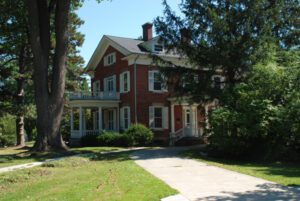
Jabez Lyman Burrell (1806-1900), originally from Massachusetts, built this house in 1852. Burrell made his living as a cattleman and farmer, but devoted much of his time serving the cause of abolitionism, helping slaves, who had escaped the South, get to Sheffield and from there to Lorain and across Lake Erie to Canada. He was also devoted to equal education for all, providing funding to a freedmen’s school in Selma, Alabama, and serving as a trustee of the Oberlin Collegiate Institute, well known for educating African Americans and women. From 1884 to 1934, this was the home of Henry Churchill King (1858-1934), who was the president of Oberlin College from 1902-1927. The Kings added the porches and rear wing and made their home a social center for the college and community. The house is listed on the National Register of Historic Places and is a City of Oberlin Historic Landmark.