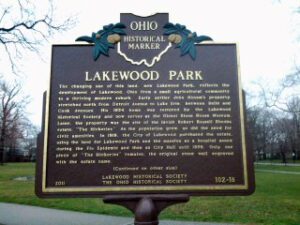
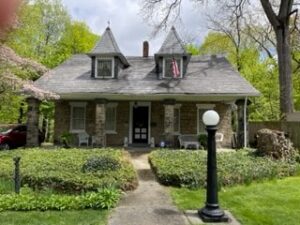
The changing use of this land, now Lakewood Park, reflects the development of Lakewood, Ohio from a small agricultural community to a thriving modern suburb. Early settler John Honam’s property stretched north from Detroit Avenue to Lake Erie, between Belle and Cook Avenues. His 1834 home was restored by the Lakewood Historical Society and now serves as the Oldest Stone House Museum. Later, the property was the site of the lavish Robert Russell Rhodes estate, “The Hickories.” As the population grew, so did the need for civic amenities. In 1919, the City of Lakewood purchased the estate, using the land for Lakewood Park and the mansion as a hospital annex during the Flu Epidemic and then as City Hall until 1959. Only one piece of “The Hickories” remains; the original stone wall engraved with the estate name.
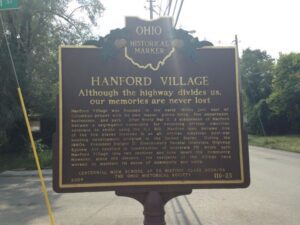
Hanford Village was founded in the early 1900s just east of Columbus proper with its own mayor, police force, fire department, businesses, and park. After World War II, a subdivision of Hanford became a segregated community for returning African American veterans to settle using the G.I. Bill. Hanford then became one of the few places involved in an all African American post-war housing development program in the United States. During the 1960s, President Dwight D. Eisenhower’s Federal Interstate Highway System Act resulted in construction of Interstate 70 which split Hanford Village into two sections and tore apart the community. However, since the division, the residents of the village have worked to maintain its sense of community and unity.
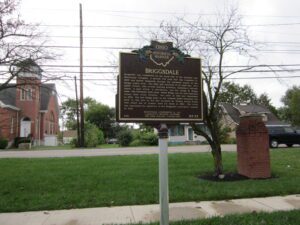
Briggsdale was established on the north side of the Columbus and Harrisburg Turnpike, a private toll road that was completed in 1849 and passed diagonally through the southeast corner of the Briggs family farm. The 1893 plat consisted of 97 small lots, five public streets, and several existing buildings, including a railroad depot, a post office, a schoolhouse, and the Joseph M. Briggs home. The Italianate style home, where Briggs and his wife Louisiana raised their seven children, was built in 1881 and demolished in 1958. The last Briggs home on the original family farmstead was built on this site in 1911 and occupied by William Irving Briggs (the eldest son of Joseph) until his death in 1964. The house was demolished for expansion of the Briggsdale Apartments complex in 2018.
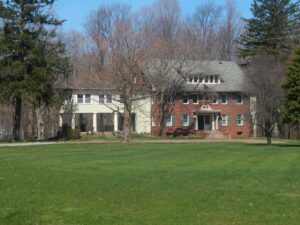
Greenwood Farm straddles the East Branch of Euclid Creek where a waterfall and gorge expose outcroppings of Euclid bluestone. George and Maude Maynard Phypers acquired the property in 1908. Four generations of the Phypers family lived here until the City of Richmond Heights purchased it in 2004. Called Cleveland’s “Insurance Dean” for his leadership in the field, George (1873-1972) was a businessman and civic leader. He served on the Richmond Heights Village Council from 1921 to 1953. Maude (1872-1965) was the first woman to serve on the local school board (1931). The 17-acre farm includes a 19th century post-and-beam English barn and a 1917 Colonial Revival brick house. A powerhouse supplied electricity to the farm and a nearby school prior to rural electrification in the 1930s. Greenwood Farm was listed on the National Register of Historic Places in 2016.
The Curtis-Preyer Stone House takes its name from two families associated with its early history. Richard and Clarissa Dille Curtis purchased 70 acres in the Connecticut Western Reserve from veteran Elias Lee in 1819. The Euclid Township “Turkey Knob” settlement soon thrived around Dugway Brook, springs sites, and an American Indian crossroads. The Curtis, Dille, Lee, and Stillman families, related by marriage, helped each other succeed by harnessing the creek to power their grist and saw mills and selling quarried stone and felled timber. Sometime between 1819 and 1835 Curtis built his stone house using the Berea sandstone quarried on site. The roof was created of ax-hewn “pegged” tree timbers, and the thick stone walls fashioned of uncoursed, chiseled stones. A central chimney fed seven fireplaces and a bake oven.
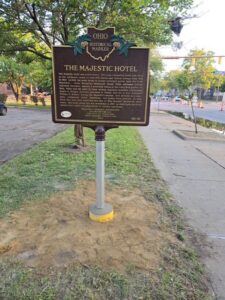
The Majestic Hotel was a five-story, 250-room residential hotel that stood on the northeast corner of East 55th Street and Central Avenue from 1902 to 1967. In 1924 the hotel began to accept overnight guests. Amid the Great Migration, owner Hungarian immigrant Joseph Weiss welcomed African American travelers, earning a perennial listing in the Green Book guides. In 1944, Weiss sold the hotel to three African American investors: businessman Alonzo G. Wright, attorney Lawrence O. Payne, and Call & Post publisher William O. Walker. During the Majestic’s heydey, such services as a pharmacy, restaurant, tailor, beautician, and barber were offered. Its Rose Room jazz club drew musicians and fans to “Blue Monday” parties for many years. The hotel closed and was demolished in 1967, as civil rights advances opened more public accommodations to African Americans.