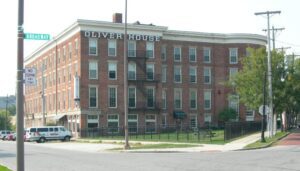
Overlooking the “Middlegrounds,” an early site of railroad, immigration, and commercial activity, the Oliver House opened in 1859 as Toledo’s premier hotel. It was designed by nationally prominent architect Isaiah Rogers, in the Greek Revival style, and built by the family of William Oliver for whom the hotel was named; owner of this land, Oliver was one of Toledo’s earliest real estate investors. (Continued on other side)
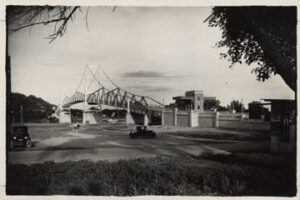
On December 15, 1967, about one mile downstream from this historic marker, a national tragedy occurred. Forty-six interstate travelers lost their lives when the Silver Bridge collapsed into the Ohio River during five o’clock rush hour traffic. The 2,235 foot two-way vehicular bridge connected Point Pleasant, West Virginia and Kanauga, Ohio via U.S. Route 35. The West Virginia Ohio River Company built the structure in 1928 for $1.2 million. The bridge, unique in its engineering conception, was the first of its design in America and the second in the world. Instead of woven-wire cable, the bridge was suspended on heat-treated eye-bar chains. It was named the “Silver Bridge” because it was the first in the world to be painted with aluminum paint. In 1969, two years later, its replacement, the Silver Memorial Bridge was dedicated.
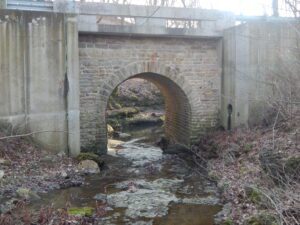
Listed on the National Register of Historic Places in 2009, the span is the oldest in Clark County a traveler can cross. It is also one of the oldest stone bridges in use in Ohio. Stone mason Samuel S. Taylor (1837-1930) built the culvert from locally quarried limestone in 1871, his first public works project. A Civil War veteran, Taylor worked on several projects, including the Mill Run underground sewer (1877), Champion’s East Street shops (1883), and the foundation for Springfield’s city hall (1890).
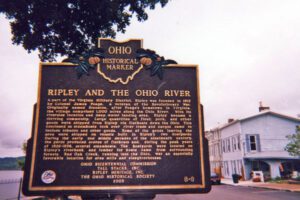
A part of the Virginia Military District, Ripley was founded in 1812 by Colonel James Poage, a veteran of the Revolutionary War. Originally named Staunton, after Poage’s hometown in Virginia, the village comprised 1,000 acres along the Ohio River. With its riverside location and deep water landing area, Ripley became a thriving community. Large quantities of flour, pork, and other goods were shipped from Ripley via flatboats down the Ohio. This continued as steamboats took over river trade and cargos came to include tobacco and other goods. Some of the goods leaving the area were shipped on vessels built in Ripley’s two boatyards. During the early and middle decades of the nineteenth century, the yards produced scores of flatboats and, during the peak years of 1826-1836, several steamboats. The boatyards were located on Ripley’s riverbank and lumber for boats came from surrounding forests. Red Oak Creek, running into the Ohio, was an especially favorable location for area mills and slaughterhouses.
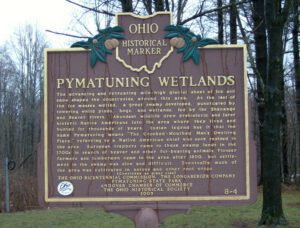
The advancing and retreating mile-high glacial sheet of ice and snow shaped the countryside around this area. As the last of the ice masses melted, a great swamp developed, punctuated by towering white pines, bogs, and wetlands, fed by the Shenango and Beaver rivers. Abundant wildlife drew prehistoric and later historic Native Americans into the area where they lived and hunted for thousands of years. Indian legend has it that the name Pymatuning means “The Crooked-Mouthed Man’s Dwelling Place,” referring to a Native American chief who once resided in the area. European trappers came to these swamp lands in the 1700s in search of beaver and other fur-bearing animals. Pioneer farmers and lumbermen came to the area after 1800, but settlement in the swamp was slow and difficult. Eventually much of the area was cultivated in onions and other root crops. (continued on other side)
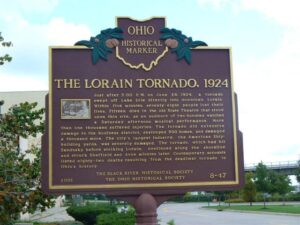
Just after 5:00 P.M on June 28, 1924, a tornado swept off Lake Erie directly into downtown Lorain. Within five minutes, seventy-eight people lost their lives. Fifteen died in the old State Theatre that stood upon this site, as an audience of two hundred watched a Saturday afternoon musical performance. More than one thousand suffered injuries. The tornado did extensive damage to the business district, destroyed 500 homes, and damaged a thousand more. The city’s largest industry, the American Shipbuilding yards, was severely damaged. The tornado, which had hit Sandusky before striking Lorain, continued along the shoreline and struck Sheffield and Avon minutes later. Contemporary accounts listed eighty-two deaths resulting from the deadliest tornado in Ohio’s history.
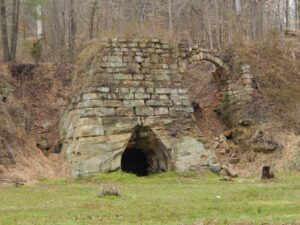
Olive Furnace in Lawrence County was one of 83 blast furnaces in the Hanging Rock iron-making region of southern Ohio and northern Kentucky. John Campbell (1808-1891), the “Father of Ironton,” and others established the furnace in 1846. The base of the furnace is carved out of rock and supported by Roman style arches. Only one of these arches remains some 170 years later. The furnace became a stop on the Underground Railroad. Conductors ushered escaping slaves through the area to points further north. The Olive Furnace was the last charcoal furnace to operate in Lawrence County. After seven decades of service, the furnace was sold and dismantled for scrap in 1915. Olive Furnace was listed on the National Register of Historic Places in 2007.
In 1918, Charles Young made a desperate attempt to convince the U.S. Army that he was fit for duty. The Army’s highest-ranking Black officer, he had been medically retired and not given a command during World War I. To demonstrate his fitness, he rode 497 miles from his home in Wilberforce, Ohio, to Washington, D.C. Leaving on June 6 he made the journey in 17 days, 16 on horseback and 1 resting. Averaging 31 miles each day, he rode 45 minutes and walked 15 minutes every hour. Upon his arrival, Young met with Secretary of War Newton Baker. Pressured by the Black press and the White House, Baker hedged. He recalled Young to active duty a year later and assigned him to Camp Grant, Illinois, just five days before the end of the war.