


, OH
Players of the Cleveland Browns gathered eleven Black professional athletes and future mayor Carl Stokes to discuss with boxer Muhammad Ali (January 17, 1942-June 3, 2016) his refusal to serve in the Vietnam War. After their private meeting on June 4, 1967, the twelve men decided to “support Ali on principle” and held a lengthy national press conference. The boxer, considered the “greatest heavyweight of all time,” garnered national scorn and paid a high price for his stance. Ali was arrested, found guilty of draft evasion, his passport confiscated, titles stripped, and U.S. boxing licenses suspended. The men in attendance also faced condemnation and threats. In 1971, the Supreme Court unanimously overturned Ali’s conviction. The Cleveland Ali Summit is considered “one of the most important civil rights acts in sports history.”
, OH
The Greater Abyssinia Baptist Church (GABC) organized with 250 members on December 16, 1945, at a Phillis Wheatley Association meeting. Led by its first pastor, Rev. John Rollins Plummer, the congregation raised $47,000 to purchase the Jewish Synagogue at East 105th Street and Tacoma Avenue from the Beth Hamedrosh Hagodel Beth Israel Congregation in 1946. It later purchased a parsonage, land for parking, and created a Federal Credit Union. Tragically, Rev. Plummer was killed in a car accident on October 22, 1951. The church’s lower auditorium was remodeled and dedicated as J.R. Plummer Memorial Hall. Honoring its missionary and pastoral care foundations, the church built a $3M senior citizens complex nearby. An endowment fund, instituted by its pastor’s savings in 1995, ensures that this commitment to civic leadership endures.
, OH
Acquiring the African American Cultural Garden was a struggle for equitable access to public space in Cleveland during the Civil Rights era. Between 1961 and 1977, Black Clevelanders sought space to celebrate Black pride and culture within Cleveland’s Cultural Gardens. Activists lobbied the Cultural Garden Federation, City Council, and engaged the Black community to acquire a garden space. When the African American Cultural Garden was dedicated on October 23, 1977, dignitaries from Ghana, Togo, Kenya, and Tanzania, were joined by national, state, and city officials to celebrate the first garden space assigned to a community of color.
, OH
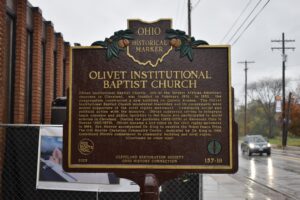
Olivet Institutional Baptist Church, one of the largest African American churches in Cleveland, was founded in February 1931. In 1950, the congregation constructed a new building on Quincy Avenue. The Olivet Institutional Baptist Church ministerial leadership and its congregants were ardent supporters of the civil rights movement. Combining social and political action with the ministry, Olivet supported sit-ins to integrate lunch counters and public facilities in the South and participated in social activism in Cleveland. During the pastorate (1952-1973) of Reverend Odie M. Hoover (1921-1973), Olivet became a key voice in the civil rights movement. In 1964, Rev. Hoover accompanied Dr. King to receive the Nobel Peace Prize. The O.M. Hoover Christian Community Center, dedicated by Dr. King in 1966, symbolized Olivet’s commitment to community building and civil rights. (Continued on other side)
, OH
The building at 1380 E. 6th Street, designed by Walker and Weeks, served as the Cleveland Board of Education 1931-2013. During the 1950s and 1960s, the segregation of Cleveland Public Schools was the center of the city’s civil rights movement. Parents, like Daisy Craggett and Eddie Gill, protested relay classes and intact busing. The United Freedom Movement, a coalition of 50 civic, religious, and parent organizations, initiated demonstrations, sit-ins, and pickets, to galvanize the fight for education equality. On April 7, 1964, Reverend Bruce Klunder, vice president of Cleveland’s Congress of Racial Equality, was accidentally killed by a bulldozer at the future Stephen E. Howe Elementary School while he lay in a construction ditch to protest school re-segregation. His death ignited an April 20 boycott in which 85-95% of Cleveland’s Black students participated. (Continued on other side)
, OH
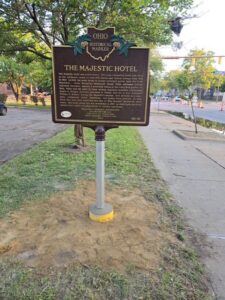
The Majestic Hotel was a five-story, 250-room residential hotel that stood on the northeast corner of East 55th Street and Central Avenue from 1902 to 1967. In 1924 the hotel began to accept overnight guests. Amid the Great Migration, owner Hungarian immigrant Joseph Weiss welcomed African American travelers, earning a perennial listing in the Green Book guides. In 1944, Weiss sold the hotel to three African American investors: businessman Alonzo G. Wright, attorney Lawrence O. Payne, and Call & Post publisher William O. Walker. During the Majestic’s heydey, such services as a pharmacy, restaurant, tailor, beautician, and barber were offered. Its Rose Room jazz club drew musicians and fans to “Blue Monday” parties for many years. The hotel closed and was demolished in 1967, as civil rights advances opened more public accommodations to African Americans.