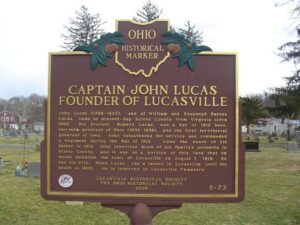
Lucasville Cemetery was originally established as the Lucas Family burying ground, with Susannah Lucas as the first recorded burial on May 4, 1809. Susannah’s husband, Captain William Lucas, a Revolutionary War veteran, is interred here along with the first wife of Governor Robert Lucas, Eliza “Betsy” Brown Lucas. By 1816, the cemetery was used as a public burying ground. Hand carved monuments inscribed with poetry can be found in the old section. Recognized as one of the oldest cemeteries in southern Ohio, Lucasville Cemetery has interred veterans of the Revolutionary War, War of 1812, Civil War, Spanish-American War, World Wars I and II, Korea, and Vietnam.
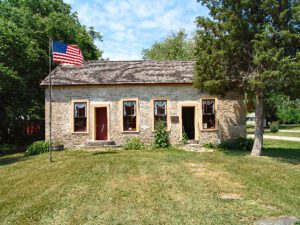
Built in 1822, this native limestone structure was the home of Benajah Wolcott, first keeper of the Marblehead Lighthouse (originally called the Sandusky Bay Light), and his second wife, Rachel Miller Wolcott. Benajah maintained the lighthouse from 1822 until his death ten years later. After Benajah’s passing the U.S. Government appointed Rachel as the keeper, making her the first female lighthouse keeper on the Great Lakes. The building is the oldest known residence still standing in Ottawa County and is a fine example of a “hall-and-parlor house,” an early American home design.
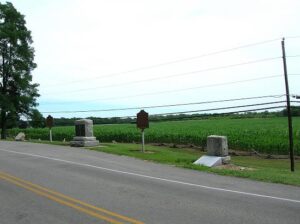
In the mid-1700s, France found its influence waning among midwestern tribes as it contested for Native American trade and military alliances with Great Britain. Shortly after Miami chief Memeskia (also known as Old Britain or La Demoiselle) moved his village to Pickawillany, British traders were given permission to establish a small post in the village, which was deep in the territory claimed by France. When French demands to evacuate the post failed, Charles Langlade led a party of 250 Ottawa and Ojibwe warriors and French Canadians in a surprise attack on the Miami village on June 21, 1752. The trading post was destroyed, British traders were taken to Detroit as prisoners, and Memeskia was executed. Pickawillany was completely abandoned soon after. As a prelude to the French and Indian War, the Battle of Pickawillany fueled land claim and trading right conflicts between France and Britain.
Following a wage reduction from 70 to 60 cents per ton after many Hocking Valley coal mines consolidated in 1883, the Ohio Miners’ Amalgamated Association struck on June 23, 1884. The operators responded by offering an even smaller tonnage rate and a requirement for returning miners to sign no-strike contracts. The strike idled three thousand miners in 46 mines at Nelsonville, Murray City, New Straitsville, Carbon Hill, Buchtel, Longstreth, and Shawnee. (Continued on other side)
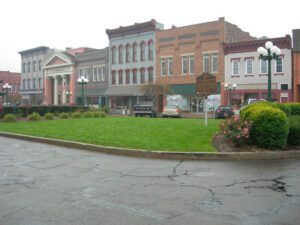
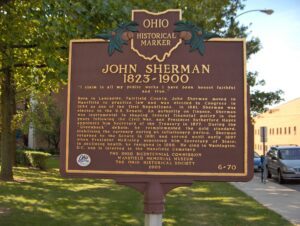
Born in Lancaster, Fairfield County, John Sherman moved to Mansfield to practice law and was elected to Congress in 1854 as one of the first Republicans. In 1861, Sherman was elected to the U.S. Senate. An authority on finance, Sherman was instrumental in shaping federal financial policy in the years following the Civil War, and President Rutherford Hayes appointed him Secretary of the Treasury in 1877. During the “Greenback” debate, he re-implemented the gold standard, stabilizing the currency during an inflationary period. Sherman returned to the Senate in 1881 and served until early 1897 when President McKinley appointed him Secretary of State; in declining health, he resigned in 1898. He died in Washington, D.C. and is interred in the Mansfield Cemetery.
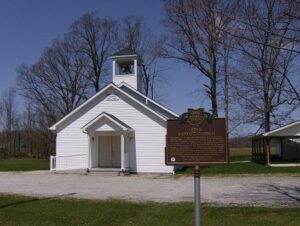
Thirteen African American families migrated to Pebble Township in Pike County in the early 1820s from Virginia. Some of the families were former slaves while others were freeborn people of color. Their farm knowledge and skill helped to make them prosperous, angering some of their white neighbors who began a campaign of harassment. Ten of the original African American settlers eventually moved away, but despite the difficulties with the white population, other African Americans continued to arrive to the settlement. They founded a church, later known as the Eden Baptist Church, built a meeting hall, and organized a school. Several of the families were also involved in the activity of the Underground Railroad. The PP Settlement thrived until the 1950s when, for economic reasons, residents moved to other communities.
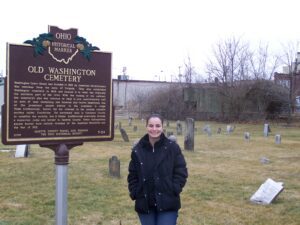
Washington Court House was founded in 1810 by American Revolutionary War veterans from the state of Virginia. They also established Washington Cemetery in 1810 and located it in what was originally the southern part of the town. With the coming of the railroad, the cemetery’s size was reduced to what is now approximately half an acre of land containing one hundred and twelve headstones. One of the prominent people buried in the cemetery is Judge Wade Loofborough, known for his interest in the utopian socialist society called Fourierism. He purchased land in Clermont County to establish the society, but it failed. Loofborough eventually became a respected judge and lawyer in Fayette County. Other distinguished people buried here include veterans of the American Revolution and the War of 1812.
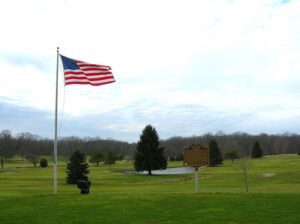
Golfer and World War II veteran William J. Powell, excluded from playing on many American golf courses because of his race, overcame the indignity of discrimination by creating his own course. Hand built in two years and opened in 1948, Clearview Golf Club is the first golf course in the United States designed, built, and owned by an African-American. The acclaimed course harmonizes with the landscape and bears many design elements of traditional British courses. A triumph of perseverance over discrimination, Clearview represents the historic postwar era when athletes first broke the “color line” in American sports.