Invited to speak at three Cleveland high schools, Dr. Martin Luther King Jr. delivered his powerful “Rise Up!” speech to students at Glenville High School on April 26, 1967. It signaled King’s opening drive to elect African Americans to prominent government positions in northern cities. Encouraging students to “develop a sense of somebodiness,” King challenged them to “work passionately and unrelentingly for first-class citizenship.” Recognizing the fear of racial unrest in the city, King underscored the significance of nonviolence. “Our power lies in our ability to say non-violently that we’re not going to take it any longer,” he asserted. Making Carl Stokes’ mayoral bid the focus of his push for Black voters to elect Black leaders, King urged Glenville’s students to join civil rights organizations and community action programs.
The Greater Abyssinia Baptist Church (GABC) organized with 250 members on December 16, 1945, at a Phillis Wheatley Association meeting. Led by its first pastor, Rev. John Rollins Plummer, the congregation raised $47,000 to purchase the Jewish Synagogue at East 105th Street and Tacoma Avenue from the Beth Hamedrosh Hagodel Beth Israel Congregation in 1946. It later purchased a parsonage, land for parking, and created a Federal Credit Union. Tragically, Rev. Plummer was killed in a car accident on October 22, 1951. The church’s lower auditorium was remodeled and dedicated as J.R. Plummer Memorial Hall. Honoring its missionary and pastoral care foundations, the church built a $3M senior citizens complex nearby. An endowment fund, instituted by its pastor’s savings in 1995, ensures that this commitment to civic leadership endures.
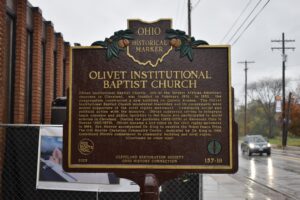
Olivet Institutional Baptist Church, one of the largest African American churches in Cleveland, was founded in February 1931. In 1950, the congregation constructed a new building on Quincy Avenue. The Olivet Institutional Baptist Church ministerial leadership and its congregants were ardent supporters of the civil rights movement. Combining social and political action with the ministry, Olivet supported sit-ins to integrate lunch counters and public facilities in the South and participated in social activism in Cleveland. During the pastorate (1952-1973) of Reverend Odie M. Hoover (1921-1973), Olivet became a key voice in the civil rights movement. In 1964, Rev. Hoover accompanied Dr. King to receive the Nobel Peace Prize. The O.M. Hoover Christian Community Center, dedicated by Dr. King in 1966, symbolized Olivet’s commitment to community building and civil rights. (Continued on other side)