

, OH
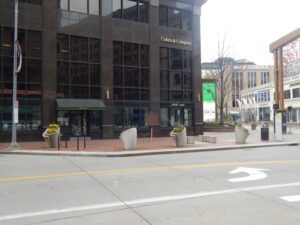
ʻAbdu’l-Bahá (1844-1921) visited Cleveland on His historic journeys to Europe and North America to proclaim the message of His Father, Baháʼu’lláh, Prophet-Founder of the Baháʼí Faith. Together they suffered 40 years of imprisonment and exile, which began in Persia with their support of the Báb, Baháʼu’lláh’s forerunner. In 1912, following His release from prison in Palestine, ʻAbdu’l-Bahá toured many American cities as Baháʼu’lláh’s designated successor. He spoke in Cleveland on May 6th and 7th, at the former Hotel Euclid and other sites, sharing this message: “The oneness of humankind will be a fact. The various religions shall be united, and the various races shall be known as one kind. The Orient and the Occident shall be united and the banner of international peace shall be unfurled. The world shall find peace and the equality and rights of men shall be established.” Since His visit, the Baháʼí Faith has gained millions of followers, and it has been established in most countries and territories of the world.
, OH
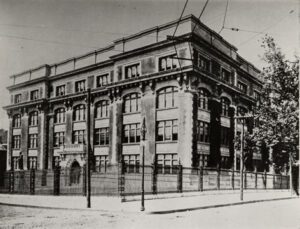
William and Abigail Cutter Woodward founded Woodward High School, the first public high school west of the Allegheny Mountains, on this site October 24, 1831. Concerned that the poor of Cincinnati had no avenues for education, the Woodwards donated land, time, funding, and expertise to this venture that brought the arts and sciences to “those who have not the means of procuring such advantages themselves.” Notables include Dr. Joseph Ray, principal, 1851-1855, author of several popular mathematics texts; Professor William McGuffey, author of the well-known readers and spellers; and William Howard Taft, Class of 1874, former U.S. President. From 1856-1863, the home of Levi and Catherine Coffin was also located on this site. Both were legendary abolitionishts who helped enslaved people escape to freedom in Canada. Levi is often referred to as the “President of the Underground Railroad.”
, OH
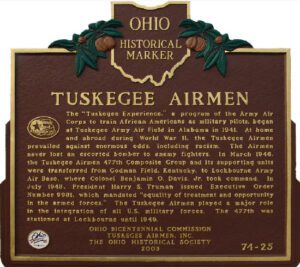
The “Tuskegee Experiment,” a program of the Army Air Corps to train African Americans as military pilots, began at Tuskegee Army Air Field in Alabama in 1941. At home and abroad during World War II, the Tuskegee Airmen prevailed against enormous odds, including racism. The Airmen never lost an escorted bomber to enemy fighters. In March 1946, the Tuskegee Airmen 477th Composite Group and its supporting units were transferred from Godman Field, Kentucky, to Lockbourne Army Air Base, where Colonel Benjamin O. Davis, Jr. took command. In July 1948, President Harry S. Truman issued Executive Order Number 9981, which mandated “equality of treatment and opportunity in the armed forces.” The Tuskegee Airmen played a major role in the integration of all U.S. military forces. The 477th was stationed at Lockbourne until 1949.
, OH
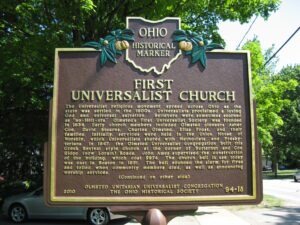
The Universalist religious movement spread across Ohio as the state was settled in the 1800s. Universalists proclaimed a loving God and universal salvation. Believers were sometimes scorned as “no-Hell-ers.” Olmsted’s First Universalist Society was founded in 1834. Early church members included Olmsted pioneers Asher Coe, David Stearns, Charles Olmsted, Elias Frost, and their families. Initially, services were held in the Union House of Worship, which Universalists shared with Methodists and Presbyterians. In 1847, the Olmsted Universalist congregation built this Greek Revival style church at the corner of Butternut and Coe Ridge (now Lorain) Roads. John Ames supervised the construction of the building, which cost $974. The church bell in use today was cast in Boston in 1851. The bell sounded the alarm for fires and tolled when community members died, as well as announcing worship services.
, OH
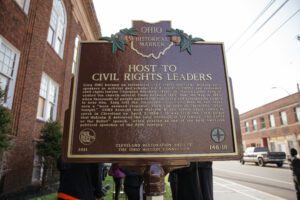
Cory United Methodist Church is an icon of Cleveland’s civil rights movement. As one of the city’s largest Black-owned churches during the 1960s, Cory hosted events for national, local, and grassroots organizations such as the Fair Employment Practices Committee, NAACP Cleveland Branch, Cleveland Chapter of the Congress of Racial Equality (CORE), and United Freedom Movement. Over 75 years later, Cory UMC continues its long tradition of community programming that promotes equity and education. Originally designed by architect Albert F. Janowitz to house the Anshe Emeth Beth Tefilo congregation, the building served as the Cleveland Jewish Center from 1922 to 1945. The Methodist congregation purchased it in 1946. Since 1961, the building has also been home to the Glenville Recreation Center. Cory UMC was designated as a local landmark by the Cleveland Landmarks Commission in 2012.
, OH
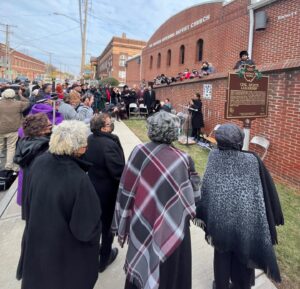
The Greater Abyssinia Baptist Church (GABC) organized with 250 members on December 16, 1945, at a Phillis Wheatley Association meeting. Led by its first pastor, Rev. John Rollins Plummer, the congregation raised $47,000 to purchase the Jewish Synagogue at East 105th Street and Tacoma Avenue from the Beth Hamedrosh Hagodel Beth Israel Congregation in 1946. It later purchased a parsonage, land for parking, and created a Federal Credit Union. Tragically, Rev. Plummer was killed in a car accident on October 22, 1951. The church’s lower auditorium was remodeled and dedicated as J.R. Plummer Memorial Hall. Honoring its missionary and pastoral care foundations, the church built a $3M senior citizens complex nearby. An endowment fund, instituted by its pastor’s savings in 1995, ensures that this commitment to civic leadership endures.
, OH
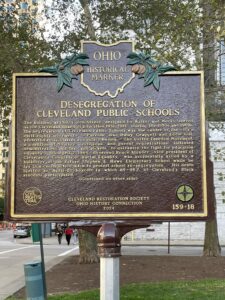
The building at 1380 E. 6th Street, designed by Walker and Weeks, served as the Cleveland Board of Education 1931-2013. During the 1950s and 1960s, the segregation of Cleveland Public Schools was the center of the city’s civil rights movement. Parents, like Daisy Craggett and Eddie Gill, protested relay classes and intact busing. The United Freedom Movement, a coalition of 50 civic, religious, and parent organizations, initiated demonstrations, sit-ins, and pickets, to galvanize the fight for education equality. On April 7, 1964, Reverend Bruce Klunder, vice president of Cleveland’s Congress of Racial Equality, was accidentally killed by a bulldozer at the future Stephen E. Howe Elementary School while he lay in a construction ditch to protest school re-segregation. His death ignited an April 20 boycott in which 85-95% of Cleveland’s Black students participated. (Continued on other side)