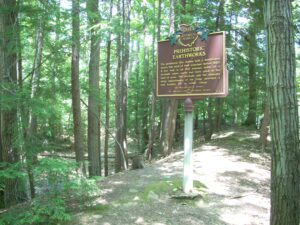
The prehistoric Erie Indians built a fortification across this neck of land sometime before 1650. A low wall is all that remains today of a stockade where earth had been piled at the base of posts. The stockade and the naturally steep embankments of the ridge provided a safe location for an Indian village.
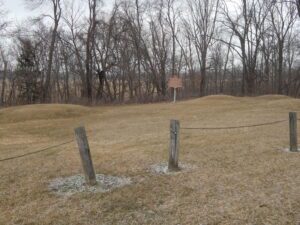
The Nettle Lake Mound Group consists of 4 low mounds overlooking a stream that runs into Nettle Lake. The mounds vary in height from 1 to 3 feet and in diameter from 18 to 30 feet. The mounds are composed primarily of reddish-brown sand (secondary mound) covering a layer of darker sand and loam (primary mound). These mounds have been partially excavated in the past by pot hunters in search of relics. Although the records of these excavations are vague and incomplete, pottery fragments, burials, and flint artifacts found in the mounds indicate that they were constructed by the Hopewell Indians.
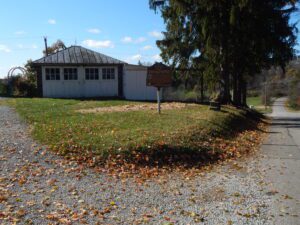
These structures stand as an exception to the usual wood frame or brick construction of farm buildings in this region in the late nineteenth century. The house and barn, built circa 1871 and 1883-1885 respectively, reflect Frederick Kindelberger’s (1835-1911) creativity and vision to instill a responsibility to the land. The Kindelberger family purchased the farm in 1846, after they had emigrated from Alsace-Lorraine. The walls of the barn were created using a distinct architectural design, whereas they taper from 25 inches thick at the base to 12 inches thick at the top. Stonemasons and family members labored using sandstone, which was quarried on the eighty-acre farm, to construct the buildings. Due to their stone construction, the house and barn were placed on the National Register of Historic Places in 1980.
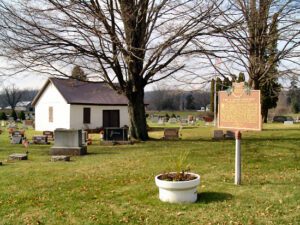
Earl Sloan’s accumulation of a fortune from the formulation and sale of “Sloan’s Liniment” resulted in the creation of a living legacy. To “honor the place of his nativity” Dr. Earl Sloan donated funds to build the Sloan Library for the people of Zanesfield. With a wish to teach boys and girls “trades, mechanical and domestic science,” he also provided for the establishment of the Sloan Industrial School. Dr. Sloan’s vision for the future continues to aid and inspire young people today as they benefit from educational opportunities made possible through his generosity.
The landscape of northwest Ohio was formed by melting ice and the glacial lakes left behind in its wake. Because of the low gradient (3 feet fall per mile) to the northeast, the flat lacustrine plain evolved into a large swamp. A massive swamp forest with huge hardwoods, broken only sporadically with intermittent wet prairies and savannahs, dominated the landscape. Both prehistoric and historic Indians farmed the flood plains of the Maumee River and its tributaries: Auglaize, Tiffin, and Blanchard rivers. (continued on other side)
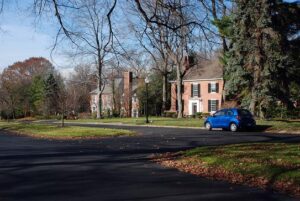
Youngstown’s earliest automobile suburb, Forest Glen Estates was developed in the 1920s during a period of change in urban transportation patterns and rapid expansion in the regional steel economy. A composite of design work by leading northeastern Ohio landscape and residential architects, the park-like suburb integrates period revival architecture into the natural landscape and blends gracefully with adjacent Mill Creek Park. Gently curving streets with low curbs and landscaped islands were a novel departure from traditional grid patterns. Attached garages and walkways that connect to driveways rather than the street reflect the influence of the personal automobile in the suburban landscape during this era. In 1998, the Forest Glen Estates Historic District was listed on the National Register of Historic Places.
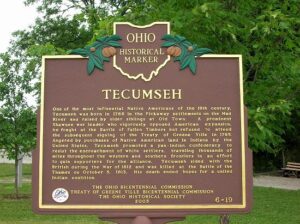
One of the most influential Native Americans of the 19th century, Tecumseh was born in 1768 in the Pickaway settlements on the Mad River and raised by older siblings at Old Town. A prominent Shawnee war leader who vigorously opposed American expansion, he fought at the Battle of Fallen Timbers but refused to attend the subsequent signing of the Treaty of Greene Ville in 1795. Angered by purchases of Native American land in Indiana by the United States, Tecumseh promoted a pan-Indian confederacy to resist the encroachment of white settlers, traveling thousands of miles throughout the western and southern frontiers in an effort to gain supporters for the alliance. Tecumseh sided with the British during the War of 1812 and was killed at the Battle of the Thames on October 5, 1813. His death ended hopes for a united Indian coalition.
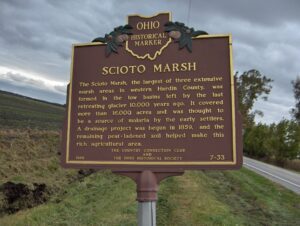
The Scioto Marsh, the largest of three extensive marsh areas in western Hardin County, was formed in the low basins left by the last retreating glacier 10,000 years ago. It covered more than 16,000 acres and was thought to be a source of malaria by the early settlers. A drainage project was begun in 1859, and the remaining peat-ladened soil helped make this rich agricultural area.