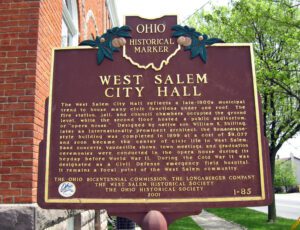
The West Salem City Hall reflects a late-1800s municipal trend to house many civic functions under one roof. The fire station, jail, and council chambers occupied the ground level, while the second floor hosted a public auditorium, or “opera house.” Designed by native son William K. Shilling, later an internationally prominent architect, the Romanesque-style building was completed in 1899 at a cost of $9,077 and soon became the center of civic life in West Salem. Band concerts, vaudeville shows, town meetings, and graduation ceremonies were conducted in the opera house during its heyday before World War II. During the Cold War it was designated as a Civil Defense emergency field hospital. It remains a focal point of the West Salem community.
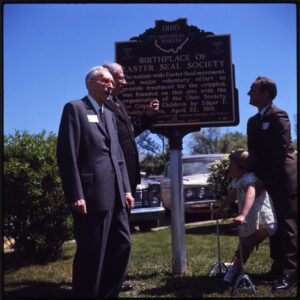
The nation-wide Easter Seal movement, first major voluntary effort to provide treatment for the crippled, was founded on this site with the organization of the Ohio Society for Crippled Children by Edgar F. (Daddy) Allen, April 22, 1919.
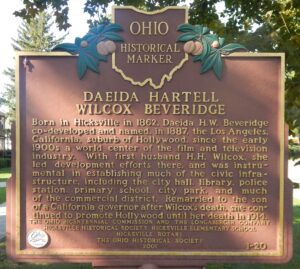
Born in Hicksville in 1862, Daeida H.W. Beveridge co-developed and named, in 1887, the Los Angeles, California, suburb of Hollywood, since the early 1900s a world center of the film and television industry. With first husband H.H. Wilcox, she led development efforts there, and was instrumental in establishing much of the civic infrastructure, including the city hall, library, police station, primary school, city park, and much of the commercial district. Remarried to the son of a California governor after Wilcox’s death, she continued to promote Hollywood until her death in 1914.
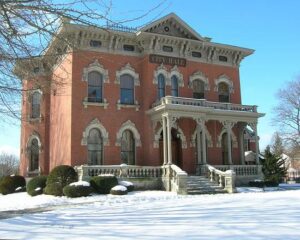
This ornate Victorian/Italianate house was constructed in 1871 as the home of Henry Bishop Perkins, Sr., a civic, business, and political leader of the Western Reserve. During the 19th and early 20th century political figures such as U.S. Grant, James A. Garfield, Rutherford B. Hayes, Benjamin Harrison and William McKinley were visitors to this house.
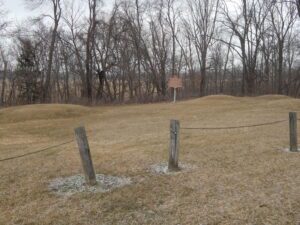
The Nettle Lake Mound Group consists of 4 low mounds overlooking a stream that runs into Nettle Lake. The mounds vary in height from 1 to 3 feet and in diameter from 18 to 30 feet. The mounds are composed primarily of reddish-brown sand (secondary mound) covering a layer of darker sand and loam (primary mound). These mounds have been partially excavated in the past by pot hunters in search of relics. Although the records of these excavations are vague and incomplete, pottery fragments, burials, and flint artifacts found in the mounds indicate that they were constructed by the Hopewell Indians.
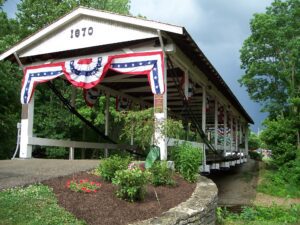
Restored in 1963, the Germantown Covered Bridge on East Center Street, spanning Little Twin Creek, was 93 years old and is reputed to be the only existing covered bridge of its kind in the world. For 41 years this unique inverted bow string truss covered bridge spanned Little Twin Creek on the Dayton Pike in Germantown, Ohio. In 1911 it was removed to its present location where it has been restored and beautified as a link with Ohio’s early history. It is a symbol of individual initiative in America’s early history.
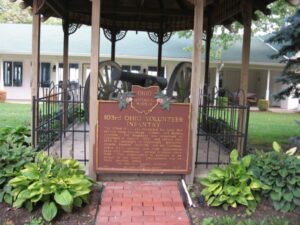
The 103rd O.V.I. was recruited for Civil War service from Cuyahoga, Lorain, and Medina counties. The Regiment was organized at Cleveland in August, 1862, and served until 1865 in campaigns at Cincinnati, Knoxville, Atlanta, Franklin, Nashville, and the Carolinas.103rd O.V.I. veterans and their descendants have held continuous, annual reunions since 1867. The organization is believed to be unique in the nation. Descendants live on these grounds today.
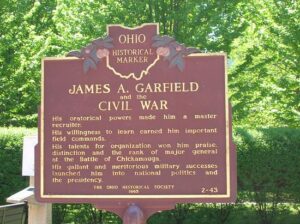
His oratorical powers made him a master recruiter. His willingness to learn earned him important field commands. His talents for organization won him praise, distinction and the rank of major general at the Battle of Chickamauga. His gallant and meritorious military successes launched him into national politics and the presidency.