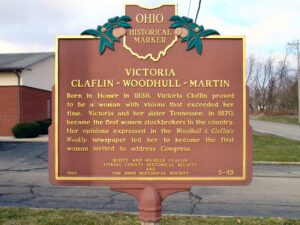
Born in Homer in 1838, Victoria Claflin proved to be a woman with visions that exceeded her time. Victoria and her sister Tennessee, in 1870, became the first women stockbrokers in the country. Her opinions expressed in the Woodhull & Claflin’s Weekly newspaper led her to become the first woman invited to address Congress.
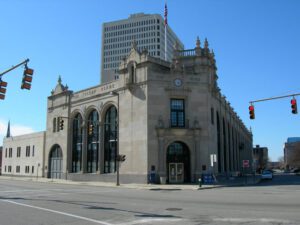
The Toledo Blade is the city’s oldest continuing business. The newspaper was first published on December 19, 1835, during the Ohio-Michigan boundary dispute known as the “Toledo War.” The name is derived from that conflict and the famous swords of Toledo, Spain. A copy of the first edition and two gift swords from that Spanish city are displayed inside the Blade Building.
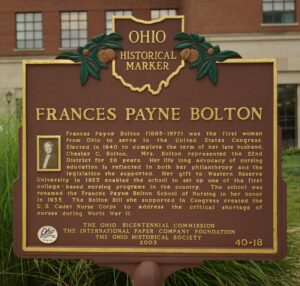
Frances Payne Bolton (1885-1977) was the first woman from Ohio to serve in the United States Congress. Elected in 1940 to complete the term of her late husband, Chester C. Bolton, Mrs. Bolton represented the 22nd District for 28 years. Her life long advocacy of nursing education is reflected in both her philanthropy and the legislation she supported. Her gift to Western Reserve University in 1923 enabled the school to set up one of the first college-based nursing programs in the country. The school was renamed the Frances Payne Bolton School of Nursing in her honor in 1935. The Bolton Bill she supported in Congress created the U.S. Cadet Nurse Corps to address the critical shortage of nurses during World War II.
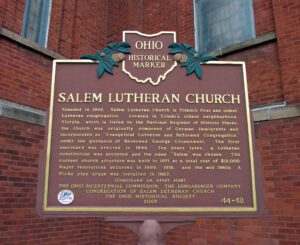
Founded in 1842, Salem Lutheran Church is Toledo’s first and oldest Lutheran congregation. Located in Toledo’s oldest neighborhood, Vistula, which is listed on the National Register of Historic Places, the church was originally composed of German immigrants and incorporated as “Evangelical Lutheran and Reformed Congregation” under the guidance of Reverend George Cronenwett. The first sanctuary was erected in 1844. Ten years later, a Lutheran constitution was accepted and the name “Salem” was chosen. The current church structure was built in 1871at a total cost of $12,000. Major renovations occurred in 1889, 1916, and the mid 1960s. A Wicks pipe organ was installed in 1967. (continued on other side)
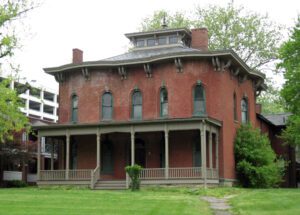
The Cozad-Bates House is one of the oldest remaining structures in Cleveland’s University Circle. The original section, built circa 1853, is the only pre-Civil War residential structure left in the neighborhood. Built by Samuel and Jane Cozad’s son, Andrew Cozad, the first section used locally made brick to form a simple two-story, one-room-deep, vernacular English-I house. The family owned a large portion of the land which is now occupied by University Circle. Justus Cozad, Andrew’s son, returning from the west where he worked as a railroad superintendent and civil engineer, built the later section on Mayfield Road for his larger family in 1872. It is a rare surviving example of Italianate-influenced residential architecture, including a hipped roof, curved bay windows, paired eave brackets, and prominent belvedere. The house was listed on the National Register of Historic Places in 1974 and designated as a Cleveland Landmark in 2006.
“Uncle” George Lathrop Cooley (1861-1939) was known as the “Champion of the Farmer” for his advocacy on behalf of rural interests. He was born on a farm at the northwest corner of Dover and Hilliard Roads in Dover Township (Westlake). He attended area schools and Ohio Northern University and, in 1887, married Clara Hall. Cooley served as Dover Township trustee from 1901-1905 and as president of Dover’s village council in 1916. Cooley’s interest in better roads led him to supervise the hard-surfacing of Dover Center Road, which ran by his house. From about 1900 to 1913, he was involved in road construction and helped to organize state highway departments in Ohio, Louisiana and California. (Continued on other side)
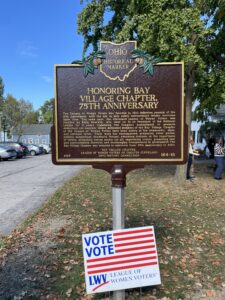
The Bay Village Chapter of the League of Women Voters was established in Spring 1948, with Dorothy M. Austin as president. The goal of the chapter was to ensure all citizens of Bay Village had the information they needed to cast an educated vote. They first met in the Cahoon family homestead, which then served as the city library and later as Rose Hill Museum. Gladys H. Luecke led the group on its first study, a city charter form of government for the village. Voters approved the charter on April 12, 1949, and the Village of Bay officially became the “City of Bay Village” in 1951. Since its founding, the Bay Village Chapter has made an educated voter its first priority by supporting citizen participation in government and influencing public policy through education and advocacy.