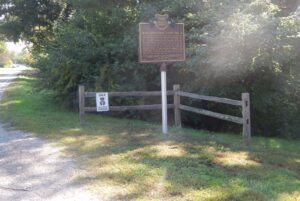
After completing Fort Winchester, Brigadier General James Winchester ordered his troops to cross to the north side of the Maumee River. The troops occupied the new site, Camp #2, from November 3-10, 1812. An earthen fortification was built for protection. Militia soldier Elias Darnell recorded on November 4th that “The weather is very rainy, which makes our situation extremely unpleasant…. Four of this army have gone to the silent tomb to-day never more to visit their friends in Kentucky; the fever is very prevalent in camp; nearly every day there is one or more buried.” Winchester referred to a burial place for the encampment in his General Orders for November 5th. Camp #2 proved to be too wet and marshy, Winchester ordered his army to move to six miles down river to a site called Camp #3.
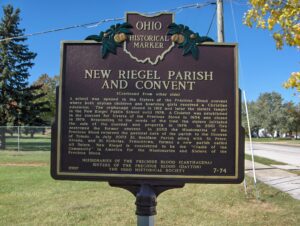
St. Boniface Catholic Church began in 1834 as a mission of several area churches and in 1836, the parish built its first church. In 1844 Bishop John Purcell commissioned Swiss born, Father Francis de Sales Brunner, a Missionary of the Precious Blood, to take pastoral charge of St. Boniface. Under the leadership of Father Brunner, the Missionaries of the Precious Blood, established in Italy in 1815, and the Sisters of the Precious Blood, founded in Switzerland in 1834, began ministry here in New Riegel (Wolfscreek) in 1844. Over two hundred acres of land were purchased for the priests, brothers, and sisters. The Missionaries brought spiritual support, farm labor, and education to the German immigrants of New Riegel. The sisters began their ministry of prayer in the convent, Mary at the Crib, on December 22, 1844. (Continued on other side)
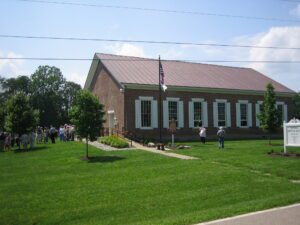
The Hopewell Associate Reformed Church and Cemetery, now known as Historic Hopewell, was founded in 1808 in a log building that was replaced in 1826 with the present building. It was built by the area’s first settlers, mainly Scotch-Irish who left Kentucky and South Carolina because of their opposition to slavery. The church encouraged worship by African Americans and played an important role in the Underground Railroad. It became the parent church for four “Daughter” Presbyterian congregations: Fairhaven in 1835, Oxford in 1837, College Corner in 1849, and Morning Sun in 1876. Reverend Alexander Porter, the first pastor, was committed to education and constructed a school near the Hopewell Spring that still produces clear water. “Old Hopewell” was completely refurbished in 1880, but by 1915 the membership declined and regular services discontinued. Today Hopewell holds Sunday services in the summer and is maintained by a generous and devoted group of volunteers.
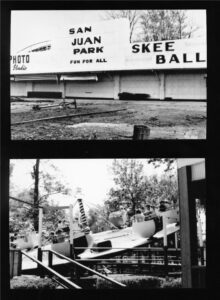
Nicknamed “Ohio’s Million Dollar Playground” or “Atlantic City of the Midwest,” Sandy Beach Amusement Park opened here on May 29, 1924. The park at Indian Lake featured a 2,000-foot long roller coaster and other popular rides, a boardwalk, and the Minnewawa Dance Hall. The Minnewawa and its succeeding dance pavilions hosted the greatest names of the Big Band era, and thousands of people came from all over Ohio to listen and dance to these popular entertainers. Societal turmoil and rioting in the 1960s affected the popularity of the park. Diminishing crowds, plus competition from larger theme parks such as Cedar Point and Kings Island, led to the park closing in the early 1970s. The lone remnant of the park is the steel arch bridge that spans the harbor.
William McKinley was the 25th President of the United States. Following McKinley’s assassination in 1901, the Village of Jackson dedicated this triangle of land as a park in his honor. Earlier in the nineteenth century, a small school had occupied the plot. In 1902, a local commission was appointed to oversee the development of a park. It was not, however, until 2012 that the Jackson Garden Lovers Club finished the commission’s long overdue work. The park was dedicated in 2013, 111 years after it began.
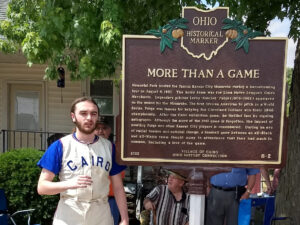
Memorial Park hosted the famous Kansas City Monarchs during a barnstorming tour on August 4, 1961. The home team was the Lima Metro League’s Cairo Merchants. Legendary pitcher Leroy “Satchel” Paige (1906-1982) appeared on the mound for the Monarchs. The first African American to pitch a World Series, Paige was famous for helping the Cleveland Indians win their 1948 championship. After the Cairo exhibition game, he thrilled fans by signing autographs. Although the score of the 1961 game is forgotten, the impact of meeting Paige and other Kansas City players is remembered. During an era of racial tension and national change, a baseball game between an all-Black and all-White team taught many in attendance that they had much in common, including a love of the game.
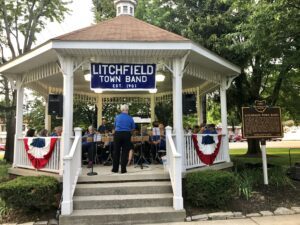
Around 1900, the newly formed Litchfield Cemetery and Park Association needed a band to lead processions to and from the town cemetery on Memorial Day. The Litchfield Town Band was born. Urial Crow served as its first director, so the group was sometimes known as “The Crow Band”. Although there were periods when the band was inactive, it has been a community institution for more than a century. The group plays a broad repertoire of standards and marches by John Philip Sousa at Memorial Day and other commemorations, ice cream socials, and various community events. Directors have included Urial Crow, Loren Hayes (c. 1915), Floyd Koons (mid-1920s), Raymond Bradley (1935-1939), Hal Leach (1939-1945), Kenneth Bradley (1946-2011) and Cynthia Bennett (since 2012).
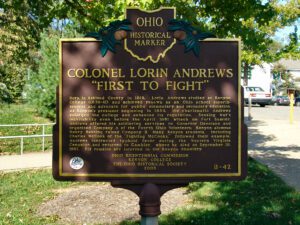
Born in Ashland County in 1819, Lorin Andrews studied at Kenyon College (1838-41) and achieved renown as an Ohio school superintendent and advocate for public elementary and secondary education. As Kenyon’s president beginning in 1854, the charismatic Andrews enlarged the college and enhanced its reputation. Sensing war’s inevitability even before the April 1861 attack on Fort Sumter, Andrews offered his soldiering services to Governor Dennison and organized Company A of the Fourth Ohio Volunteers; Kenyon alumnus Henry Banning raised Company B. Many Kenyon students, including Charles McCook of the “Fighting McCooks,” followed their example. Andrews contracted typhoid fever during the Western Virginia Campaign and returned to Gambier, where he died on September 18, 1861. His remains are interred in the Kenyon cemetery.