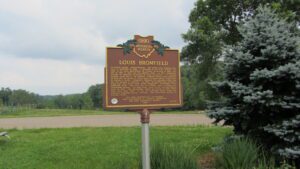
Acclaimed author, conservationist, and farmer Louis Bromfield was born in Mansfield in 1896. A graduate of the city’s schools, he went on to study agriculture at Cornell University in 1914, but left in 1915 to help run his family’s farm. In 1916, Bromfield enrolled in Columbia University to study journalism. As America entered World War I, he enlisted in United States Army Ambulance Service and saw action in seven major European battles. Determined to become a writer, Bromfield finished his education after the war and became a reporter. In 1921, he married Mary Appleton Wood and they would have three daughters. Bromfield’s first published novel, the Green Bay Tree (1924), was a critical and commercial success; his third novel, Early Autumn, won the Pulitzer Prize in 1927. The Bromfields moved to France in 1925 where they lived until 1938. In all, he published thirty books and authored numerous stories, articles, and screenplays during his writing career.
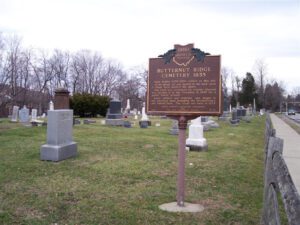
Isaac Scales (1786-1821) settled on this site. At his death, he was buried in his back yard. A large rock marked his grave. The land was reclaimed by Charles Olmsted who deeded it to the Township in 1835 for a public burial ground. Early settlers and veterans, who fought in six American wars including the Revolutionary, are buried here. The crypt was built in 1879.
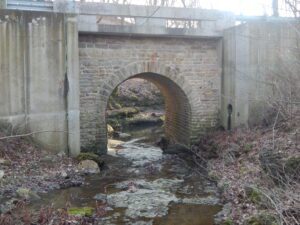
Listed on the National Register of Historic Places in 2009, the span is the oldest in Clark County a traveler can cross. It is also one of the oldest stone bridges in use in Ohio. Stone mason Samuel S. Taylor (1837-1930) built the culvert from locally quarried limestone in 1871, his first public works project. A Civil War veteran, Taylor worked on several projects, including the Mill Run underground sewer (1877), Champion’s East Street shops (1883), and the foundation for Springfield’s city hall (1890).
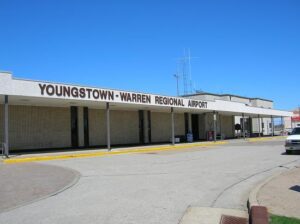
Born on April 18, 1913, in Barrea, Province L’Aquila Abruzzi, Italy to Salvatore and Maria (Lombardozzi) Campana, Mary Ann Campana immigrated to the United States with her parents at age eight. Raised in Youngstown and educated in the Youngstown Public Schools and Youngstown College, Ms. Campana was a pioneer in Ohio, National, and international aviation. In 1932, at age eighteen, she achieved the distinction of being the first licensed woman pilot in Ohio. On June 4, 1933, with only 44 hours of prior flying time, Mary Ann established the world’s endurance record in the Light plane class for a non-refueled flight. Flying above Youngstown in a 500-pound Taylor Cub Plane with a 40-horsepower engine and loaded with 40 gallons of gasoline, she flew for 12 hours and 27 minutes without a parachute, breaking the old record by one hour and ten minutes before electrical storms forced her down. (Continued on other side)
(Stout Post Office) A thriving riverport in the 19th Century, founded in 1835 by William Stout. Elisha Stout, son of William, born and raised here, was one of the founding fathers of Omaha, Nebraska, and Denver, Colorado. Former site of Adamsville which served as the county seat of Adams County from Dec., 1797, to Dec., 1798. A log courthouse and jail were erected here to serve the public.
This site is dedicated to Dominick Labino, 1910-1987, glass scientist, engineer, artist, and inventor. Credited with 57 patents, Mr. Labino invented pure silica fiber which was used in insulating tiles covering the space shuttle Columbia and the Apollo, Mercury, and Gemini spacecraft. As a glass artist, Labino was co-founder of the studio glass movement in America. His art works are in over 60 museums in the U.S. and abroad, and his architectural elements of hot cast panels are in many public buildings. His forte was original formulation of glass of high quality, durability, and unusual color effects. A resident of Grand Rapids since 1956, he was a benefactor and warm friend to the village.
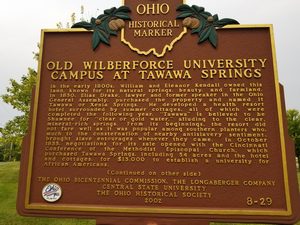
In the early 1800s, William and Eleanor Kendall owned this land, known for its natural springs, beauty, and farmland. In 1850, Elias Drake, lawyer and former speaker in the Ohio General Assembly, purchased the property and named it Tawana or Xenia Springs. He developed a health resort hotel surrounded by summer cottages, all of which were completed the following year. “Tawana” is believed to be Shawnee for “clear or gold water,” alluding to the clear, mineral-rich springs. From its beginnings, the resort did not fare well as it was popular among southern planters who, much to the consternation of nearby antislavery sentiment, brought slave entourages whenever they came. In October 1855, negotiations for its sale opened with the Cincinnati Conference of the Methodist Episcopal Church, which purchased Tawana Springs, including 54 acres and the hotel and cottages, for $13,000 to establish a university for African Americans. (Continued on other side)
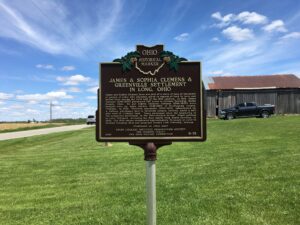
James and Sophia Clemens’ lives are part of a story of tens of thousands of people of color who migrated north in search of land to farm and better lives during the first half of the 19th century. In 1818, James Clemens (1781-1870) purchased 387 acres in German Township, Darke County, Ohio. He and Sophia (Sellers) Clemens (1786-1875) were brought here by Adam Sellers (1742-1821) of Rockingham County, Virginia. In 1822, Thornton Alexander (1783-1851), emancipated by A. Sellers, purchased land in Randolph County, Indiana, about a half mile west of Clemens’ land. These purchases were the beginning of the Greenville Settlement on the Ohio-Indiana border. Other settlers of color followed, including the Bass family from North Carolina, in 1828. The 1830 census enumerated approximately 78 people of color in German Township Ohio and adjacent Green’s Fork Township, Indiana. (Continued on other side)