

, OH
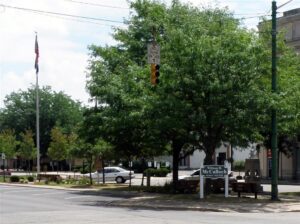
William McCulloch was born in Holmes County where he was educated in a one-room schoolhouse before moving to Wooster to attend high school and the College of Wooster. He attained prominence as Ohio’s Speaker of the House from 1939-1943 and House member from the Fourth Ohio Congressional District from 1948-1973. During his time in Washington, McCulloch was best known as a co-sponsor and staunch advocate of the Civil Rights Act of 1964. He was recognized by President Lyndon Johnson as the prime mover for passage of this landmark legislation. As a conservative Republican voice in the House, he was instrumental in championing other civil rights legislation, including fair housing and public accommodations. McCulloch was a founding partner in 1928 of the Piqua law firm that bears his name.

, OH
Ohio’s oldest surviving municipal market house, Findlay Market was designed under the direction of City Civil Engineer Alfred West Gilbert (1816-1900). It was listed on the National Register of Historic Places in 1972. The structure was among the first market houses in the United States to use iron frame construction technology. Originally an open pavilion, much of the market was erected in 1852, but disputes with contractors delayed its opening until 1855. The center masonry tower was built in 1902. Soon after, public health concerns prompted enclosure of the market stalls and the addition of plumbing and refrigeration. Until then, vendors found cool storage in deep cellars beneath nearby breweries. The tower bell was brought from Cincinnati’s Pearl Street Market in 1934. Findlay Market was renovated in 1973-74 and again in 2002-03.
, OH
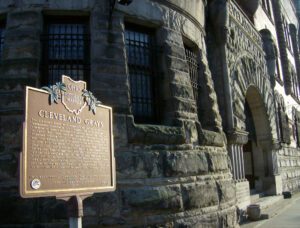
The Cleveland Grays were organized by statute in 1837 as an independent volunteer militia company. The Grays were the first company to leave Cleveland for service during the Civil War. In April 1861, they were designated Company E, 1st Ohio Volunteer Infantry (OVI). They saw action at Vienna Station and First Manassas and also served in the 84th OVI and were on duty with the 150th OVI at Fort Stephens when Confederate General Jubal Early attacked Washington in the summer of 1864. During the Spanish-American War the Grays volunteered for service and were admitted to the National Guard as the 1st Battalion of Engineers, 10th OVI. In 1916, they joined General John J. Pershing’s Punitive Expedition against Mexico. After service on the Mexican border, the Grays became part of the 1st Battalion, 148th Infantry Regiment, 37th “Buckeye” Division. (continued on other side)
, OH
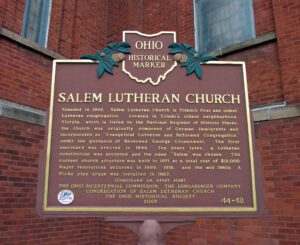
Founded in 1842, Salem Lutheran Church is Toledo’s first and oldest Lutheran congregation. Located in Toledo’s oldest neighborhood, Vistula, which is listed on the National Register of Historic Places, the church was originally composed of German immigrants and incorporated as “Evangelical Lutheran and Reformed Congregation” under the guidance of Reverend George Cronenwett. The first sanctuary was erected in 1844. Ten years later, a Lutheran constitution was accepted and the name “Salem” was chosen. The current church structure was built in 1871at a total cost of $12,000. Major renovations occurred in 1889, 1916, and the mid 1960s. A Wicks pipe organ was installed in 1967. (continued on other side)
, OH
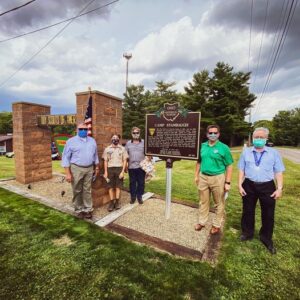
The Boy Scouts of America began in 1910, and by 1912, Scouting was established in the Mahoning Valley. Camp Stambaugh opened in July 1919, thanks to a gift from the estate of prominent local industrialist Henry H. Stambaugh (1858-1919). In his will he had named his friend and business partner Phillip J. Thompson as trustee of Stambaugh’s 86.5 acre Indian Creek Farm. Stambaugh’s expectation was that Thompson would convey the property to the local Scouting organization. In 1919 the property was mostly a treeless pasture and one could see Indian Creek from Stambaugh’s hay barn near Leffingwell Road. That first summer a Council Ring was carved from an old limestone quarry just north of the creek. (Continued on other side)
, OH
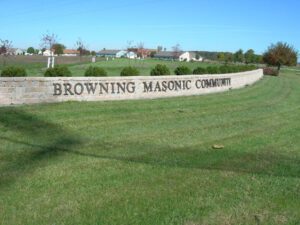
This location was selected in 1936 for a Memorial Home for aged Masons, at the wishes of Otis Avery Browning. Browning, a prominent Toledo businessman, book publisher, civic leader, and Mason, set forth the plans for this Home in a will he prepared in 1922, creating a trust for the Otis Avery Browning Masonic Memorial Fund. His will states, “It is one of the chief purposes of my will, that I may become an instrument, under God’s directing care, in providing for the erection and maintenance of a home for aged people, where they may be properly cared for and with all modern comforts.”
, OH
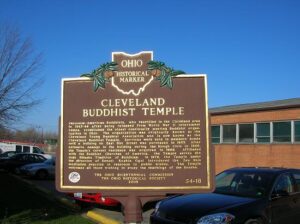
Japanese-American Buddhists, who resettled in the Cleveland area in 1943-44 after being released from World War II internment camps, established the oldest continually meeting Buddhist organization in Ohio. The organization was originally known as the Cleveland Young Buddhist Association and is now known as the Cleveland Buddhist Temple. Services were held in members’ homes until a building on East 81st Street was purchased in 1955. After extensive damage to the building during the Hough riots in 1966, the Temple’s current residence was acquired in 1968. Affiliated with the Buddhist Churches of America, the Temple serves the Jodo Shinshu Tradition of Buddhism. In 1979, the Temple under the direction of Sensei Koshin Ogui introduced the Zen Shin meditation practice in response to public wishes. The Temple welcomes all those wishing to study the teachings of the Buddha.
, OH
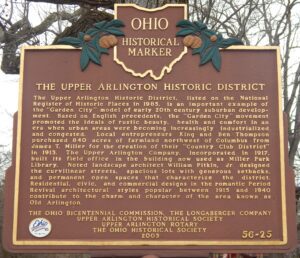
The Upper Arlington Historic District, listed on the National Register of Historic Places in 1985, is an important example of the “Garden City” model of early 20th century suburban development. Based on English precedents, the “Garden City” movement promoted the ideals of rustic beauty, health and comfort in an era when urban areas were becoming increasingly industrialized and congested. Local entrepreneurs King and Ben Thompson purchased 840 acres of farmland northwest of Columbus from James T. Miller for the creation of their “Country Club District” in 1913. The Upper Arlington Company, incorporated in 1917, built its field office in the building now used as Miller Park Library. Noted landscape architect William Pitkin, Jr. designed the curvilinear streets, spacious lots with generous setbacks, and permanent open spaces that characterize the district. Residential, civic, and commercial designs in the romantic Period Revival architectural styles popular between 1915 and 1940 contribute to the charm and character of the area known as Old Arlington.