

, OH
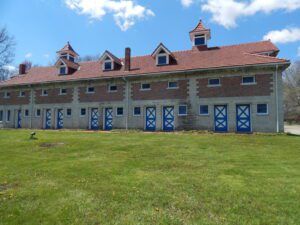
Ohio Columbus Barber, a wealthy Ohio businessman and founder of Barberton, retired in 1905 to develop his Anna Dean Farm. Built in 1910, the colt barn was a part of this 3000-acre estate. Although originally intended for bulls, the building was converted in 1912 to a stable for colts. Akron architects Harpster and Bliss designed the barn, and it was the smallest on the farm. Like many buildings erected by Barber, the colt barn features the patriotic red, white, and blue color scheme he favored. Between Barber’s death in 1920 and the founding of the Barberton Historical Society in 1974, all but nine of the estate’s thirty-five original buildings were razed. The historical society saved the colt barn in 1978, which led to the birth of the city’s historic preservation movement. The society completed restoration of the colt barn in 1998 with a grant from the Barberton Community Foundation.
, OH
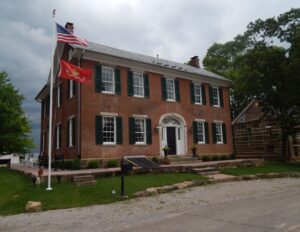
Erected in 1828, the Randolph Mitchell House is a five-bay, Federal-style “I” house. Its facade features a doorway with an Adam-style fan and sidelights. The interior boasts a grand stairway in the foyer and fine woodwork throughout. Randolph Mitchell (1796-1847) was born in Rockingham County, Virginia. In 1819, Mitchell and his mother Sarah (1765-1844), settled in New Reading and he married Lydia Witmer (1798-1872). They had four children. A merchant, Mitchell kept an ample smokehouse and owned a tannery and real estate. He served as a justice of the peace for Reading Township. After Mitchell’s death, his son-in-law, Dr. W.W. Arnold (1818-1872) maintained his practice in the home, where he and Caroline Mitchell Arnold (1825-1888) lived. Their son William Arnold (1858-1948) acquired the house, which remained in the family until 1951. The property was listed on the National Register of Historic Places in 1978.
, OH
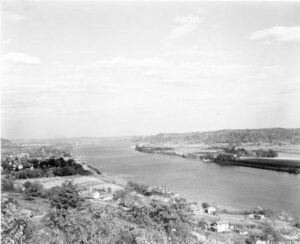
The Ohio River, the southeast border of Gallia County, played a significant role in the development of Gallipolis and Gallia County. One of the state’s first thoroughfares, this waterway enabled pioneers to settle in what was known as the Northwest Territory. On October 17, 1790, approximately 500 French immigrants arrived in Gallipolis, traveling by flatboats from Pittsburgh, and settled in log cabins in what is now City Park, in the heart of Gallipolis. This established the second oldest permanent settlement in the territory. The settlers relied on the River for communication, commerce, and transportation, and the River brought postal service to Gallipolis in 1794. As local business and river trade developed in the 1800s, Gallipolis became a thriving port. The scenic Ohio River is an important inland waterway, providing transportation for many commodities between major cities. The River also provides recreational opportunities for both visitors and residents, including water sports, fishing, and boating.
, OH
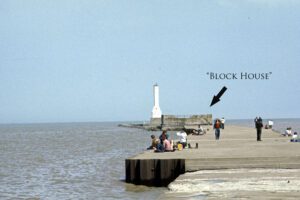
Lake Erie commerce has played a central role in the development of Huron. Important among Huron’s maritime industries were shipbuilding and commercial fishing. The city’s shipbuilding industry dates to the first decades of the nineteenth century. Shipyards were located on the Huron River’s west bank, slightly north of this marker, and also upstream at Fries Landing. Among the vessels built at Huron were the Great Western, constructed in 1838 and the first lake ship to have above-deck cabins, and the Golden Age, which, at 286 feet, was the largest craft on the Great Lakes when built in 1886. Huron shipbuilding declined as the nineteenth century drew to a close. Commercial fishing emerged thereafter, serving as Huron’s economic cornerstone for over fifty years. Huron’s fishing enterprises included the Huron, Kishman, Scott, and Zimmerman fish companies. By 1950, however, polluted lake waters ravished the once-lucrative industry. Although shipbuilding and commercial fishing are no longer a part of Huron’s daily life, they each had a profound effect upon the community’s growth for nearly two centuries.
, OH
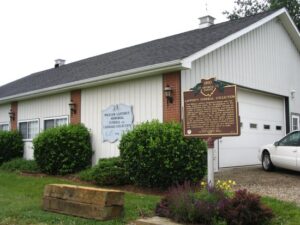
The William Lafferty Memorial Funeral and Carriage Collection shows the development of the funeral business since the mid-1800s through an exhibit of caskets, funeral clothing, and hearses collected and preserved by James William Lafferty (1912 – 1987). William was a member the fourth generation of Laffertys to serve West Union and Adams County. Characteristic of the early history of the profession, William Voris (W.V.) Lafferty (1830-1922) founded the business in 1848 to meet the demand for caskets, which he, as a furniture and cabinetmaker, was often asked to build. (Continued on other side)
, OH
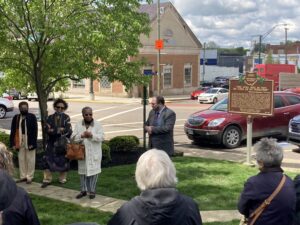
Ellamae Simmons, born and raised in Mount Vernon, became the first African American woman physician to specialize in asthma, allergy, and immunology in the country. Graduating in the top of her high school class, she dreamed of attending Ohio State University to become a nurse but was rejected as that program “did not have the facilities for training” the young black girl. Whenever Simmons encountered a barrier in life she refused to accept rejection, tenaciously steered the course of her own life, and blazed new trails for others. She ultimately earned degrees in nursing (Hampton, 1940), pre-med biological sciences (OSU, 1948), social work (OSU, 1950), and medicine (Howard University, 1959). Dr. Simmons again broke gender and racial barriers when hired by Kaiser Permanente in 1965. She practiced there until retiring in 1989. Simmons died aged 101.
, OH
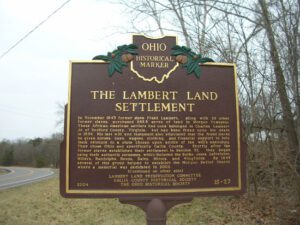
In November 1843 former slave Frank Lambert, along with 29 other former slaves, purchased 265.5 acres of land in Morgan Township. These African American settlers had once belonged to Charles Lambert Jr. of Bedford County, Virginia, but had been freed upon his death in 1839. His last will and testament also stipulated that the freed slaves be given horses, oxen, wagons, clothing, and financial support to help them relocate to a state chosen upon advise of the will’s executors. They chose Ohio and specifically Gallia County. Shortly after the former slaves established their settlement in Section 32, they began using their authentic surnames, which included the Burks, Jones, Leftwiches, Millers, Randolphs, Reeds, Sales, Minnis, and Wingfields. By 1845 several of this group helped to establish the Morgan Bethel Church where a memorial was dedicated in 2002. (continued on other side)
, OH
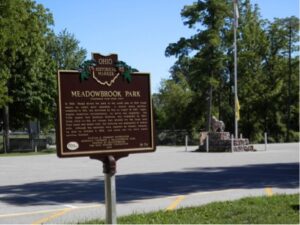
Meadowbrook Park began as a Tiffin, Fostoria & Eastern Electric Railway plan to draw weekend riders. Laura Stephenson Sneath, wife of a major company stakeholder, led the park development. Originally north of Wolf Creek, Meadowbrook included a baseball diamond and a 1902 dance pavilion. In 1923, William Richards purchased the buildings and leased the land from Henry Matthews of Matthews Boat Company. The pavilion was destroyed by fire under suspicious circumstances on October 12, 1925, but no one was charged. James Garfield Haugh, president of the Gem Manufacturing Company, purchased the land in 1925. (Continued on other side)