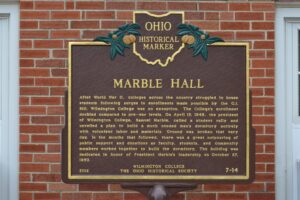
After World War II, colleges across the country struggled to house students following surges in enrollments made possible by the G.I. Bill. Wilmington College was no exception. The College’s enrollment doubled compared to pre-war levels. On April 13, 1948, the president of Wilmington College, Samuel Marble, called a student rally and unveiled a plan to build a much needed men’s dormitory entirely with volunteer labor and materials. Ground was broken that very day. In the months that followed, there was a great outpouring of public support and donations as faculty, students, and community members worked together to build the dormitory. The building was dedicated in honor of President Marble’s leadership on October 27, 1950.
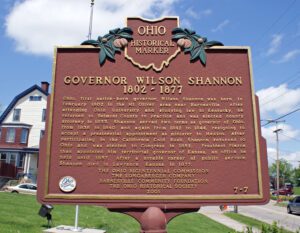
Ohio, first native-born governor, Wilson Shannon was born in February 1802 in the Mt. Olivet area near Barnesville. After attending Ohio University and studying law in Kentucky, he returned to Belmont County to practice and was elected county attorney in 1833. Shannon served two terms as governor of Ohio, from 1838 to 1840 and again from 1842 to 1844, resigning to accept a presidential appointment as minister to Mexico. After participating in the California Gold Rush, Shannon returned to Ohio and was elected to Congress in 1852. President Pierce then appointed him territorial governor of Kansas, an office he held until 1857. After a notable career of public service, Shannon died in Lawrence, Kansas, in 1877.
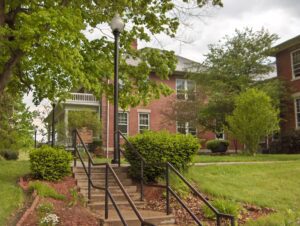
In the first quarter of the nineteenth century, when the general public believed that the insane and paupers could be rehabilitated into productive citizens, the Ohio Legislature gave authorization to county commissioners to establish county “poor houses.” The Athens County Home, formerly known as the Athens County Infirmary, opened on this site in 1857 to provide care for indigent citizens of Athens County. When fire destroyed the original building in 1903, a new building was constructed from 1904-1905, designed with the capacity to house up to one hundred people. When it was built, it was considered to be one of the finest and most modern charitable institutions of its time. The facility continued to provide housing for indigent and elderly residents until 1997 when the County Commissioners closed the home and it became a primary location for the delivery of social services in Athens County. (continued on the other side)
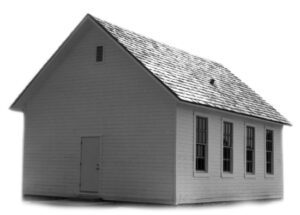
Descendants of slaves, who may have reached Ohio through the Underground Railroad, and other African Americans, formed the community of Flatwoods in the southwest part of Bokescreek Township. This one-room schoolhouse was built circa 1868 for African American children of Flatwoods and remained open until 1923. Remnants of past lessons remain inscribed on the chalkboard. The schoolhouse was threatened with demolition in 1999 and later moved to Veteran’s Park. The Logan County Historical Society owns and maintains the site as a living history museum.
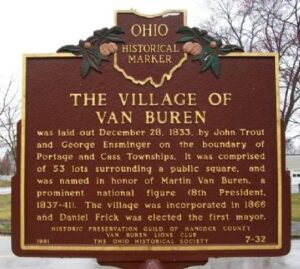
The Village of Van Buren was laid out December 28, 1833, by John Trout and George Ensminger on the boundary of Portage and Cass Townships. It was comprised of 53 lots surrounding a public square, and was named in honor of Martin Van Buren, a prominent national figure (8th President, 1837-41). The village was incorporated in 1866 and Daniel Frick was elected the first mayor.
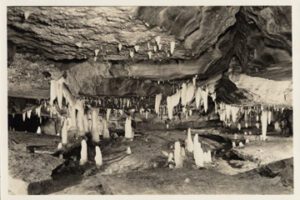
In 1897, a farm boy investigating the disappearance of water into a sinkhole in a nearby field discovered this system of subterranean passageways. Digging down a few feet, he found an opening to a cave that had begun forming perhaps several thousand years earlier during the Ice Age in soluble limestone bedrock that was approximately 400 million years old. Ground water dripping down from the cavern’s ceiling continues to form stalactites, stalagmites, and mineral coatings on the cavern’s walls, floor, and ceiling. A portion of Ohio Caverns near the discovery site was opened to the public in 1897, but that section closed in 1925 when a more extensive and geologically interesting part of the cave was discovered. Ohio Caverns is the largest known cave system in the state and is widely considered to be the most beautiful of all Ohio caves.
John “Appleseed” Chapman (b. September 26, 1774—d. March 18, 1845) was the first lessee of this 160 acre tract (NW 1/4, S 20, T 20, R 16), when he secured it for 99 years from the Virginia Military District School Lands on April 10, 1815. This $320 lease complied with the Ordinance of 1785 which stipulated that proceeds from the sale or lease of a 36th of all new land in the Northwest Territory be used to support public education. Perrysville author, Rosella Rice, knew Appleseed. In a history of Ashland County, she wrote, “One of his nurseries is near us and I often go to the secluded spot on the quiet banks of the creek [Blackfork]…with sod never broken since the old man did it.” Attributed as Green Township’s first permanent settler, Abram Baughman’s original 160 acres (c. 1807) adjoined this property to the west.
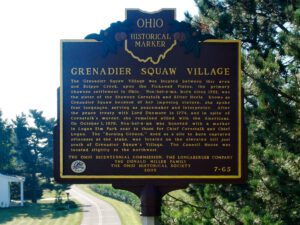
The Grenadier Squaw Village was located between this area and Scippo Creek, upon the Pickaway Plains, the primary Shawnee settlement in Ohio. Non-hel-e-ma, born circa 1722, was the sister of the Shawnee Cornstalk and Silver Heels. Known as Grenadier Squaw because of her imposing stature, she spoke four languages, serving as peacemaker and interpreter. After the peace treaty with Lord Dunmore in 1774, and in spite of Cornstalk’s murder, she remained allied with the Americans. On October 1, 1978, Non-hel-e-ma was honored with a marker in Logan Elm Park near to those for Chief Cornstalk and Chief Logan. The “Burning Ground,” used as a site to burn captured prisoners at the stake, was located on the elevated hill just south of Grenadier Squaw’s Village. The Council House was located slightly to the northwest.