

, OH
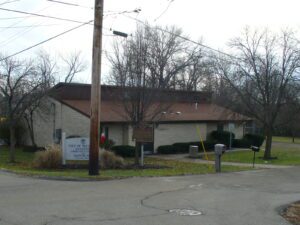
Civic organizations played pivotal roles in the development of the residential community of Hazelwood, founded as a subdivision of Blue Ash in 1888. The Hazelwood Civic Association, initially established as the Brothers Civic Society in 1941, addressed community needs by working for public improvements and promoting civic relations through social events and educational programs. Efforts by the HCA led to the construction of a new civic center and the introduction of the Boy and Girl Scouts and other programs that were previously unavailable to African-American children. Hazelwood’s deterioration and the threat of encroaching industrial development led to the formation of the Hazelwood Improvement Corporation in 1968. The HIC, acting as an agent of the city of Blue Ash, helped to upgrade housing, pave roads, build new homes to ensure a residential nature, install water and sewage systems, and erect streetlights. In 1997, the Hazelwood Community Association was organized to assist residents during Hazelwood’s transition to a racially integrated community.
, OH
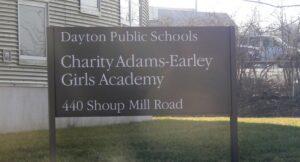
In 1942, Charity Adams Earley (1918-2002) became the first African American woman to receive a commission in what became the Women’s Army Corps (WACs). She rose through the ranks to command the 6888th Central Postal Directory Battalion in Europe, the only unit of African American women to serve overseas in World War II. Upon leaving the service in 1946, she was the WAC’s highest-ranking African American officer, a lieutenant colonel. Raised in Columbia, South Carolina, Earley moved to Ohio to attend Wilberforce University and later The Ohio State University. She married Stanley Earley, Jr., M.D. in 1949 and they later moved to Dayton. She became active in civic affairs, including serving on the Sinclair Community College Board of Trustees.
, OH
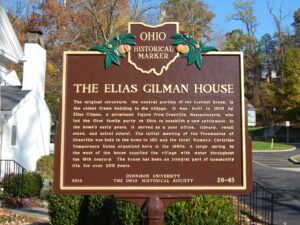
The original structure, the central portion of the current house, is the oldest frame building in the village. It was built in 1808 by Elias Gilman, a prominent figure from Granville Massachusetts, who led the first family party to Ohio to establish a new settlement . In the home’s early years, it served as a post office, library, retail store, and select school. The initial meeting of the Freemasons of Granville was held in the home in 1811 and the local Women’s Christian Temperance Union organized here in the 1880s . A large spring to the west of the house supplied the village with water throughout the 19th century . The house has been an integral part of community life for over 200 years.
, OH
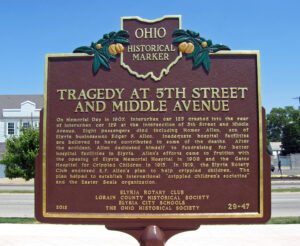
On Memorial Day in 1907, interurban car 123 crashed into the rear of interurban car 129 at the intersection of 5th Street and Middle Avenue. Eight passengers died including Homer Allen, son of Elyria businessman Edgar F. Allen. Inadequate hospital facilities are believed to have contributed to some of the deaths. After the accident, Allen dedicated himself to fundraising for better hospital facilities in Elyria. Allen’s efforts came to fruition with the opening of Elyria Memorial Hospital in 1908 and the Gates Hospital for Crippled Children in 1915. In 1919, the Elyria Rotary Club endorsed E.F. Allen’s plan to help crippled children. The plan helped to establish international “crippled children’s societies” and the Easter Seals organization.
, OH
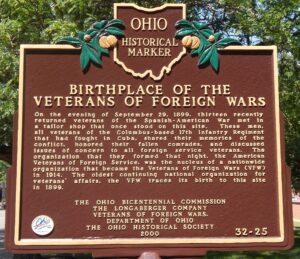
On the evening of September 29, 1899, thirteen recently returned veterans of the Spanish-American War met in a tailor shop that once stood on this site. These men, all veterans of the Columbus-based 17th Infantry Regiment that had fought in Cuba, shared their memories of the conflict, honored their fallen comrades, and discussed issues of concern to all foreign service veterans. The organization that they formed that night, the American Veterans of Foreign Service, was the nucleus of a nationwide organization that became the Veterans of Foreign Wars (VFW) in 1914. The oldest continuing national organization for veterans’ affairs, the VFW traces its birth to this site in 1899.
, OH
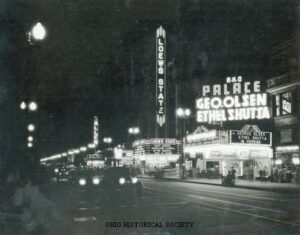
The Theater District, bound by Chester Avenue, Prospect Avenue, East 18th, East 9th and East 12th Streets, came into being at the turn of the 20th century, when Cleveland emerged as a thriving metropolis. Built between 1890-1928, the area hosted a variety of fine retail stores, theaters, prestigious clubs, restaurants, and distinct office buildings. The rise of television and flight to the suburbs sent downtown entertainment into a death spiral, until a 1970 grass roots effort saved from demolition the surviving post-World War I theaters (the State, Ohio, Hanna, Allen, and Palace), making it the “world’s largest theater restoration project.” It became a catalyst for reinvestment in downtown properties, restoring civic pride and giving testimonial to the creative vision of the city’s civic leaders and citizenry. By the year 2000, Cleveland’s Theater District boasted the nation’s 2nd largest performing arts center.
, OH
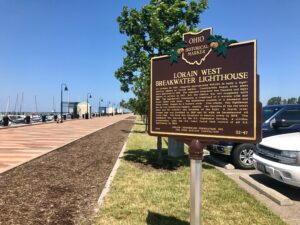
On October 22, 1913, Congress appropriated $35,000 to build a light-and-fog station at Lorain harbor. Construction began after plans were approved in 1916. The concrete structure was finished and light placed in service in 1917, but the station was not completed until 1919. The lighthouse’s foundation is comprised of a wooden crib and boxes filled with stone. The lighthouse consists of a basement and three floors, topped by a lantern room. Like others, this lighthouse had its own identifying signals, namely, the duration of the fog horn’s blast and the rotation and duration of the light. A fourth order Fresnel lens was installed in 1919 and lit with an incandescent oil vapor lamp. The lamp was converted to electric power in 1932. The lighthouse was manned by the U.S. Lighthouse Service, a civilian organization, until the U.S. Coast Guard took control of all U.S. lighthouses in 1939.
, OH
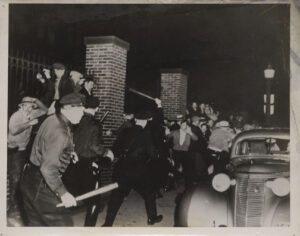
Five Depression-era strikes against many of Akron’s rubber companies culminated in a giant “sit-down” strike against Goodyear Tire and Rubber Company, the industry’s leader, in February and March of 1936. The fledgling United Rubber Workers (URW), created in September 1935, used the tactic of being at work but not working that had been pioneered by rank-and-file workers in a successful 1934 strike against the General Tire and Rubber Company. After a peaceful month-long strike, the URW won recognition from Goodyear and reached a settlement on March 22. The 1936 Akron Rubber Strike was one of the earliest successes for the Committee for Industrial Organization (CIO), sparking a wave of industrial organizing and similar strikes in 1936 and 1937. The “sit-down” strategy extended beyond the rubber industry and was instrumental in the founding of the industrial union movement in the United States.