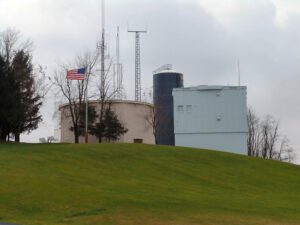
Campbell Hill is named for Charles D. Campbell of Bellefontaine, who owned this land from 1898 to 1937. A marble stone marker atop the hill, set in 1900 by the U.S. Coast and Geodetic Survey, marks it as the highest point in Ohio at an elevation of 1549.09 feet. In 1951, the federal government established the 664th Aircraft Control and Warning (AC&W) Squadron here as part of the North American Air Defense Command (NORAD). Its military and civilian operators used sophisticated radar and computer equipment to locate and identify aircraft as friendly or suspicious, and relayed information to a central site in Battle Creek, Michigan. This Cold War site operated until 1969. It was converted to civilian use as a vocational education center in 1974.
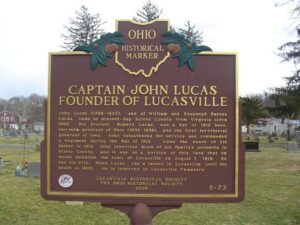
Lucasville Cemetery was originally established as the Lucas Family burying ground, with Susannah Lucas as the first recorded burial on May 4, 1809. Susannah’s husband, Captain William Lucas, a Revolutionary War veteran, is interred here along with the first wife of Governor Robert Lucas, Eliza “Betsy” Brown Lucas. By 1816, the cemetery was used as a public burying ground. Hand carved monuments inscribed with poetry can be found in the old section. Recognized as one of the oldest cemeteries in southern Ohio, Lucasville Cemetery has interred veterans of the Revolutionary War, War of 1812, Civil War, Spanish-American War, World Wars I and II, Korea, and Vietnam.
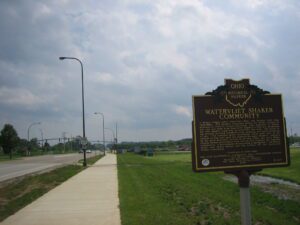
A Shaker village called Watervliet, Ohio, was located here from 1806-1900. The Shakers, originally called the United Society of Believers in Christ’s Second Appearing, were followers of Mother Ann Lee who came from Manchester, England in 1774 and established the first Shaker community in Watervliet, New York. The tenets of the religion included communal living, celibacy, and public confession of sins. The frenzied dance movements, which were part of the worship of their sect, gave the members the name “Shakers.” Attracted by the great Kentucky revivals in the late 1700s and early 1800s, Eastern Shaker missionaries came west to find converts and establish communities. A discontented Presbyterian congregation in the Beaver Creek area called Beulah was the nucleus for the Watervliet Shaker community. (continued on other side)
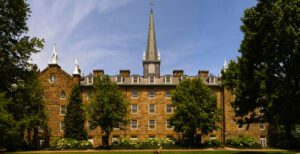
The state’s oldest private institution of higher education, Kenyon College was founded in 1824 in Worthington by Philander Chase, first Episcopal bishop of Ohio, and relocated to Gambier four years later. Both college and village are named for British benefactors, statesman Lord Kenyon and naval hero Lord Gambier. Throughout its history, Kenyon has prepared men and women for leading roles in society, including nineteenth-century graduates Edwin M. Stanton, Abraham Lincoln’s secretary of war, and Rutherford B. Hayes, Ohio governor and U.S. president. In the twentieth century, Kenyon educated such literary luminaries as poet Robert Lowell and novelist E.L. Doctorow. Kenyon has also been an innovator in education-the Advanced Placement Program began as the Kenyon Plan in the 1950s.
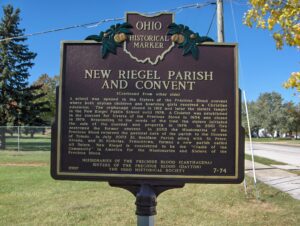
St. Boniface Catholic Church began in 1834 as a mission of several area churches and in 1836, the parish built its first church. In 1844 Bishop John Purcell commissioned Swiss born, Father Francis de Sales Brunner, a Missionary of the Precious Blood, to take pastoral charge of St. Boniface. Under the leadership of Father Brunner, the Missionaries of the Precious Blood, established in Italy in 1815, and the Sisters of the Precious Blood, founded in Switzerland in 1834, began ministry here in New Riegel (Wolfscreek) in 1844. Over two hundred acres of land were purchased for the priests, brothers, and sisters. The Missionaries brought spiritual support, farm labor, and education to the German immigrants of New Riegel. The sisters began their ministry of prayer in the convent, Mary at the Crib, on December 22, 1844. (Continued on other side)
John “Appleseed” Chapman (b. September 26, 1774—d. March 18, 1845) was the first lessee of this 160 acre tract (NW 1/4, S 20, T 20, R 16), when he secured it for 99 years from the Virginia Military District School Lands on April 10, 1815. This $320 lease complied with the Ordinance of 1785 which stipulated that proceeds from the sale or lease of a 36th of all new land in the Northwest Territory be used to support public education. Perrysville author, Rosella Rice, knew Appleseed. In a history of Ashland County, she wrote, “One of his nurseries is near us and I often go to the secluded spot on the quiet banks of the creek [Blackfork]…with sod never broken since the old man did it.” Attributed as Green Township’s first permanent settler, Abram Baughman’s original 160 acres (c. 1807) adjoined this property to the west.
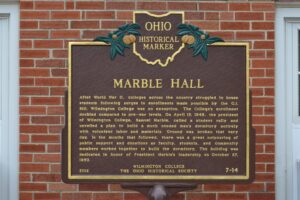
After World War II, colleges across the country struggled to house students following surges in enrollments made possible by the G.I. Bill. Wilmington College was no exception. The College’s enrollment doubled compared to pre-war levels. On April 13, 1948, the president of Wilmington College, Samuel Marble, called a student rally and unveiled a plan to build a much needed men’s dormitory entirely with volunteer labor and materials. Ground was broken that very day. In the months that followed, there was a great outpouring of public support and donations as faculty, students, and community members worked together to build the dormitory. The building was dedicated in honor of President Marble’s leadership on October 27, 1950.
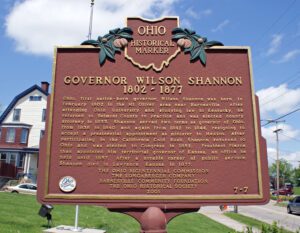
Ohio, first native-born governor, Wilson Shannon was born in February 1802 in the Mt. Olivet area near Barnesville. After attending Ohio University and studying law in Kentucky, he returned to Belmont County to practice and was elected county attorney in 1833. Shannon served two terms as governor of Ohio, from 1838 to 1840 and again from 1842 to 1844, resigning to accept a presidential appointment as minister to Mexico. After participating in the California Gold Rush, Shannon returned to Ohio and was elected to Congress in 1852. President Pierce then appointed him territorial governor of Kansas, an office he held until 1857. After a notable career of public service, Shannon died in Lawrence, Kansas, in 1877.