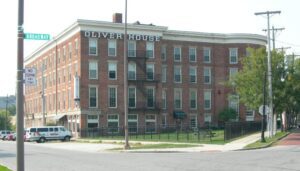
Overlooking the “Middlegrounds,” an early site of railroad, immigration, and commercial activity, the Oliver House opened in 1859 as Toledo’s premier hotel. It was designed by nationally prominent architect Isaiah Rogers, in the Greek Revival style, and built by the family of William Oliver for whom the hotel was named; owner of this land, Oliver was one of Toledo’s earliest real estate investors. (Continued on other side)
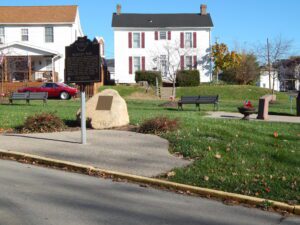
William McKinley was the 25th President of the United States. Following McKinley’s assassination in 1901, the Village of Jackson dedicated this triangle of land as a park in his honor. Earlier in the nineteenth century, a small school had occupied the plot. In 1902, a local commission was appointed to oversee the development of a park. It was not, however, until 2012 that the Jackson Garden Lovers Club finished the commission’s long overdue work. The park was dedicated in 2013, 111 years after it began.
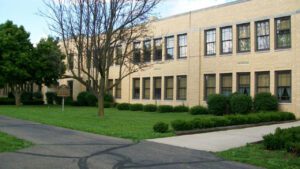
Colonel Ebenezer Zane played a major role in the development of Ohio, a role that helped place it on the path to statehood. A veteran of the Revolutionary War and experienced road builder, he received permission from Congress in 1796 to build a road into the Northwest Territory, which would be called Zane’s Trace. In exchange for his work, Zane received land grants where the trace would cross the Muskingum, Hocking, and Scioto rivers. The trace began in Wheeling, West Virginia (then Virginia) and ended at Limestone, Kentucky (present-day Maysville) on the Ohio River. Opening in 1797, it brought settlement into Ohio, including Lancaster. Its route crossed the playground area of East Elementary from the northeast corner of today’s playground to the southwest corner, lot #18, East Addition, as recorded on an 1897 map of Lancaster.
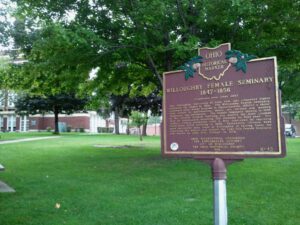
The village of Chagrin, founded in 1798, changed its name in 1834 to honor Dr. Westel Willoughby, a pioneer medical educator. That same year, the Willoughby University of Lake Erie was chartered, and the Willoughby Medical College opened its doors, signaling the beginning of medical education in northern Ohio. The Medical College trained 160 doctors, educated in contemporary methods of medicine, anatomy, chemistry, and surgery. Financial struggles and public outcry against grave-robbing — which supplied cadavers for anatomy classes — hampered the college’s development. The movement of faculty to Cleveland and the transfer of the state charter to Columbus hastened the demise of the Medical College in 1847, and laid the foundation for the establishment of the medical schools of Case Western and Ohio State universities. (Continued on side two)
745 Davids Drive (is across the street from Greenway sign and pull-in)
Wilmington
, OH
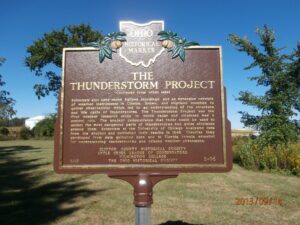
Before and during World War II, the aviation industry was vulnerable to adverse weather conditions, particularly thunderstorms. In 1945, Congress mandated the nation’s first large-scale, scientific study of thunderstorms. The Thunderstorm Project was a cooperative undertaking of the U.S. Weather Bureau, Army Air Force, Navy, and the National Advisory Committee for Aeronautics (predecessor of NASA). The first phase of the project was conducted in Florida in 1946 and the second phase in Clinton County in 1947, partly because weather fronts frequently pass through this area. Pilots from the Clinton County Army Air Force Base made many flights through storms of varying intensities and all stages of development. (Continued on other side)
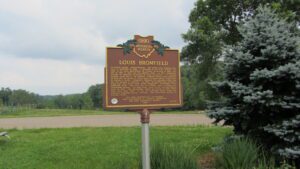
Acclaimed author, conservationist, and farmer Louis Bromfield was born in Mansfield in 1896. A graduate of the city’s schools, he went on to study agriculture at Cornell University in 1914, but left in 1915 to help run his family’s farm. In 1916, Bromfield enrolled in Columbia University to study journalism. As America entered World War I, he enlisted in United States Army Ambulance Service and saw action in seven major European battles. Determined to become a writer, Bromfield finished his education after the war and became a reporter. In 1921, he married Mary Appleton Wood and they would have three daughters. Bromfield’s first published novel, the Green Bay Tree (1924), was a critical and commercial success; his third novel, Early Autumn, won the Pulitzer Prize in 1927. The Bromfields moved to France in 1925 where they lived until 1938. In all, he published thirty books and authored numerous stories, articles, and screenplays during his writing career.
Agricultural development and cultivation on steep lands led to severe soil erosion in the nation in the 1920s and 1930s. In response, the United States Department of Agriculture established the Soil Conservation Service (SCS) in 1935. The SCS established the North Appalachian Experimental Watershed (NAEW) in the hills of Coshocton County to study and develop methods of conserving soil and water resources. The Federal government and Coshocton County purchased 1,047 acres of land for the program and, in 1936, field research equipment was installed and buildings constructed. The Works Progress Administration (WPA) and Civilian Conservation Corps (CCC) provided labor near the program’s inception, as did the Civilian Public Service Agency during World War II. (Continued on other side)
Muskingum River Parkway, S of the Putnam Avenue/6th Street Bridge
Zanesville
, OH
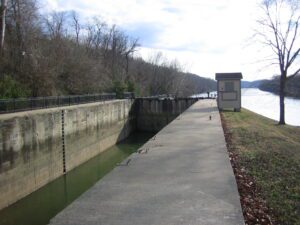
The Zanesville lock, canal, and dam were part of a series of eleven such built on the Muskingum River from Marietta to Ellis, north of Zanesville, from 1836 to 1841. The improvements made the shallow river navigable by steamboats. The State of Ohio funded the project as part of the Ohio Canal System. The locks are approximately 35 feet wide and 160 feet long. The river improvements spurred the development of industry in Zanesville, including pottery manufacture, shipbuilding, and grain milling. From Zanesville, goods could be shipped north to the Ohio Canal and Lake Erie. Products could also be sent south to Marietta and then east to Pittsburgh or southwest to New Orleans. Steamboats brought in manufactured goods, staples, mail, and entertainment. After 1880, competition from railroads caused a gradual decline in the river traffic. Today the locks remain in operation for the enjoyment of pleasure boaters.