


, OH
The Committee for Industrial Organization, later called the Congress of Industrial Organizations (CIO), formed the Steel Workers Organizing Committee (SWOC) under the leadership of CIO president John L. Lewis in April 1936. Following successful CIO strikes in the rubber and automobile industries, SWOC won contracts in early 1937 with the United States Steel Corporation and Jones and Laughlin Steel, the largest steel makers in the United States, also known as “Big Steel.” On May 26, 1937, SWOC struck three “Little Steel” companies whose operations were concentrated in the Mahoning Valley: Inland Steel, Republic Steel, and Youngstown Sheet and Tube. By early June, the first major steel strike since 1919 idled more than 28,000 Canton, Warren, and Youngstown steelworkers. (continued on other side)
, OH
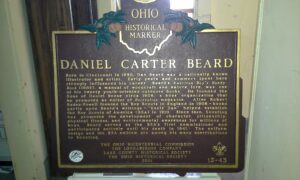
Born in Cincinnati in 1850, Dan Beard was a nationally known illustrator and artist. Early years and summers spent here strongly influenced his career. Beard’s American Boy’s Handy-Book (1882), a manual of woodcraft and nature lore, was one of his twenty youth-oriented outdoors books. He founded the Sons of Daniel Boone circa 1906, a boys’ organization that he promoted as editor of Recreation magazine. After Robert Baden-Powell founded the Boy Scouts in England in 1908-based partly upon Beard’s writings-“Uncle Dan” helped establish the Boy Scouts of America (BSA) in 1910. Since then, Scouting has promoted the development of character, citizenship, physical fitness, and environmental awareness for millions of boys. Beard served as the BSA’s first commissioner and participated actively until his death in 1941. The uniform design and the BSA emblem are among his many contributions to Scouting.
, OH
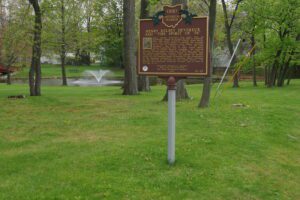
Henry Kelsey Devereux was born into an aristocratic family on October 10, 1859 in Cleveland, Ohio. Ohio artist, Archibald Willard, chose Harry, as he was fondly known, to portray the drummer boy in one of America’s most famous patriotic paintings, “The Spirit of ’76”. At the time Willard approached him to pose, young Harry was a cadet at Brooks Military Academy. He married socialite Mildred French in 1885 and in 1910 they settled in her father’s pretentious country estate in Wickliffe, Ohio (presently Telshe Yeshiva College). His passion for harness racing and for breeding horses culminated in the organization of the American Association of Trotting Horse Breeders and his position as president of the Grand Circuit. The affluent and charitable Wickliffe resident died in 1932 at the age of 72.
, OH
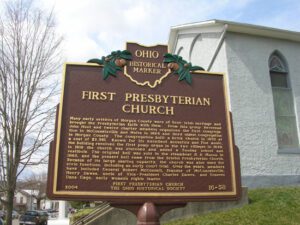
Many early settlers of Morgan County were of Scot-Irish heritage and brought the Presbyterian faith with them. From this group Reverend John Hunt and twelve charter members organized the first congregation in McConnelsville and Malta in 1824 and third oldest congregation in Morgan County. The congregation built a brick church in 1832 at a cost of $2,361. Known for its excellent acoustics and fine music, the building received the first pump organ in the two villages in 1849. In 1916 the church was stuccoed and added a Sunday school and vestibule. The original bell was sold to the steamboat H.D. Munson in 1865, and the present bell came from the Bristol Presbyterian Church. Because of its large seating capacity, the church was also used for civic functions, including an early court trial. Over the years, members have included General Robert McConnell, founder of McConnelsville, Henry Dawes, uncle of Vice-President Charles Dawes, and Frances Dana Gage, early women’s rights leader.
, OH
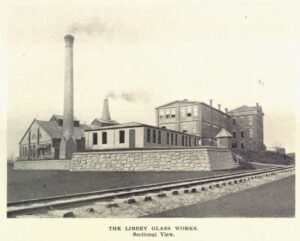
Attracted by the promotion of a civic group, as well as abundant fuel, Edward Drummond Libbey relocated his glass operation from Massachusetts to Toledo in 1888. His company was renown as a producer of fine art glass. Michael J. Owens, a Libbey Superintendent, developed the first fully automatic bottle-making machine in 1903. His invention revolutionized the industry and helped eliminate child labor in glass factories.
, OH
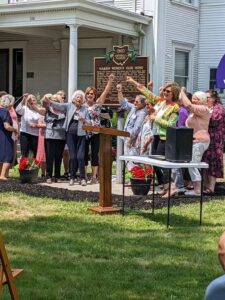
Marion civic leaders Shauck Elah Barlow and Ida Harsh Barlow built “Waldheim,” their Colonial Revival residence, between 1903-1905. Ida Barlow, then president of the Marion Women’s Club, hosted a December 1905 meeting in her new home. Members discussed art, music, literature, and ideas for “civic improvement.” In 1909, this and other Marion clubs reorganized as the Marion County Federation of Women’s Clubs. Federation members soon organized into action: providing college loans to young women; sponsoring visiting city and later school nurses; purchasing trash receptacles; providing dental clinics for low-income residents; and funding railroad crossing safety equipment. Upon her death in 1945, Barlow bequeathed her house to the Federation as the “Women’s Club Home.” The new Federation headquarters offered meeting space for the Executive Board and the many associated clubs. (Continued on other side)
, OH
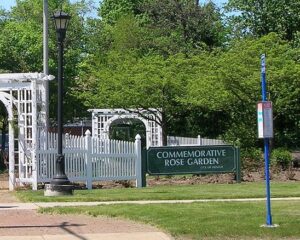
From the 1920s through the 1970s, Mentor was recognized as the Rose Capital of the Nation. Lake effect climate, a variety of soils, and abundant water made Mentor ideal for growing roses. Over a dozen growers produced about five million plants a year from their fields in Mentor. The Civic Center Complex was once a massive field of roses, and streets such as Tea Rose, Wyant, and Rosebud were named in honor of the blossoms that grew so abundantly here. Notable growers include Gerard K. Klyn, the largest rose grower in the Midwest; Joseph Kallay, who in 1932 received U.S. patent No. 10 for “Blaze;” Melvin E. Wyant, accredited rose grower, judge, and lecturer; Joseph J. Kern, nationally recognized expert on old fashioned roses; and Paul R. Bosley, who specialized in hybrid tea roses. By the 1970s, increased land values and development led to depletion of much of Mentor’s nursery lands.
, OH
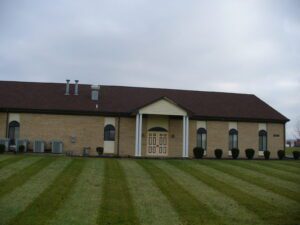
The Jain Center of Cincinnati and Dayton was established on April 22, 1979 as a non-profit tax-exempt organization under the laws of the United States and the State of Ohio. The foundation stone of the Jain temple, the first of its kind in Ohio, was laid down on August 21-22, 1994. The temple was dedicated on September 2 – 4, 1995 when more than one thousand people from all over Ohio and many other states participated in holy rituals to install three idols of Jinas (Gods). The Jain Center is a place for the teaching of non-violence, reverence for life, and compassion for all beings. The center was the home of the twelfth biennial convention for the Federation of Jain Associations in North America, which was held on July 3 – 6, 2003. (Continued on the other side)