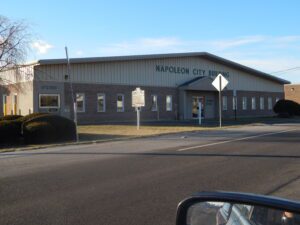
The completion of the Miami and Erie Canal passing through Napoleon in 1843 provided a way to receive manufactured goods, export farm products, and power local mills. The early industries of Napoleon utilized the canal as a source of reliable water power, which led to the development of a mid-19th-century industrial waterfront. Some of the local businesses that relied on the canal were Sayger’s Saw-mill (1843), John Ritter Flouring Mill (1850), Augustin Pilliod’s Napoleon Flouring Mill (1853), and the Napoleon Woolen Mill (1863). These mills used flumes, or artificial channels, to divert canal water to their water wheels. These brick-arch flumes were instrumental in bringing Napoleon into the national economy.
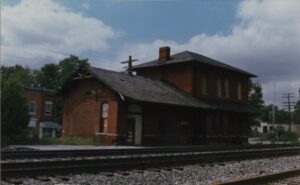
By the mid 1830s, Ohio had developed a canal system that linked Lake Erie in the north to the Ohio River in the south. Despite the success of the canals, transportation companies searched for other methods to traverse the state. They found their answer in the railroad industry, which proved to be much faster, cheaper, and more reliable than canals. Located on Lake Erie, Sandusky, Ohio was a major trading depot in the area. Plans were made to connect Sandusky to Cincinnati’s port on the Ohio River. On September 4, 1835, construction began in Sandusky on the Mad River and Lake Erie Railroad line, forming the first railroad line located entirely in Ohio. The railroad reached Tiffin by 1841 and Springfield by 1848, where it merged with the Little Miami Railroad line, connecting Lake Erie to the Ohio River.
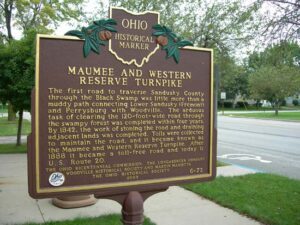
The first road to traverse Sandusky County through the Black Swamp was little more than a muddy path connecting Lower Sandusky (Fremont( and Perrysburg with Woodville. The arduous task of clearing the 120-foot-wide road through the swampy forest was completed within four years. By 1842, the work of stoning the road and draining adjacent lands was completed. Tolls were collected to maintain the road, and it became known as the Maumee and Western Reserve Turnpike. After 1888 it became a toll-free road and today is State Route 20.
Intersection of Springfield Street and Centennial Blvd
Riverside
, OH
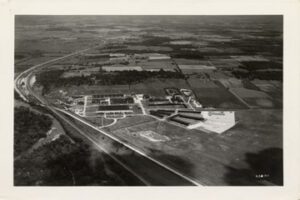
Named for the 1903 co-inventors of the airplane, Wilbur and Orville Wright of Dayton, Ohio, Wright Field has been the center of aeronautical research, development, and weapon system acquisition since its establishment. Wright Field assumed this mission and was dedicated on October 12, 1927 after McCook Field (1917-1927), America’s “Cradle of Aviation” near downtown Dayton, closed its gates. ?Here on this ground where Wilbur and Orville Wright brought to full life man’s age-old dream of rising in flight above the earth, we of Wright Field consecrate ourselves to the splendid vision and unswerving purpose which motivated those great and honored pioneers of the sky. Their patience, their firm determination, their untiring devotion to their aim ” these we take as a light to guide and inspire us.” –Creed of Wright Field, December 17, 1942
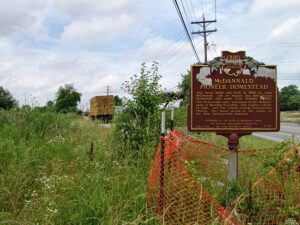
This brick home was built in 1856 by John McDannald, son of Samuel and Bell (Craig) McDannald who came from Virginia in 1813. The McDannalds were prominent in the development of Blendon Township, The Central College of Ohio, and The Central College Presbyterian Church. This house served as one station on the Ohio Underground Railroad.
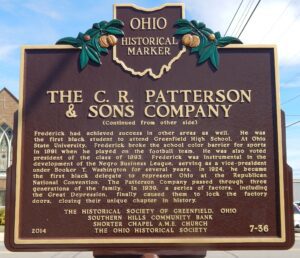
The factory of the C. R. Patterson & Sons Company once stood near here at 138 N. Washington Street. Established in the mid-nineteenth century by the black businessman Charles Richard (C. R.) Patterson and his white partner, J. P. Lowe, the business, originally known as J. P. Lowe & Company, became a successful carriage firm. Patterson became the sole owner in 1893 and changed the name to C. R. Patterson & Sons. After succeeding his father as owner, C. R.’s son, Frederick, became the first known African-American automobile manufacturer. Under his leadership, the company transitioned from building carriages to automobiles, then to trucks and buses to keep up with the changing demands of the transportation industry. (Continued on other side)
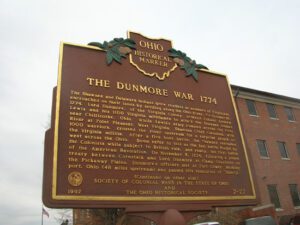
The Shawnee and Delaware Indians grew restless as numbers of Virginians encroached on their lands by settling along the Ohio River. On October 10, 1774, Lord Dunmore, of the Virginia Colony, ordered Colonel Andrew Lewis and his 1100 Virginia militiamen to attack the Shawnee Indians near Chillicothe, Ohio. While Lewis’s army camped across the Ohio River at Point Pleasant, West Virginia, Shawnee Chief Cornstalk, with 1000 warriors, crossed the river upstream for a surprise attack on the Virginia militia. After a five hour battle, the Shawnee retreated west across the Ohio. Some refer to this as the last battle fought by the Colonists while subject to British rule, and really, the first battle of the American Revolution. On November 5, 1774, following a peace treaty between Cornstalk and Lord Dunmore at Camp Charlotte on the Pickaway Plains, Dunmore’s officers met at Fort Gower, Hockingport, Ohio (48 miles upstream) and passed this resolution of “liberty”: (continued on other side)
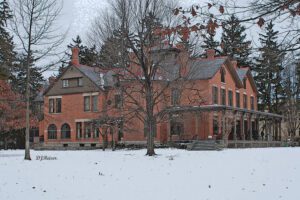
The twenty-five acre estate Spiegel Grove was the home of Rutherford Birchard Hayes, the 19th president of the United States. Spiegel Grove received its name from the German word “spiegel,” meaning mirror, describing pools that collect beneath the trees after a rainstorm. Hayes’s uncle, Sardis Birchard, a Fremont merchant, built the home on this site in 1863. The Hayeses moved to Spiegel Grove after Hayes’s second term as Ohio governor ended in 1873. They inherited the estate in 1874. The family left Fremont after Hayes’s election as Ohio governor in 1875, and U.S. president in 1876. They returned to Spiegel Grove in 1881. The Hayeses expanded the home in 1880 and 1889. Lucy and Rutherford Hayes died at Spiegel Grove in 1889 and 1893 respectively. They were reburied at Spiegel Grove in 1915. Their children donated the property to the state of Ohio in 1909 in order to establish the nation’s first presidential library.