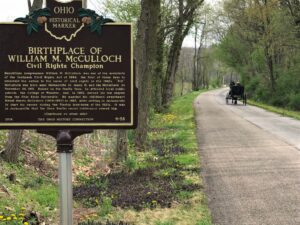
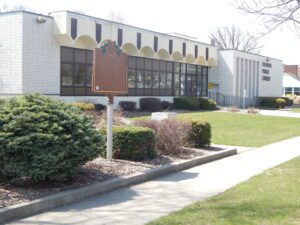
Republican congressman William M. McCulloch was one of the architects of the landmark Civil Rights Act of 1964, the first of three laws to recommit the nation to the cause of civil rights in the 1960s. “Bill” McCulloch was born near Holmesville to James H. and Ida McCulloch on November 24, 1901. Raised on the family farm, he attended local public schools, the College of Wooster, and, in 1925, earned his law degree from the Ohio State University. He married his childhood sweetheart Mabel Harris McCulloch (1904-1990) in 1927, after settling in Jacksonville to start his career during the Florida land-boom of the 1920s. It was in Jacksonville that the Deep South’s racial intolerance seared him. (Continued on other side)
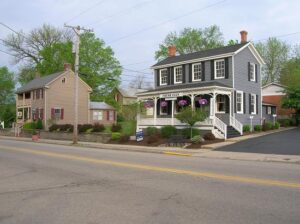
David and Rachel Burnet Evans built this Federal style house in 1836. Their son, Dr. John Evans (1814-1897), nationally known physician, statesman, and educator, lived here as a young man. After graduating from Lynn Medical College in Cincinnati, Dr. Evans became a prominent physician in Indiana and helped establish the Indiana Hospital for the Insane. He is recognized as one of the founders and first president of Northwestern University in Evanston, Illinois. He was appointed by President Abraham Lincoln as the first governor of the Colorado Territory and is credited for developing the railroad system in Colorado. His desire to institute a system of higher education in the territory led to the founding of Colorado Seminary, later known as Denver University. Evanston, Illinois and Mt. Evans near Denver were named in his honor.
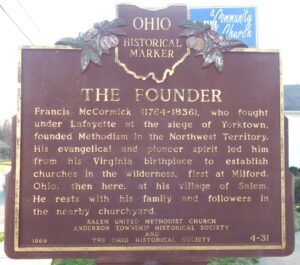
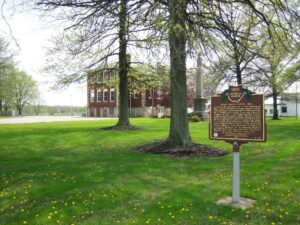
Francis McCormick (1764-1836), who fought under Lafayette at the siege of Yorktown, founded Methodism in the Northwest Territory. His evangelical and pioneer spirit led him from his Virginia birthplace to establish churches in the wilderness, first at Milford, Ohio, then here, at his village of Salem. He rests with his family and followers in the nearby churchyard.
Myron T. Herrick, Governor of Ohio from 1904 to 1906, was born in Huntington Township in 1854 and lived here until age 12. A respected Cleveland attorney and businessman, Herrick was a friend and confidant to Senator Mark Hanna and Presidents McKinley, Taft, and Harding. His public service career culminated in two appointments as ambassador to France, from 1912 through the outbreak of World War I in 1914, and again from 1921 until his death in 1929. Enormously popular with the French people, Herrick escorted Charles Lindbergh in Paris after his historic 1927 transatlantic flight.
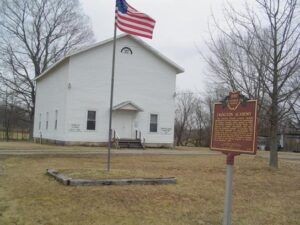
The Ewington Citizens’ Literary Institute purchased this site and sponsored the construction of Ewington Academy which opened in 1859. The building, designed by George Ewing, was financed by popular subscription with much labor and materials donated. It provided high school level education to approximately 60 students each year. It ceased operation as an academy in 1901 and then served as an elementary school until about 1947. Ewington Academy was listed on the National Register of Historic Places September, 1982.
A farm boy with a tenth grade education, Leslie Peltier, born near Delphos in 1900, achieved fame as one of the most famous astronomers of the twentieth century. In 1916, he raised $18 dollars by picking 900 quarts of strawberries on his father’s farm in order to purchase his first telescope. His stargazing abilities led Harvard Observatory’s Dr. Harlow Shapley to proclaim him “the world’s greatest non-professional astronomer.” During his 65 years of stargazing, Leslie Peltier discovered 12 comets and two novae and made 132,000 variable star observations. Peltier made his discoveries on his homemade “merry-go-round” observatory that rotated on a child’s merry-go-round track and housed the optics from a 6-inch, f/8 telescope on loan from Princeton University. To recognize his achievements, the Astronomical League created the annual Leslie C. Peltier Award in 1980 to recognize an amateur astronomer who contributed to astronomy observations of lasting significance.
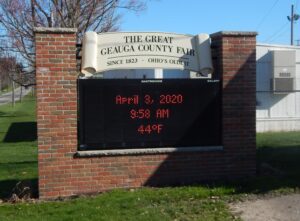
The Great Geauga County Fair is the longest continuously operating county fair in Ohio. The fair is a major county gathering event each year, pulling together people from the whole county. Geauga’s settlers imported the idea of the county fair with them from New England. The fair’s parent organization, the Geauga County Agricultural and Manufacturing Society, began holding fairs on Chardon Square in 1823. Since then, the Geauga County Fair has served as a gathering place and form of education to promote local agriculture and introduce farmers to new farming developments and each other. Controversy arose between 1840 and 1854 after Lake County ceded and Chardon, Claridon, and Burton vied for the permanent fair grounds. Burton’s proposal was accepted, improvements began immediately, and the fair grew quickly. The Great Geauga County Fair continues as a time-honored tradition.
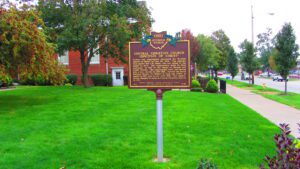
Harvey Howard, a local druggist, built the house at 407 North Market Street around 1860. After many owners, Captain James B. Taylor bought the home in 1893. Taylor commanded Company H of the 120th Ohio Volunteer Infantry during the Civil War. He studied law after the war and moved his practice to Wooster in 1882. Taylor’s wife Emelie died in 1905 and in 1906 Taylor sold the property to become Wooster’s first city hospital. Many of the town’s noted physicians practiced here and the facility was eventually enlarged to accommodate 30 beds. The house was a hospital until 1943, when Central Christian Church purchased it. The church used the building for education programs and restored much of its decor, including four fireplaces, inlaid floors, and bronze door hardware.