On this site stood the Main Gatehouse of the Anna Dean Farm, estate of Barberton town founder and industrialist Ohio C. Barber. The Anna Dean Farm was not only a lavish estate but also a farming showcase built to promote and develop scientific agricultural practices in the United States.
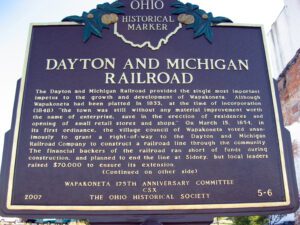
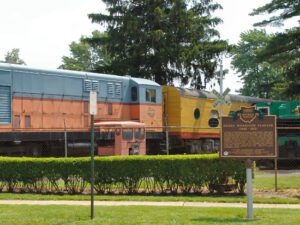
The Dayton and Michigan Railroad provided the single most important impetus to the growth and development of Wapakoneta. Although Wapakoneta had been platted in 1833, at the time of incorporation (1848), “the town was still without any material improvement worth the name of enterprise, save in the erection of residences and opening of small retail stores and shops.” On March 15, 1854, in its first ordinance, the village council of Wapakoneta voted unanimously to grant a right-of-way to the Dayton and Michigan Railroad Company to construct a railroad line through the community. The financial backers of the railroad ran short of funds during construction, and planned to end the line at Sidney, but local leaders raised $70,000 to ensure its extension. (Continued on other side)
A founder of the Standard Oil Company, Henry Morrison Flagler spent his formative years in Bellevue and began his business career here in 1844, building his home near this site in 1858. He first became associated with John D. Rockefeller as a fellow grain merchant. The two later formed the Standard Oil Company in 1870 with capital partially furnished by members of the local Harkness family. Standard Oil became America’s largest and most powerful corporation in the late 1800s, and Flagler used his wealth to develop the state of Florida. His Florida East Coast Railroad, known as “the railroad over the sea,” extended from Jacksonville to Key West, Florida. The cities of Miami, Palm Beach, Fort Lauderdale, and St. Augustine grew with Flagler’s intensive development efforts.
Through the terms of his will, British absentee landowner Samuel Gist (c.1723-1815) freed his 350 Virginia slaves and provided funds for their relocation, the purchase of land and homes, and the establishment of schools and churches. Gist’s executors acquired over 2,000 acres of land in Ohio, including two large tracts in Scott and Eagle townships in Brown County in 1819. In 1831 and 1835, an agent of the Gist estate purchased 207 acres in Fairfield Township (now Penn Township), Highland County, and divided the acreage into thirty-one lots. The Gist Settlement in Highland County was the last to be purchased and settled. In 1857, the Ohio Legislature granted the Highland County Court of Common Pleas control over the freedmen’s trust monies. In 2003 descendants of the freed Gist slaves still inhabited part of the original settlement.
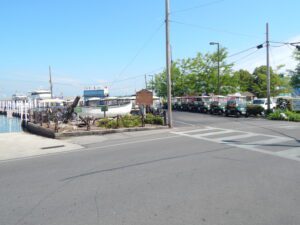
On July 18, 1907, Dr. Lee deForest broadcast the first ship-to-shore radio message from the steam yacht Thelma. The communication provided quick, accurate race results of the Annual Inter-Lakes Yachting Association (I-LYA) Regatta. Frank E. Butler, a Monroeville, Ohio, native and assistant to deForest, was stationed in the pavilion at Fox’s Dock (known today as The Jet Express Dock) and received the radio transmission. The creation of the vacuum tube by deForest permitted the rapid development of radio and eventually television. The inventor disliked the existing term “wireless,” and chose a new moniker — “radio.” On this site wireless-transmission radio broadcasting was born.
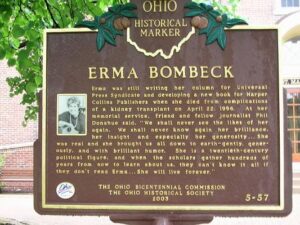
Erma Fiste was born in Dayton on February 21, 1927. While attending Patterson Cooperative High School, she worked as a copygirl for the Dayton Herald. After graduating from the University of Dayton in 1949, she married Bill Bombeck. She returned to the Dayton Journal-Herald as a reporter. Four years later she left the paper to raise three children, Betsy, Andy and Matt. She continued to write part-time from home. In 1965, Glenn Thompson of the Dayton Journal-Herald spotted her column in the Kettering-Oakwood Times and offered her a twice-a-week column. After three weeks he brought it to the attention of Newsday Syndicate. “At Wit’s End” grew to become nationally syndicated in over 900 newspapers. Erma wrote twelve books; nine made The New York Times Best Sellers List. In 1975 she joined the original cast of “Good Morning America” on ABC-TV and appeared regularly for eleven years.
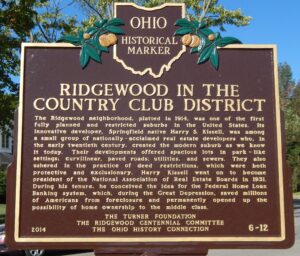
The Ridgewood neighborhood, platted in 1914, was one of the first fully planned and restricted suburbs in the United States. Its innovative developer, Springfield native Harry S. Kissell, was among a small group of nationally-acclaimed real estate developers who, in the early twentieth century, created the modern suburb as we know it today. Their developments offered spacious lots in park-like settings; curvilinear, paved roads; utilities, and sewers. They also ushered in the practice of deed restrictions, which were both protective and exclusionary. Harry Kissell went on to become president of the National Association of Real Estate Boards in 1931. During his tenure, he conceived the idea for the Federal Home Loan Banking system, which, during the Great Depression, saved millioins of Americans from foreclosure and permanently opened up the possibility of home ownership to the middle class.
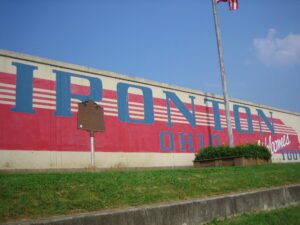
In 1849, the city of Ironton was founded by local ironmasters, railroaders, and financiers associated with the Ohio Iron and Coal Company. They saw the city as a manufacturing and shipping point for their products. As a young industrial city, Ironton prospered when river transportation facilitated the development and export of Lawrence County’s natural resources and manufactured items. The Iron Railroad Company was also established to transport pig iron and manufactured goods from nearby towns to Ironton, to awaiting steamboats on the Ohio River. Steamboats, in the form of towboats, packet boats, and showboats, traveled the river providing the city with goods, services, and entertainment. The Ironton wharf and boat landing once served the community as a gathering place to greet incoming passengers, receive mail, and hear the latest news.