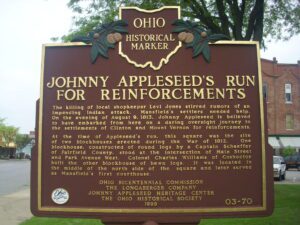
The killing of local shopkeeper Levi Jones stirred rumors of an impending Indian attack. Mansfield’s settlers needed help. On the evening of August 9, 1813, Johnny Appleseed is believed to have embarked from here on a daring overnight journey to the settlements of Clinton and Mount Vernon for reinforcements. At the time of Appleseed’s run, this square was the site of two blockhouses erected during the War of 1812. One blockhouse, constructed of round logs by a Captain Schaeffer of Fairfield County, stood at the intersection of Main Street and Park Avenue West. Colonel Charles Williams of Coshocton built the other blockhouse of hewn logs. It was located in the middle of the north side of the square and later served as Mansfield’s first courthouse.
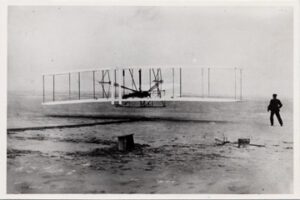
In 1899, Wilbur and Orville Wright of Dayton built a kite to test a revolutionary flight control system, and in 1900, built their first airplane (glider). With promising results, the Wrights built man-carrying gliders and airplanes to refine their ideas. Wind tunnel experiments led to accurate calculations of lift and drag. In 1903 in Kitty Hawk, North Carolina, they made the first sustained, controlled, powered flight in history, lasting 12 seconds. By 1905, the Wright brothers had developed the first practical airplane and the skills to pilot it. The U.S. Army Signal Corps purchased a Wright flyer, the first practical military aircraft, in 1909. Through public demonstrations beginning in 1908, the Wright brothers showed the world the future of aviation.
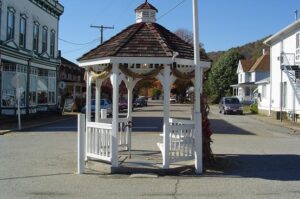
Monroe County’s ground-water resources are valuable assets for its people and economy. Especially notable are the substantial quantities of water that can be obtained in the medium sand and gravel underground aquifers located on the eastern side of the county. The Sardis Town Pump, which taps into one of these aquifers, has been in continuous operation since the nineteenth century and has played an important role in the daily life of Sardis residents. At approximately 78 feet deep, it was originally operated with a hand pump and converted to electricity in 1951. It is the drinking choice for many in the community and throughout Monroe County. It is the last of four known public wells that have served the village of Sardis.
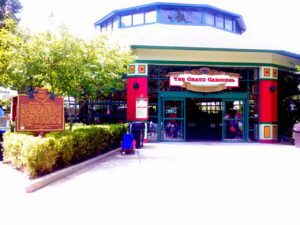
This “Grand Carousel,” manufactured in 1914 by the William I. Mangels Company with wood horses carved by the Marcus Illions Company, was first located at Olentangy Park, an interurban-era amusement park in Clintonville. In 1938, the Mangels-Illions carousel was relocated to the Scioto Ranch Park (also known as the Zoo Amusement Park and Wyandot Lake). On June 17, 2000, the restored carousel, with the original 52 horses and 2 chariots, began “spinning its magic” at this location. Of the nearly 5000 “Grand Carousels” that were operational in the early 1900s, fewer than 200 remain.
Youngstown’s earliest automobile suburb, Forest Glen Estates was developed in the 1920s during a period of change in urban transportation patterns and rapid expansion in the regional steel economy. A composite of design work by leading northeastern Ohio landscape and residential architects, the park-like suburb integrates period revival architecture into the natural landscape and blends gracefully with adjacent Mill Creek Park. Gently curving streets with low curbs and landscaped islands were a novel departure from traditional grid patterns. Attached garages and walkways that connect to driveways rather than the street reflect the influence of the personal automobile in the suburban landscape during this era. In 1998, the Forest Glen Estates Historic District was listed on the National Register of Historic Places.
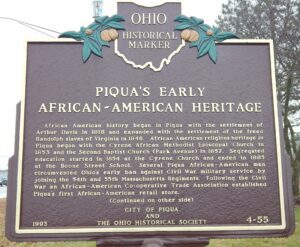
African-American history began in Piqua with the settlement of Arthur Davis in 1818 and expanded with the settlement of the freed Randolph slaves of Virginia in 1846. African-American religious heritage in Piqua began with the Cyrene African Methodist Episcopal Church in 1853 and the Second Baptist Church (Park Avenue) in 1857. Segregated education started in 1854 at the Cyrene Church and ended in 1885 at the Boone Street School. Several Piqua African-American men circumvented Ohio’s early ban against Civil War military service by joining the 54th and 55th Massachusetts Regiments. Following the Civil War an African-American Co-operative Trade Association established Piqua’s first African-American retail store. Continued on/from other side)
The Caldwell Downtown Historic District is the historic commercial and governmental core of the Village of Caldwell, which was founded in 1857 on farmland owned by Joseph and Samuel Caldwell. Caldwell serves as the county seat of Noble County, the last of Ohio’s 88 counties to be organized. The agricultural community prospered and by 1873 was the second-largest producer of tobacco in Ohio. The Pennsylvania Railroad arrived in 1872, and the development of salt, oil, coal, and natural gas extraction companies followed during the 1880s. Two separate fires in 1897 devastated portions of the north and south quadrants of the district. As a result, Caldwell formed a volunteer fire department and the Village Council introduced legislation prohibiting construction of wood buildings within a block of the public square. (Continued on other side)
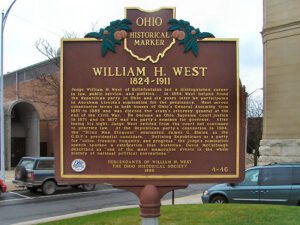
Judge William H. West of Bellefontaine led a distinguished career in law, public service, and politics. In 1854 West helped found the Republican party in Ohio and six years later he participated in Abraham Lincoln’s nomination for the presidency. West served consecutive terms in both houses of Ohio’s General Assembly from 1857 to 1865 and was elected the state’s attorney general at the end of the Civil War. He became an Ohio Supreme Court justice in 1871 and in 1877 was his party’s nominee for governor. After losing his sight, Judge West retired from the court but continued to practice law. At the Republican party’s convention in 1884, the “Blind Man Eloquent” nominated James G. Blaine as the G.O.P.’s presidential candidate. Defining Republicans as a party for “union, freedom, humanity, and progress,” the judge’s nomination speech sparked a celebration that historian David McCullough described as “one of the most memorable events in the whole history of national political conventions.”