

, OH
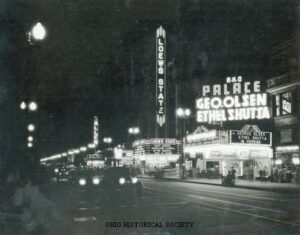
The Theater District, bound by Chester Avenue, Prospect Avenue, East 18th, East 9th and East 12th Streets, came into being at the turn of the 20th century, when Cleveland emerged as a thriving metropolis. Built between 1890-1928, the area hosted a variety of fine retail stores, theaters, prestigious clubs, restaurants, and distinct office buildings. The rise of television and flight to the suburbs sent downtown entertainment into a death spiral, until a 1970 grass roots effort saved from demolition the surviving post-World War I theaters (the State, Ohio, Hanna, Allen, and Palace), making it the “world’s largest theater restoration project.” It became a catalyst for reinvestment in downtown properties, restoring civic pride and giving testimonial to the creative vision of the city’s civic leaders and citizenry. By the year 2000, Cleveland’s Theater District boasted the nation’s 2nd largest performing arts center.
, OH
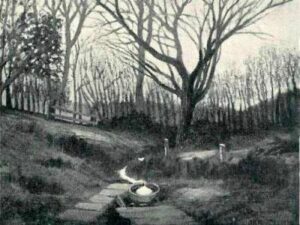
A salt spring, located about a mile west of this site, was the primary attraction for immigrants to the Western Reserve territory in the mid-1700s. Prior to European-American settlement, Indians used the springs, boiling the water to extract the salt and using it for preserving meat among other uses. In 1755, surveyor Lewis Evans underscored the importance of the springs by noting it on his “General Map of the Middle British Colonies in America.” This enticed immigrants from western Pennsylvania to the region. In addition to the salt itself, the abundance of wildlife near the spring ensured good hunting in the area. (Continued on other side)

, OH
Near this site in Over-The-Rhine was one of the original Kroger Grocery & Baking Company stores, where Bernard H. Kroger began serving the Over-the-Rhine area in 1902. Kroger was 23 years old when he opened his first store, The Great Western Tea Company, at 66 East Pearl Street near the Cincinnati Riverfront in July of 1883. By 1902, when the company was incorporated as the Kroger Grocery & Baking Company, Kroger operated 40 stores. By 1908, the company had grown to a chain of 136 stores in Cincinnati, Dayton, Columbus, and Northern Kentucky, and began making deliveries to customers with 200 mule-drawn wagons. Kroger was the first to combine meats and groceries under one roof and the first grocery company to operate its own bakery. Currently called the Kroger Co., the grocer is a major contributor to the local economy.
, OH
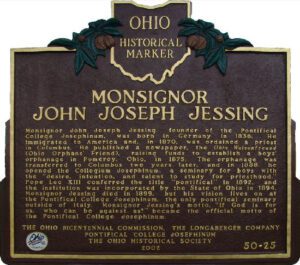
Monsignor John Joseph Jessing, founder of the Pontifical College Josephinum, was born in Germany in 1836. He immigrated to America and, in 1870, was ordained a priest in Columbus. He published a newspaper, the Ohio Waisenfreund (Ohio Orphans’ Friend), raising funds to establish a boys’ orphanage in Pomeroy, Ohio, in 1875. The orphanage was transferred to Columbus two years later, and in 1888, he opened the Collegium Josephinum, a seminary for boys with the “desire, intention, and talent to study for priesthood.” Pope Leo XIII conferred the title “pontifical” in 1892, and the institution was incorporated by the State of Ohio in 1894. Monsignor Jessing died in 1899, but his vision lives on at the Pontifical College Josephinum, the only pontifical seminary outside of Italy. Monsignor Jessing’s motto, “If God is for us, who can be against us?” became the official motto of the Pontifical College Josephinum.
, OH
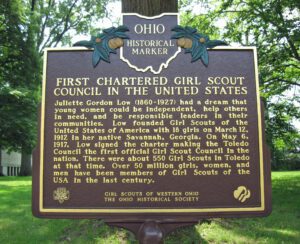
Juliette Gordon Low (1860-1927) had a dream that young women could be independent, help others in need, and be responsible leaders in their communities. Low founded Girl Scouts of the United States of America with 18 girls on March 12, 1912 in her native Savannah, Georgia. On May 6, 1917, Low signed the charter making the Toledo Council the first official Girl Scout Council in the nation. There were about 550 Girl Scouts in Toledo at that time. Over 50 million girls, women, and men have been members of Girl Scouts of the USA in the last century.
, OH
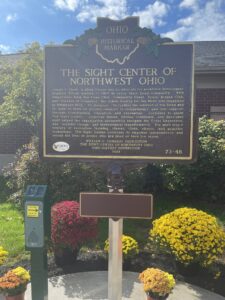
Joseph F. Clunk, a blind Ohioan and an advocate for workforce development, inspired Toledo leaders in 1923 to serve their blind community. With cooperation from the Lions Club, Community Chest, Toledo Rotary Club, and Chamber of Commerce, the Toledo Society for the Blind was organized in November 1923. Its purpose, “to further the interest of the blind and to open to them all possible avenues to independence and self-support, through investigation, education, and recreation,” continues to guide The Sight Center. Generous donors, tireless volunteers, and dedicated staff helped the organization successfully navigate the Great Depression, war, societal change, and technological transformation. For more than a century of innovative training, classes, clubs, clinics, and assistive technology, The Sight Center continues to empower independence and enrich the lives of people who are blind or have low vision.

, OH
The Council of International Programs USA (CIPUSA) promotes international understanding in global communities through professional development and cross-cultural exchange. CIPUSA evolved from the Cleveland International Program, a professional and cultural exchange program for youth leaders and social workers, established by Dr. Henry B. Ollendorff in 1956. By 2003, CIPUSA had grown to include nine affiliate offices nationwide, including two offices in Ohio, the Cleveland International Program and the Columbus International Program. Since its founding, CIPUSA has brought over 10,000 professionals for practical training from 147 countries. As a leader in international exchange CIPUSA continues Ollendorff’s vision–leading people to international training exchange programs in a variety of fields, including social services, business, and education.
, OH
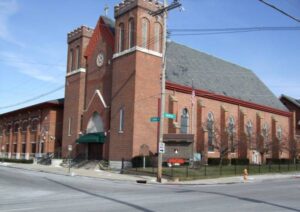
Built in 1852 and dedicated a year later, St. Patrick Church is the second oldest Roman Catholic Church in Columbus. Founded as the English speaking parish, this church of Norman Gothic design served as the home for three future bishops. Located on Naghten Street, the “Irish Broadway” of the nineteenth century, St. Patrick’s parish provided a vital place for the acculturation of the neighborhood Irish immigrants into mainstream American society. The Irish heritage is remembered through the shamrocks that emblazon the heads of each pew. Severely damaged by “the Great Fire” in 1935, the church was quickly restored and serves today as a vibrant religious center for central Ohio. The Dominican Fathers have staffed St. Patrick Church since 1885.