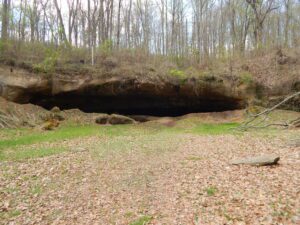
On a forested hillside south of New Straitsville, the spacious 1000 square foot Robinson’s Cave offered a secluded location with great acoustics where large groups of Hocking Valley coal miners could meet in secret. Beginning in about 1870, labor-organizing meetings were held at the cave by various emerging unions including the Knights of Labor. New Straitsville resident Christopher Evans, a well-known union organizer, used Robinson’s Cave to lead miners throughout the long Hocking Valley Coal Strike of 1884-1885. These meetings gave the miners a voice in the formation of a national organization called the National Federation of Miners and Mine Laborers, later renamed the National Progressive Union. The cave was also where non-union miners met to plan to set the Columbus & Hocking Coal & Iron Company mines on fire in a desperate attempt to end the Hocking Valley Strike. [continued on other side]
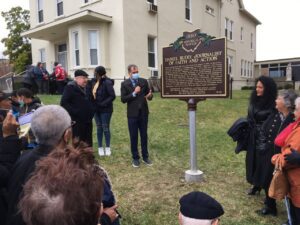
Daniel Arthur Rudd was born into slavery on August 7, 1854, in Bardstown, Kentucky. He became a newspaperman, lecturer, publicist, and tireless advocate for the Roman Catholic Church. After the Civil War Rudd moved to Springfield. Baptized and raised in Catholicism, he joined St. Raphael Parish, where the philosophy of racial equality offered by the church solidified his vision of justice. By 1885 he had established his own weekly newspaper, The Ohio State Tribune. He rebranded it The American Catholic Tribune (ACT) after moving to Cincinnati. Rudd claimed ACT was the only Catholic newspaper owned by an African American. At the height of its popularity in 1892, the publication had a circulation of 10,000. In 1893 Rudd was asked to chair the Afro-American Press Association, representing more than 200 black-owned newspapers.
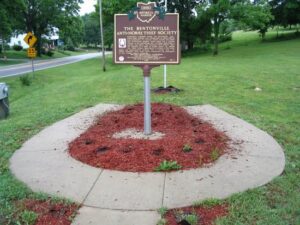
Originally a vigilante group, the Bentonville Anti-Horse Thief Society was formed here in March 1853 by area landowners to recover stolen horses and mules and to prosecute thieves. Horse theft was a serious offense in the antebellum era. Trustees nominated a captain and riders, who received a $10 reward upon the capture of a thief or stolen horse. As horses lost their former importance in society in the early 1900s, the organization evolved into a social club. Its annual banquet, held each April, celebrates the continuity of this Adams County tradition.
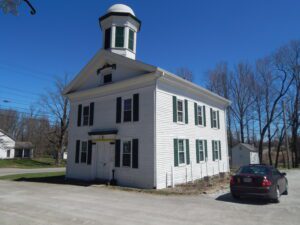
The most notable feature of Mantua Center is the “Village Green,” which harkens back to the New England heritage of Mantua Center’s early settlers. The Green sets upon land donated by Hezekiah Nooney Sr. and was important to both the social and commercial interests of the town. The businesses located here were a furniture and cabinet maker’s shop, harness shop, blacksmith shop, post office, tannery, ashery, dry goods store, and distillery. The Methodist Episcopal Church, now the Mantua Civic Center, stands at the southwest corner of the green. Eastlawn cemetery, with a burial that dates to 1816, sits along the south border. The cemetery serves as the final resting place for soldiers of several wars, including the American Revolution, as well as many other early citizens. In 1835 Horace Sizer constructed the stone wall around the cemetery adjacent to Mantua Center Road. [continued on other side]
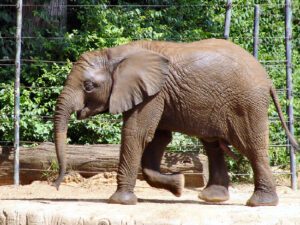
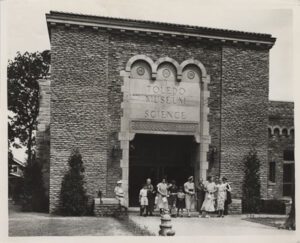
Now ranked among the country’s finest, the zoo began in 1900 with one large woodchuck in a box at Walbridge Park. After the organization of the Toledo Zoological Society, 1905-10, the zoo began its steady growth, particularly after 1923 under the leadership of Percy C. Jones. An ambitious federal construction program during the Great Depression of the 1930s provided several major structures.(See other side)
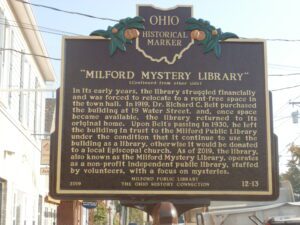
The Milford Public Library, Clermont County’s oldest continuously operating library, was founded in 1900 by a local civic organization, the Milford Village Improvement Society. It was preceded by a circulating library–one that charges patrons for renting books–that was chartered in 1822. At the time of the Milford Public Library’s founding, circulating libraries were in decline and public libraries were increasing in number as an inexpensive alternative. To obtain support for their proposed “reading room,” the Society’s Literary Committee travelled door-to-door, soliciting members and books. To become a member of the library, adults paid 25 cents and children paid 10 cents in annual dues. The library’s first–and current–home is the stone building at 19 Water Street. (Continued on other side)
Now ranked among the country’s finest, the zoo began in 1900 with one large woodchuck in a box at Walbridge Park. After the organization of the Toledo Zoological Society, 1905-10, the zoo began its steady growth, particularly after 1923 under the leadership of Percy C. Jones. An ambitious federal construction program during the Great Depression of the 1930s provided several major structures.
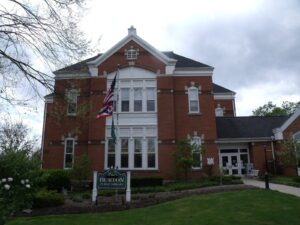
This Queen Anne style building with segmental-arched windows and steep hipped roof was Burton’s second high school. Completed in 1885 at a cost of $12,500, it is wood framed with a brick and stone exterior, modeled after an academy in River Falls, Wisconsin. Its basement and two upper floors contained 12,720 square feet of space, enough for all twelve grades. There were two separate entrances; girls entered on the left and boys on the right. Electricity was installed in 1921 by the superintendent and students. Classes met here until 1936. During its history, the building housed various organizations, including the Red Cross, Opportunity School of Geauga County (later Metzenbaum), Geauga County Historical Society, American Legion, and County Extension Office. In 1937, it became the home of the Burton Public Library and in 1983 was expanded with a north wing designed to be architecturally consistent with the original 1885 structure.