

, OH
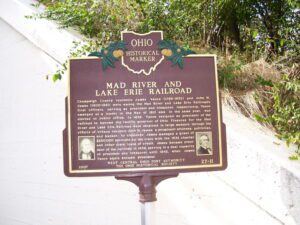
Champaign County residents Joseph Vance (1786-1852) and John H. James (1800-1881) were among the Mad River and Lake Erie Railroad’s first officers, serving as president and treasurer, respectively. Vance emerged as a leader in the War of 1812 and, in the same year, was elected to public office. In 1836, Vance resigned as president of the railroad to become the twelfth governor of Ohio. Finances for the Mad River and Lake Erie Railroad were obtained in large measure through the efforts of Urbana resident John H. James, a prominent attorney, politician, and banker. As treasurer, James managed a grant of $200,000 provided by the state with the 1832 charter and other state loans of credit. James became president of the railroad in 1836, serving in a dual capacity of president and treasurer until 1842, when James Vance again became president.
, OH
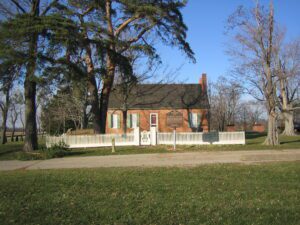
As Oxford Township was developing in the mid-1800s, a cluster of farmsteads near its northern border developed and was designated the “Doty Settlement.” As was the custom, the community took its name from a prominent family in the area. In or near the settlement were a church and cemetery, a school, a blacksmith shop, a sawmill, a distillery, a furniture shop, and a fulling mill for cleansing, shrinking, and thickening cloth. With the frontier spirit of self-reliance, it was seldom necessary to travel several miles into Oxford village for additional goods or services. Working together, the community farmed local fields and bartered for other items. Men, women, and children worked long, hard hours in the fields harvesting corn and wheat. It is evident that these families, living in an agricultural society, possessed many useful skills for surviving in the Ohio country.
, OH
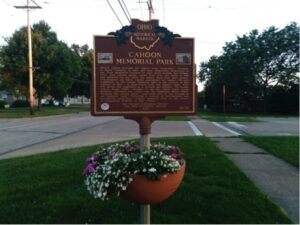
Joseph Cahoon brought his family from Vergennes, Vermont, to Dover Township in 1810, and they established themselves as the first permanent settlers in what would become Bay Village, Ohio. The Cahoon house, called Rose Hill, was built in 1818 and replaced the log cabin the family built upon their arrival. Granddaughter Ida Maria Cahoon bequeathed her family’s 115-acre homestead as the Cahoon Memorial Park to the citizens of Bay Village in 1917. In accordance with the family’s wish, Rose Hill serves the community as a museum and library. The Reuben Osborn House (1815), thought to be the oldest frame house between Cleveland and Lorain, and the Community House (1882), formerly the Cahoon barn, join Rose Hill on the grounds of the memorial park. Providing a variety of recreational and educational activities, Cahoon Memorial Park is the center of community activity in Bay Village.
, OH
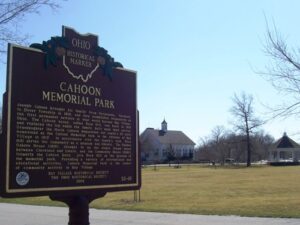
Joseph Cahoon brought his family from Vergennes, Vermont, to Dover Township in 1810, and they established themselves as the first permanent settlers in what would become Bay Village, Ohio. The Cahoon house, called Rose Hill, was built in 1818 and replaced the log cabin the family built upon their arrival. Granddaughter Ida Maria Cahoon bequeathed her family’s 115-acre homestead as the Cahoon Memorial Park to the citizens of Bay Village in 1917. In accordance with the family’s wish, Rose Hill serves the community as a museum and library. The Reuben Osborn House (1815), thought to be the oldest frame house between Cleveland and Lorain, and the Community House (1882), formerly the Cahoon barn, join Rose Hill on the grounds of the memorial park. Providing a variety of recreational and educational activities, Cahoon Memorial Park is the center of community activity in Bay Village.
, OH
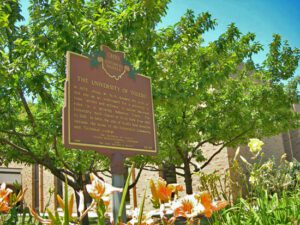
In 1872, Jesup W. Scott donated 160 acres at this site as an endowment for a university to train “artists and artisans” to assume important roles in a growing industrial Toledo. The University held classes at Scott Park from 1922 to 1931. In 1969, the site of Scott’s land donation became the site of the University’s Community and Technical College.
, OH
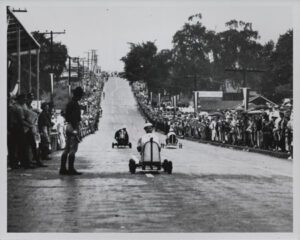
An annual summer tradition for American youth since the 1930s, the All-American Soap Box Derby was the concept of journalist Myron E. (“Scottie”) Scott, who covered an impromptu homebuilt gravity-car race in Dayton in 1933. Scott conceived and promoted a prize-awarding event later that year, and to his surprise 362 boys entered the race. Restrictions on material cost and participants’ ages widened the sport’s appeal; the Soap Box Derby held its first national championship in Akron in 1935, sponsored by the auto and rubber industries. Derby Downs, built as a public works project by the New Deal-era Works Progress Administration (WPA), has been the event’s home since 1936. The Soap Box Derby continues to promote the values of craftsmanship, sportsmanship, and perseverance for generations of American youth.
, OH
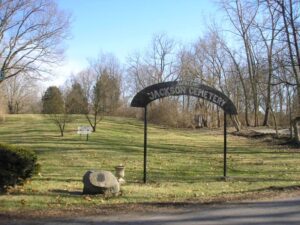
In 1833, John Randolph from Roanoke, Virginia, died leaving three wills that requested that all of his slaves be set free and that land be purchased for them. Although contested for thirteen years by his family, the slaves were freed and the executor of the wills, Randolph’s cousin Judge William Leigh purchased about 2,000 acres of farm land in Mercer County, Ohio. Traveling by wagon train, the freed slaves, 383 in all, reached their destination in 1846, but were forced to turn back by earlier established white settlers. They turned around and ended up north of Piqua where they purchased land and developed the Village of Rossville. Later some moved on to other places in Miami County and well as Shelby County. In Rossville, they established an African Baptist Church in 1869, cemetery in 1866, and public black school in 1872.
, OH
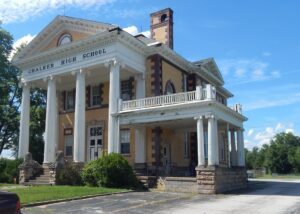
Southington native Newton Chalker built, furnished, and donated Chalker High School to his community in 1907. Chalker was born in 1842 in Southington Township and lived there until adulthood. He later built a prosperous law and real estate practice in Akron. Chalker’s dedication to improve educational opportunities in the township likely originated with his personal struggle to complete high school, which was repeatedly interrupted by financial concerns and family obligations. The Chalker High School building was designed in the Neo-Classical Revival architectural style which was favored for public buildings, churches and schools early in the twentieth century. The building exhibits Classical influences through the use of fluted columns that support a pedimented gable, resembling a Greek temple. Chalker High School and the Civil War Monument were listed in the National Register of Historic Places in 2010. (Continued on other side)