State Route 534 (Phelps Creek Road) and State Route 87 (Kinsman Road NW)
Mesopotamia
, OH
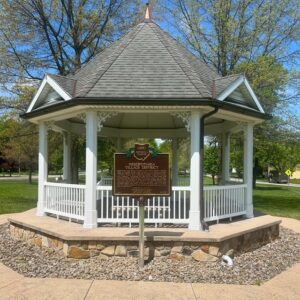
Mesopotamia Village District was listed in the National Register of Historic Places on December 24, 1974. Many consider it to be “the most unspoiled nineteenth century central green type of village in northeastern Ohio.” The district includes houses, commercial buildings, a town hall, churches, and a cemetery. Surrounding the 1600-foot-long public green these structures represent Greek Revival, Gothic Revival, Queen Anne, Italianate, and vernacular architectural styles constructed between 1820 and 1902. One of the oldest buildings in the district is the colonnaded Greek Revival commercial building at the southwest end of the green. Built in the 1820s for early resident Isaac Clark, it was operated as a store by F.C. Peck. Over the ensuing centuries it has served as a barber shop, post office, and an undertakers. (Continued on other side)
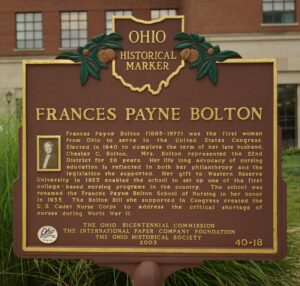
Frances Payne Bolton (1885-1977) was the first woman from Ohio to serve in the United States Congress. Elected in 1940 to complete the term of her late husband, Chester C. Bolton, Mrs. Bolton represented the 22nd District for 28 years. Her life long advocacy of nursing education is reflected in both her philanthropy and the legislation she supported. Her gift to Western Reserve University in 1923 enabled the school to set up one of the first college-based nursing programs in the country. The school was renamed the Frances Payne Bolton School of Nursing in her honor in 1935. The Bolton Bill she supported in Congress created the U.S. Cadet Nurse Corps to address the critical shortage of nurses during World War II.
In 1798, Judge Turhand Kirtland came to Township 1, Range 1 as an agent of the Connecticut Land Company. In 1804, Kirtland donated the Village Green and the graveyard adjoining the church to the residents of Poland. On the Green, the settlers built a log meetinghouse and school. Prior to 1812, the local militia drilled here and, in 1861, young men trained here before leaving to fight in the Civil War. The graveyard contains some 450 graves of early families of Poland, including settlers such as Kirtland, Fowler, Walker, Morse, Arrel, Adair, Lee, McCombs, and Truesdale. Among those buried here are thirteen Revolutionary War veterans, thirteen veterans of the War of 1812, and ten men who fought in the Civil War. In 1862, Samuel K. Hine provided in his will for the maintenance of both the Graveyard and the Green.
This burying ground was the first public cemetery located within Akron’s boundaries. It was also known as the “Old Cemetery” and the “Newton Street Cemetery.” Deacon Titus Chapman donated this land in 1808 as a burying ground, and he was probably the first person interred here when he died later that year. Early Akron settlers and their descendents, including veterans of the American Revolution, are buried here. Some of the gravestones were among the finest brought to the Western Reserve from Connecticut. The Middlebury Cemetery was used until 1853.
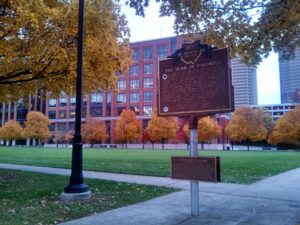
Thousands of Irish immigrants came to Columbus to seek personal and religious freedom. With the “Great Hunger” in Ireland and the completion of the Ohio and Erie Canal and the National Road, immigration to Columbus increased in the mid nineteenth century. They initially settled in the north side of the city in the swamp flats, where inexpensive land was available and work could be had on the railroads. Settlement spread to Franklinton, on Naghten Street, later known as “Irish Broadway”- part of which is now Nationwide Boulevard, and to nearby Flytown. The immigrants became domestic workers, civil servants, entrepreneurs, and served the city in police and fire departments. Others were leaders in government, law, medicine, and education. Their legacy continues today in the Irish-American population of Columbus, Ohio.
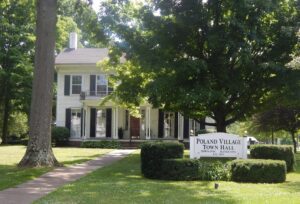
The Village of Poland officially incorporated in August 1866, a year after the end of the Civil War. In April 1867, the citizens elected John Leslie as mayor. As of 1880, Poland’s population exceeded 400. Through its history, the village has consisted of a four-acre village green, churches, schools, hotels, a sawmill, gristmill, post office, tannery, and foundry, as well as carriage, tin, and cabinet shops; drug, dry goods, and hardware stores, and doctors, blacksmiths, and shoemakers. Residents swam in and skated on Yellow Creek. The Poland Municipal Forest was established in 1938 and annexed later as the Village continued to grow. In 1966, the residents held a three day Centennial Celebration, featuring an address by Governor James Rhodes. The centennial year also saw the publication of a history of Poland and the restoration of Centennial Gardens.
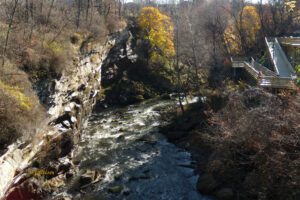
In 1879, local hardware store owners L.W. Loomis and H.E. Parks established a summer resort at Front Street and Prospect Avenue. The High Bridge Glens and Caves park spanned both sides of the Cuyahoga River and featured a dance and dining pavilion, scenic trails and overlooks, cascades and waterfalls, deep caverns, curious geological formations, and a suspension footbridge. The park also offered several manmade attractions, including what is believed to have been one of the earliest roller coasters in the area. At the height of its popularity, the park attracted more than 8,000 visitors a day, including Congressman (later president of the United States) William McKinley. (continued on other side)
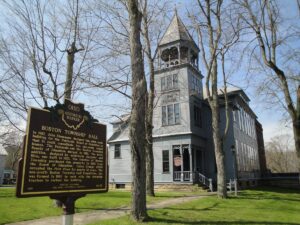
In 1887, John Eisenmann designed this stick-style building for the Peninsula Board of Education so that it could consolidate two one-room school houses. The Peninsula and the Boston Township Boards of Education merged in 1919. The brick addition, designed by architects Harpster and Bliss, was built in 1920. The trustees of Boston Township purchased this property in 1939 from the Board of Education. Union Grange #2380 occupied the first floor for nearly 50 years. The non-profit Boston Township Hall Committee, Inc. was formed in 1990 to work with the township trustees to restore the building.